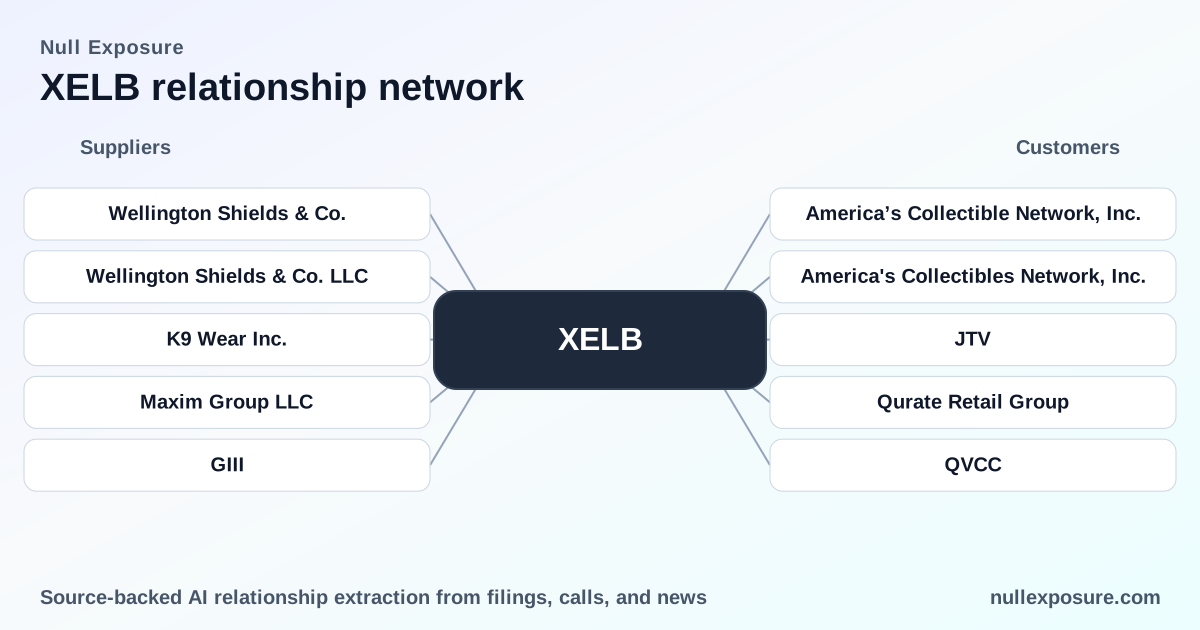
XELB: Supplier and capital-market counterparties that shape liquidity and product flow
Xcel Brands operates an asset-light, brand-building model: the company licenses celebrity and designer marks, manages product design and marketing, and monetizes through wholesale, direct-to-consumer sales, and royalty streams tied to licensed brands. Capital markets counterparties (placement agents and underwriters) are integral to Xcel’s ability to bridge working-capital gaps, while apparel manufacturers and licensing partners determine product availability and margin scalability.
For a focused look at counterparties and operational constraints that matter for underwriting exposure or supplier risk, see more at https://nullexposure.com/.
How the supplier and financing map defines Xcel’s operating posture
Xcel’s supplier footprint shows a dual dependence: creative/licensing partners drive its inventory and brand royalty commitments, and boutique capital markets firms handle repeated equity and PIPE placements to fund operations. This results in a contracting posture that is transaction-driven rather than vertically integrated—Xcel relies on third-party licensors and manufacturers to deliver products, and on placement agents to manage episodic liquidity events.
- Contracting posture: predominantly license-based and fee-for-service, not manufacturing ownership; licensing terms create recurring royalty obligations that can compress cash flow if sales lag.
- Concentration: the finance flow is concentrated in a small set of placement agents (Wellington Shields, Maxim), increasing execution risk if a counterparty relationship changes.
- Criticality: certain commercial relationships—like the Halston licensing/production tie to G-III—are operationally critical for product distribution and brand continuity.
- Maturity: licensing agreements in force since 2022 and recurring financing in FY2025 indicate a mixed maturity profile: established brand licenses but repeating capital raises to support working capital.
If you want a consolidated view of counterparties and material relationships for vendor diligence, visit https://nullexposure.com/ for full supplier profiles.
Partner-by-partner read — what investors and operators need to know
Wellington Shields & Co. / Wellington Shields & Co. LLC
Wellington Shields acted as exclusive/sole placement agent on multiple Xcel financings in FY2025, including a PIPE expected to generate roughly $2.05 million in gross proceeds and described in filings as yielding approximately $1.75 million in net proceeds after fees and commitments; those arrangements included placement-agent warrants and expense reimbursement that increase dilution and near-term cash outflows. Sources include Xcel press releases and market reports (GlobeNewswire, The Globe and Mail, QuiverQuant; December 2025–March 2026) and trading commentary noting the exclusive placement-agent role.
Maxim Group LLC
Maxim Group served as the sole placement agent on a separate public offering priced in FY2025, representing the use of boutique sell-side firms to execute equity raises rather than large full-service underwriters. CityBiz reported on the pricing of the $2.6 million public offering and Maxim’s placement role (CityBiz, FY2025).
K9 Wear Inc.
Xcel entered a licensing partnership with K9 Wear to develop and launch a pet accessories line under the Cesar Millan-branded collection "Trust. Respect. Love."—a continuation of Xcel’s strategy to monetize influencer-driven brands via third-party product partners rather than in-house manufacturing. This commercial announcement was covered by PetAge (December 2025).
G-III Apparel Group (GIII)
Xcel’s Halston master license is managed with G-III Apparel Group, one of the world’s largest designers and wholesale suppliers; G-III functions as a principal supply-channel partner for Halston products and therefore represents a critical manufacturing and distribution counterparty for that brand line. This relationship is disclosed in Xcel’s FY2024 10-K filing.
IM Topco / Isaac Mizrahi licensing (company-level signal)
Xcel disclosed a license dated May 31, 2022 with IM Topco granting rights to use Isaac Mizrahi trademarks on women’s sportswear in the U.S. and Canada in exchange for royalties. That agreement reflects Xcel’s role as a licensor licensee within a portfolio of designer and celebrity brands and creates recurring royalty obligations tied to sales volume (company disclosure, May 2022).
Royalty shortfall and spend signal (company-level)
For the year ended December 31, 2023, Xcel recognized a royalty expense shortfall of approximately $325,000 in its consolidated statements of operations, signaling that royalty commitments can generate material cash outflows when sales underperform expectations. This figure is included in company disclosures for FY2023 and is consistent with the company’s spend-band profile between $100k–$1M for certain royalty line items.
What this relationship map means for investors and operators
- Liquidity is managed through small, repeat placement firms rather than large syndicates; that increases execution risk and potential dilution per raise, but also indicates a pragmatic approach to targeted capital needs. The use of placement-agent warrants and expense reimbursement increases the effective cost of capital.
- Licensing partnerships are core revenue drivers but are cash-flow sensitive. Royalty shortfalls (e.g., $325k recognized in 2023) illustrate how sales volatility translates directly into operating pressure.
- Operational continuity relies on a small number of critical suppliers (G-III for Halston); supplier disruption or changes in licensing terms would materially affect product availability and revenue recognition timing.
- Concentration in placement agents (Wellington Shields, Maxim) streamlines execution but concentrates counterparty risk—important for covenant and timing stress testing in exposure models.
For a tailored supplier-risk brief or to build a counterparty watchlist, start here: https://nullexposure.com/.
Investor checklist and next steps
- Confirm the terms and duration of key license agreements (Halston/G-III; IM Topco/Isaac Mizrahi) and whether earnings or minimum guarantees create cash demands.
- Model recurring royalty expense volatility into cash-flow scenarios rather than treating royalties as fixed costs.
- Quantify dilution and warrant impact from placement-agent arrangements disclosed in the FY2025 financings; treat placement-agent compensation as an effective financing cost.
- Monitor the operational health of G-III and other manufacturing partners for delivery and margin risk; supplier distress would have direct P&L and inventory impacts.
If you want a structured supplier-risk report or to monitor Xcel’s counterparty events in real time, visit https://nullexposure.com/ and request the XELB supplier brief.
Bottom line
Xcel Brands operates a high-royalty, licensing-first model supported by outsized dependence on boutique capital markets partners and a small set of manufacturing licensors. The principal risks for investors are liquidity dependence on placement agents, royalty-payment volatility, and concentration with strategic suppliers like G-III. Monitoring financing terms, warrant dilution, and royalty performance is essential to evaluating both equity upside and downside exposure.