Xenon Pharmaceuticals (XENE): supplier relationships, capital markets links, and what operators should know
Xenon Pharmaceuticals is a clinical-stage neurology-focused biopharma that monetizes through licensing, milestone-driven collaborations, and eventual product commercialization, while financing development through public equity and occasional offerings. The business model centers on outsourced development and manufacturing, licensing of clinical-stage assets, and periodic capital raises that rely on a syndicate of investment banks to underwrite transactions. For investors and operators evaluating supplier and financial counterparty exposure, the combination of outsourced manufacturing/CRO reliance and recurring capital markets activity defines both operational flexibility and funding risk.
Explore supplier risk intelligence and counterparty mapping at NullExposure.
Overview — what matters for investors Xenon’s operations are characterized by extensive use of third-party CMOs and CROs, spot procurement for materials, and limited in‑house commercial manufacturing capacity. This creates a supplier posture that is flexible but reliant on external partners for critical development milestones. On the funding side, Xenon uses institutional underwriters and syndicates to execute offerings, which concentrates short-term execution risk with a set of visible banking partners. Both vectors — outsourced production and concentrated bankers — are core to how Xenon runs and funds its pipeline.
How the capital markets relationships show up A March 2026 market notice indicates multiple bulge‑bracket and mid‑cap banks are lined up as managers for a proposed offering. This group structure signals Xenon’s preference for multi‑bank syndication to diversify distribution while concentrating execution with experienced life‑science underwriters. Such arrangements lower immediate placement risk but tie pricing and timing to market appetite and the underwriters’ execution capability. For more on supplier and counterparty exposure for life sciences, visit NullExposure.
What Xenon’s supplier constraints tell us about operational risk The company’s public materials and disclosures reveal a clear supplier posture:
- Contracting posture — spot and purchase‑order driven. Xenon typically orders raw materials, APIs and drug product on a purchase‑order basis rather than committing to long‑term dedicated capacity. This grants operational flexibility but leaves Xenon vulnerable to spot market tightness and supplier repricing during periods of high demand.
- Role concentration — third‑party manufacturers and service providers. Xenon relies on CMOs for preclinical, clinical and anticipated commercial manufacture, and on CROs for trials and data generation. This outsourcing is strategic for capital efficiency but creates single‑point execution dependency on selected vendors.
- Cyber/materiality posture — limited historical impact but ongoing exposure. Xenon reports no material historical impacts from cyber incidents, indicating immaterial realized loss to date, but recognizes ongoing vulnerability given third‑party system interconnections.
- Maturity and criticality signals. These supplier arrangements are typical of a clinical‑stage biotech: high criticality for a small set of external partners, moderate maturity of supplier contracts (spot orders, not long-term capacity), and potential concentration risk if a supplier fails to perform.
Relationship-by-relationship readout (each record from the source set) Below is a concise, plain-English summary for every relationship listed in the source records, with direct source references.
-
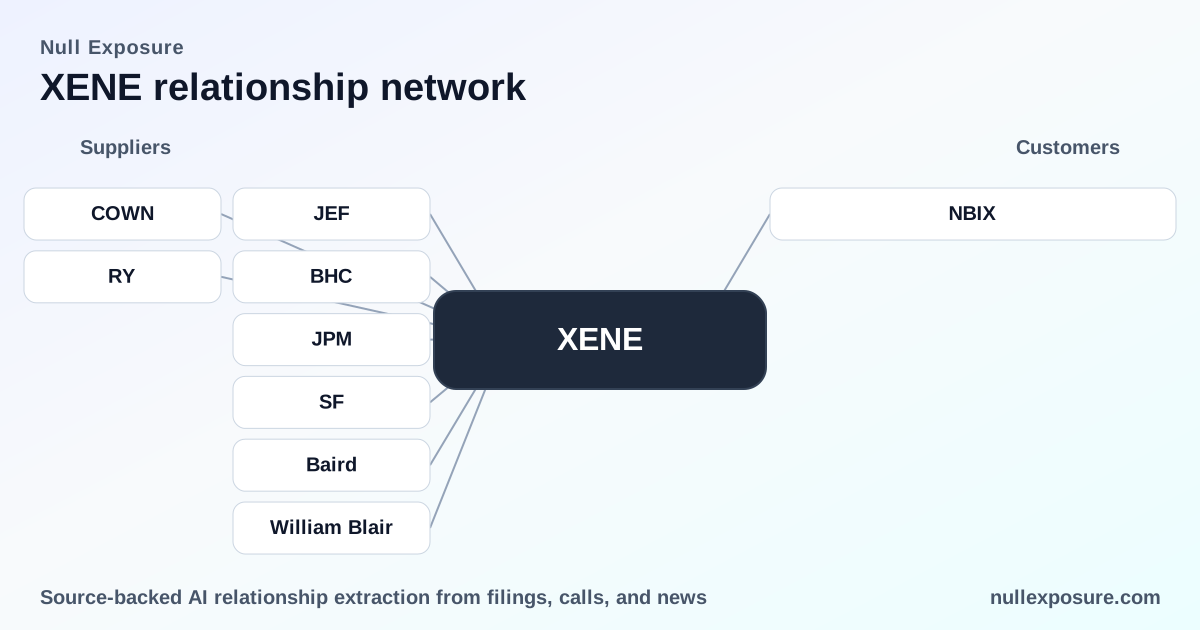
Jefferies — The firm is named among joint book‑running managers for a proposed Xenon offering, indicating a role in equity distribution and syndicate execution. Source: Bitget news post, March 10, 2026 — https://www.bitget.com/amp/news/detail/12560605250577
-
Valeant Pharmaceuticals International / Bausch Health — Coverage in The Globe and Mail traces azetukalner’s development lineage, noting Valeant originally licensed the molecule and Xenon later acquired rights; this reflects Xenon’s use of licensed-in assets to populate its pipeline. Source: The Globe and Mail, March 2026 feature on Xenon and azetukalner — https://www.theglobeandmail.com/business/article-xenon-awaiting-critical-epilepsy-drug-study-results-that-could-lead-to/
-
J.P. Morgan — Listed as a joint book‑running manager in the same offering syndicate, J.P. Morgan’s presence signals use of top-tier distribution channels for capital raises. Source: Bitget news post, March 10, 2026 — https://www.bitget.com/amp/news/detail/12560605250577
-
Valeant Pharmaceuticals International (duplicate entry with expanded context) — A separate Globe and Mail article provides additional narrative on Christopher Crean’s role in rescuing azetukalner and the licensing sequence that transferred rights to Xenon, underscoring the company’s reliance on acquired assets for pipeline advancement. Source: The Globe and Mail, March 2026 — https://www.theglobeandmail.com/business/article-xenon-pharmaceuticals-azetukalner-epilepsy-treatment-trial-results/
-
Stifel — Identified as a joint book‑running manager for the proposed equity transaction; represents mid‑market life‑science underwriting capability within the syndicate. Source: Bitget news post, March 10, 2026 — https://www.bitget.com/amp/news/detail/12560605250577
-
Baird — Cited as the lead manager for the proposed offering, indicating Baird is responsible for primary deal coordination and investor outreach in the transaction. Source: Bitget news post, March 10, 2026 — https://www.bitget.com/amp/news/detail/12560605250577
-
William Blair — Included among joint book‑runners, reinforcing the syndicate’s life‑science distribution depth. Source: Bitget news post, March 10, 2026 — https://www.bitget.com/amp/news/detail/12560605250577
-
TD Cowen — Named as a joint book‑running manager, providing specialized coverage and placement within the life‑science investor base. Source: Bitget news post, March 10, 2026 — https://www.bitget.com/amp/news/detail/12560605250577
-
RBC Capital Markets — Also listed as a joint book‑running manager, adding cross‑border distribution capability given RBC’s institutional footprint. Source: Bitget news post, March 10, 2026 — https://www.bitget.com/amp/news/detail/12560605250577
Implications for investors and operators
- Operational risk is concentrated in a small set of third‑party CMOs/CROs and governed by short‑term purchase orders rather than long-term capacity contracts; this creates flexibility but also exposure to supplier performance and market pricing.
- Capital markets execution is routed through a clear syndicate of established underwriters, which reduces distribution risk but links financing success to the syndicate’s timing and investor appetite.
- Cybersecurity disclosures classify historical impacts as immaterial, yet the interconnected vendor model means that a single third‑party incident could have outsized operational effects.
If you want a deeper counterparty map or supplier concentration scorecard for Xenon, visit NullExposure for tailored reports and supplier intelligence.
Final takeaway Xenon’s model blends outsourced operational execution with syndicated capital raises. For investors, the critical evaluation points are supplier continuity and underwriter execution; for operators, the priorities are strengthening supplier contracts, reducing single‑point dependencies, and planning contingency for financing windows. To see how supplier relationships influence valuation and event risk across life‑science firms, check our platform at NullExposure.