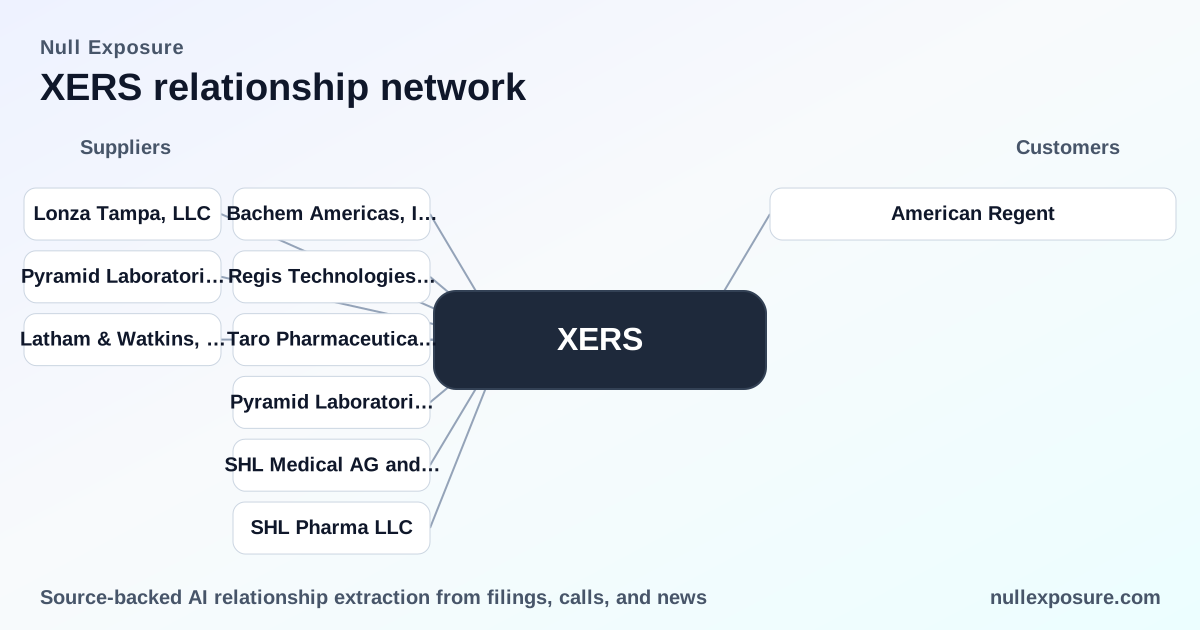
Xeris Pharmaceuticals (XERS) — supplier network and strategic dependencies
Xeris Pharmaceuticals develops and commercializes ready-to-use injectable and infusible drug formulations — products such as Gvoke (glucagon), Recorlev (levoketoconazole), and Keveyis — and monetizes through product sales supported by specialty pharmacy distribution and third‑party manufacturing agreements. The company outsources nearly all API and finished‑product production to contract manufacturers, retains commercial distribution via specialty pharmacy partners, and captures margin on branded product sales and channel services. For an investor focused on counterparty risk and supply continuity, the supplier roster and contract structure drive both the upside of scale and the downside of concentration; review supplier clauses and contingency plans before underwriting exposure. Learn more at https://nullexposure.com/.
How Xeris runs its supply chain and why it matters to investors
Xeris operates as a virtual manufacturer: the company designs formulations, secures regulatory clearances, controls commercial strategy, and relies on third parties for manufacturing, device assembly and distribution. That operating posture produces a predictable cost structure (lower fixed manufacturing capex) and faster scale-up, while embedding counterparty concentration risk.
Key operating signals pulled from company disclosures:
- Contract manufacturing is the core operating model. Xeris contracts out manufacture, assembly, testing, packaging and distribution — the company does not control CGMP or QSR execution at partner sites. This is a company-level characteristic drawn directly from its FY2024 10‑K.
- Single‑ or sole‑source relationships are material and in some cases critical. Xeris discloses single‑source dependency for specific APIs and finished products; these relationships are material to revenue for those product lines.
- Contract tenors include long‑term arrangements. Company language flags long‑term supply arrangements and the pricing exposures they can create.
- Distribution is channeled via a specialty pharmacy model. A single, experienced specialty pharmacy supports Recorlev logistics and patient access, making distribution a critical operational link.
These signals imply concentration risk and supplier control risk: failures at a partner site, contract termination, or supply chain disruption will directly impact revenue and patient access. For more detail on supplier relationships and how to quantify counterparty exposure, visit https://nullexposure.com/.
Supplier-by-supplier relationship review (what the filings say)
Below are the relationships named in Xeris’ FY2024 disclosures and related news items, with plain-English summaries and source references.
Bachem Americas, Inc.
Bachem is identified as Xeris’ primary commercial source for glucagon API and holds a U.S. drug master file for the glucagon produced in Switzerland; Xeris has a non‑exclusive API supply agreement in place. According to Xeris’ FY2024 Form 10‑K, Bachem’s validated manufacturing process underpins Gvoke supply.
Regis Technologies, Inc.
Regis is described as the sole source for levoketoconazole API produced at its Illinois facility; Xeris has a supply agreement with Regis that supports Recorlev production. This is disclosed in the FY2024 Form 10‑K and underscores a single‑source API dependency.
Taro Pharmaceuticals North America, Inc.
Taro has a supply agreement to produce Keveyis including packaging, and Xeris retains the right to manufacture or re‑source if Taro terminates at renewal — the company disclosed this arrangement in its FY2024 10‑K.
Pyramid Laboratories, Inc. (first mention)
Pyramid’s California facility is identified as a primary source for finished drug product for Gvoke and is party to a commercial supply agreement with Xeris, per the FY2024 Form 10‑K.
SHL Medical AG and SHL Pharma, LLC
SHL develops the proprietary auto‑injector platform used in Gvoke HypoPen; SHL performs device sub‑assembly in Taiwan and final assembly in Florida, and Xeris has a supply agreement covering device/device‑drug assembly, as noted in the FY2024 10‑K.
SHL Pharma LLC (separate entry)
Xeris executed an Amended and Restated Product Supply Agreement with SHL Pharma LLC effective January 30, 2023, according to Xeris’ FY2024 10‑K, formalizing terms for device and final assembly for Gvoke.
Lonza Tampa, LLC (f/k/a Xcelience, LLC)
Lonza’s Florida facility is disclosed as the sole source for Recorlev finished product, and Xeris has a supply agreement with Lonza, per the FY2024 Form 10‑K — a critical single‑source relationship for that product line.
Pyramid Laboratories Inc. (commercial supply agreement entry)
A separate FY2024 10‑K line item documents a Commercial Supply Agreement dated May 14, 2018 between Pyramid Laboratories Inc. and Xeris, reinforcing Pyramid’s commercial role in Gvoke supply.
Latham & Watkins, LLP
Xeris and Strongbridge Dublin Limited are represented by Latham & Watkins in litigation related to Recorlev, per a news report; this is a legal services relationship cited in a March 2026 news story on Yahoo Finance.
What the supplier map implies for valuation and operational risk
Xeris’ revenue profile (Revenue TTM ~$291.8M; Gross Profit TTM ~$249.3M per the company overview) benefits from commercial products and specialty pharmacy distribution, but its supplier posture concentrates operational risk. Key investor considerations:
- Concentration: multiple sole‑source relationships (Regis for levoketoconazole API; Lonza for Recorlev drug product) create single points of failure that can interrupt revenue from the related product lines. This is a structural company-level risk drawn from FY2024 disclosures.
- Contracting posture: Xeris uses long‑term and non‑exclusive supply agreements, which lock in supply but create pricing and flexibility exposures over contract horizons.
- Control and compliance: Xeris does not control manufacturing processes at partner sites and depends on partners for CGMP/QSR compliance; quality events at partners can trigger regulatory action and supply interruption.
- Distribution dependency: Recorlev distribution runs through a single specialty pharmacy channel, elevating logistical and reimbursement risk should that partner relationship be disrupted.
Major upside rests in scalable product sales and strong gross margins on finished formulations, but downside includes supplier insolvency, contract termination, or manufacturing quality failures. Investors should price in transition costs and time-to-replace when assessing downside.
- Actionable due diligence: request copies of critical supply agreements, review change‑of‑control and termination clauses, verify secondary source readiness, and stress test cash flows for extended supplier outage scenarios.
For deeper supplier‑level diligence and modeled counterparty exposure scenarios, see the firm’s research hub: https://nullexposure.com/.
Bottom line and recommended next steps
Xeris executes a capital‑efficient commercial strategy by outsourcing manufacturing and leveraging specialist device partners and a specialty pharmacy for distribution. That structure supports margin and speed to market but concentrates operational risk in a small set of contract manufacturers and a single specialty distribution channel. Investors should weigh commercial traction and analyst buy‑side conviction against documented single‑source and long‑term contractual risks before allocating capital.
If you are evaluating XERS supplier risk for underwriting, portfolio construction, or vendor resilience, start with contract review and contingency planning; more detailed counterparty profiles and scenario tools are available at https://nullexposure.com/.