X4 Pharmaceuticals (XFOR) — supplier posture, capital partners, and what investors should price in
X4 Pharmaceuticals is a clinical-stage biopharmaceutical firm that develops and commercializes therapies built around the CXCR4 axis, notably mavorixafor and the commercial product XOLREMDI; the company monetizes through product sales when commercialized, licensing and technology access fees, and periodic capital raises to fund R&D and commercialization. Investors should treat X4 as a small-cap biotech with meaningful supplier concentration and an active capital markets program — the company's supplier commitments and recent underwritten offering activity drive both execution risk and financing flexibility. For a deeper look at supplier relationships and counterparties, visit https://nullexposure.com/.
How X4’s supplier relationships shape its operational risk profile
X4 runs a classic clinical-to-commercial biopharma operating model: intensive reliance on external technology licenses, contract manufacturers, CROs and logistics partners to move a drug from trials to market. Company disclosures describe long‑term commercial supply arrangements intended to support a global launch, alongside licensing agreements that are material to the firm’s ability to use proprietary technologies for mavorixafor.
- Contracting posture: The firm uses long‑dated master services and commercial supply agreements that lock in supply capacity and terms, while incorporating standard termination mechanics (30‑day cure/notice provisions).
- Concentration and criticality: Disclosures identify single third‑party providers for both the active pharmaceutical ingredient and the finished capsule product, making supplier disruptions a high‑impact event.
- Maturity and spend: Commitments are concentrated at modest absolute spend today — the company reported approximately $1.9 million of commitments as of December 31, 2024 — but those modest figures are paired with outsized criticality given limited internal manufacturing capability.
- Commercial reach: Supply agreements are structured to support a global WHIM (XOLREMDI) launch, indicating a broad geographic footprint for fulfillment and regulatory support.
These characteristics create a profile where operational continuity depends on a small number of external partners, and where supplier counterparty risk should be modeled as a binary lever on commercialization timelines.
Who X4 is working with right now — underwriting, IR and conference activity
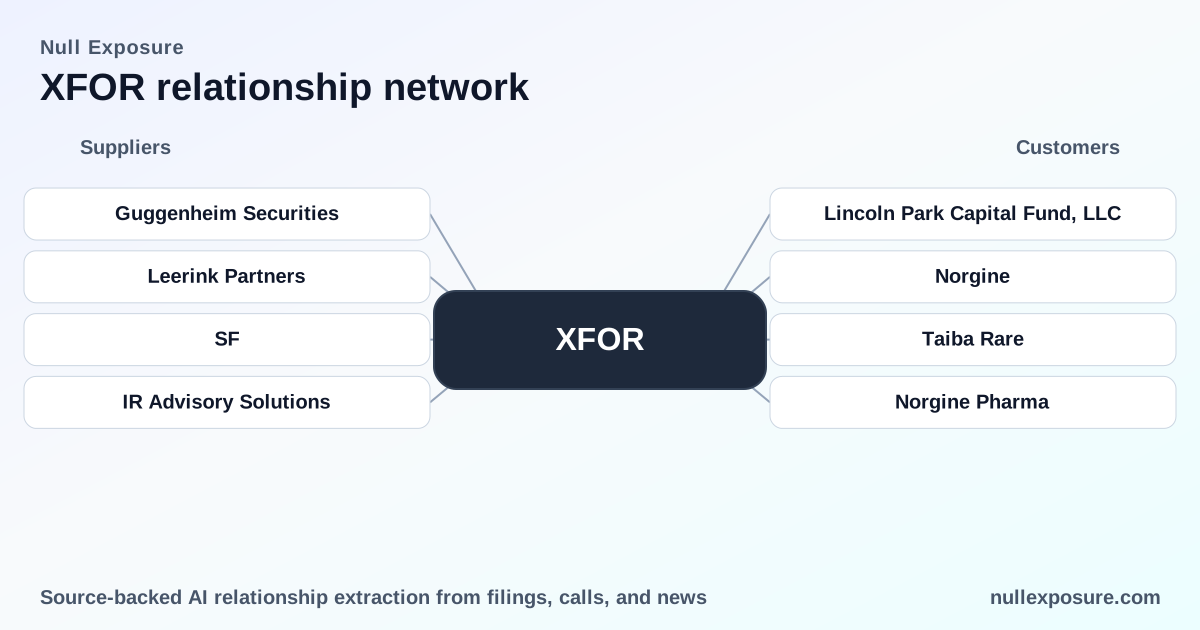
Below are the counterparties surfaced in recent reporting and what each relationship means for investors.
Guggenheim Securities — Guggenheim is acting as a joint bookrunning manager on X4’s proposed underwritten public offering, a role that positions it to execute share distribution and syndicate formation for near‑term capital needs. According to MarketScreener reporting on March 10, 2026, Guggenheim is named among the joint bookrunners for the offering.
Leerink Partners — Leerink Partners is also a joint bookrunning manager on the same proposed offering, signaling the company’s use of healthcare‑specialist banks for its capital raise. MarketScreener noted Leerink’s role in the March 10, 2026 announcement.
Stifel (SF) — Stifel joins Leerink and Guggenheim as a joint bookrunner, providing distribution reach and underwriting support tied to the March 10, 2026 public offering notice on MarketScreener. Stifel’s participation indicates a multi‑bank syndicate rather than a sole‑lead approach.
IR Advisory Solutions — Listed as the investor contact for X4 in event materials, IR Advisory Solutions is coordinating investor engagement and conference participation, including a fireside chat at the Leerink Global Healthcare Conference. SahmCapital reported the IR contact and conference participation on March 4, 2026.
What the banking and IR footprint implies for near-term financing and signaling
The combination of three joint bookrunners and an active investor relations program indicates a purposeful capital raise backed by healthcare‑focused investment banks, timed around investor conferences to maximize placement efficiency and visibility. Investors should interpret the syndicate structure as a standard approach for small‑cap biotech raises: it broadens distribution but also signals the need for additional capital to fund commercialization and continued R&D. MarketScreener’s coverage of the proposed offering (March 10, 2026) and SahmCapital’s conference notice (March 4, 2026) document this activity.
For ongoing monitoring of X4’s counterparty relationships and event timing, see https://nullexposure.com/.
Supply chain and contracting: what to stress-test in your model
Company disclosures (FY2025/FY2026 period filings and public statements) make several operational claims that should be explicitly modeled in scenario analysis:
- Single‑source manufacturing exposure. X4 states dependence on a sole third‑party for the API and a single manufacturer for the finished capsule product, which transfers a large execution risk to those providers. A supply hiccup would compress available commercial inventory and could delay launch milestones.
- Material licensing dependencies. The business relies on license agreements to access proprietary technology and patents critical to mavorixafor; licensing is therefore a non‑discretionary expense and a gating factor for commercialization.
- Long‑term but flexible contracts. Master services and supply agreements carry multi‑year terms (an example contract term extending to December 31, 2028 is disclosed) but include termination on 30 days’ notice or post‑breach provisions — contract length provides security, while termination mechanics keep exit flexibility for both sides.
- Measured committed spend today. The company reported about $1.9 million of cancellable commitments at year‑end 2024, consistent with a modest absolute spend band ($1M–$10M) but high operational leverage given product‑critical nature of those suppliers.
Treat these characteristics as company‑level signals that increase the volatility of timing and costs in commercialization scenarios.
Risk checklist investors should use
- Model supply disruption scenarios where a single‑source API or capsule manufacturer misses a delivery window; project revenue and cash‑burn impact over a 3–9 month interruption.
- Stress licensing costs and potential royalty or milestone payments tied to commercialization timing.
- Price in incremental capital raises: the presence of an active underwriting syndicate increases the probability of near‑term equity issuance, which dilutes shareholders but extends the runway.
- Monitor conference and IR calendars; management’s investor engagement cadence is a near‑term indicator of fundraising and commercialization messaging.
Mid‑article action: if you track supplier concentration and capital markets behavior for biotechs, review X4’s counterparties and contract excerpts at https://nullexposure.com/ to align your models with the disclosed supplier posture.
Bottom line: what to watch next and how to act
X4 is a small‑cap biotech with concentrated supplier exposure and active capital markets engagement. The company’s ability to scale commercial supply for XOLREMDI and to defend its licensed IP are the two largest operational levers; the presence of a multi‑bank underwriting syndicate signals imminent financing activity that investors must factor into dilution and runway assumptions. Track the following events closely: (1) outcomes and pricing of the proposed underwritten offering, (2) any amendments or supplier notices tied to the master services/commercial supply agreements, and (3) licensing milestones or disputes.
For an ongoing feed on X4’s supplier counterparties and capital market activity, check https://nullexposure.com/.
If you need a tailored risk‑adjusted cash‑flow model that incorporates supplier concentration and potential raise scenarios, visit https://nullexposure.com/ for more detailed coverage and analyst briefings.