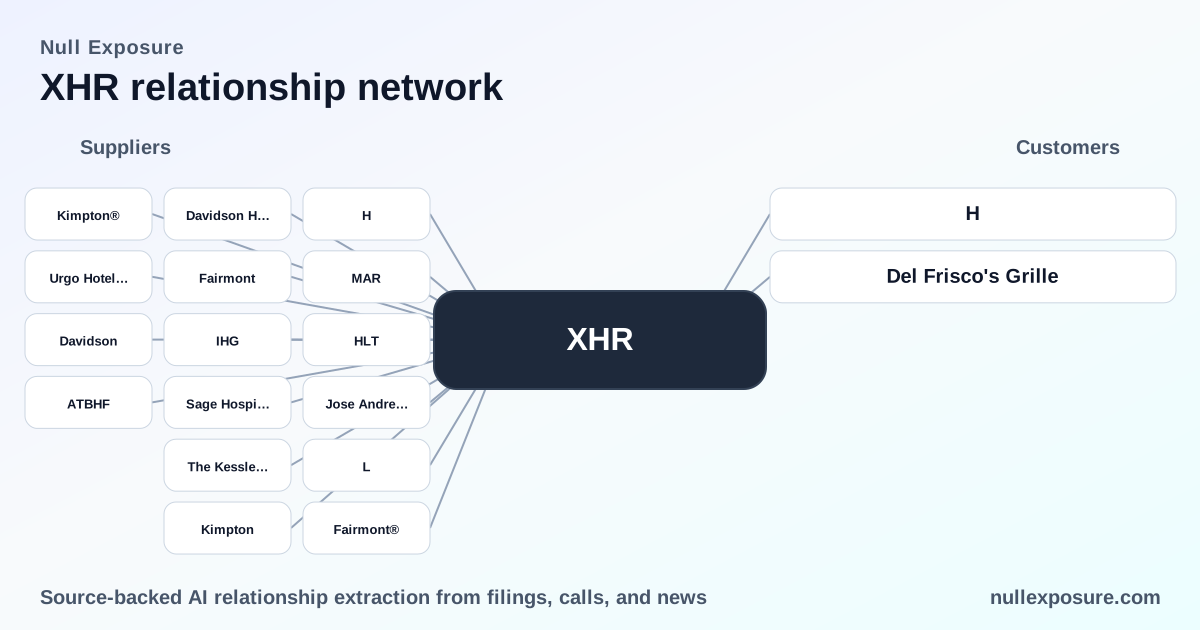
Xenia Hotels & Resorts (XHR): Supplier map and what the operator relationships mean for investors
Xenia owns a concentrated portfolio of upscale and luxury hotel real estate in top U.S. lodging and leisure markets and monetizes primarily through property ownership: capital appreciation, hotel-level cash flow and dividends to shareholders. Operational control is outsourced — Xenia structures long-term management and franchise agreements and collects economic rent and asset returns while third-party brands and managers run day-to-day hotel operations.
If you evaluate XHR as an owner-operator exposure, this supplier map and the contract profile are the primary drivers of operating leverage, counterparty risk, and asset optionality. For a deeper supplier-risk view visit https://nullexposure.com/ to see the complete supplier intelligence platform.
Quick snapshot for investors
Xenia is a publicly traded REIT (NYSE: XHR) with roughly $1.45bn market cap, $1.08bn TTM revenue, and $238m EBITDA (latest filings). The portfolio is concentrated in the luxury/upper-upscale segment and generates income through property ownership while outsourcing operations to branded hotel companies and independent management firms. Dividend yield ~3.95% and high institutional ownership (~97%) position the stock as a classic yield-plus-asset play.
- Business model driver: long-term contracts with major brands provide stable operating continuity without direct operating costs.
- Key risk: counterparty and brand concentration around a handful of major operators that control distribution and guest loyalty.
- Explore supplier relationships and filings: https://nullexposure.com/
Who Xenia relies on to run its hotels — relationship by relationship
Below are every counterpart name cited in recent disclosures and press releases. Each entry is a concise, plain-English summary with the source noted.
Hyatt Hotels Corporation / Hyatt
Xenia has acquired multiple properties from Hyatt affiliates and has left Hyatt in place as manager at several large assets — for example, Xenia bought Hyatt Regency Grand Cypress (Orlando) and Hyatt Regency Scottsdale from Hyatt affiliates with management continuing under Hyatt. Source: PR Newswire and HotelNewsResource acquisition announcements (FY2017).
Marriott / Marriott®
Marriott-branded hotels are a visible part of Xenia’s portfolio and Xenia explicitly describes expanding relationships with Marriott at properties such as The Ritz-Carlton Pentagon City; Marriott franchises and management agreements are recurring across filings. Source: PR Newswire acquisition notices and Hotel-Online coverage (FY2017–FY2018).
Hilton / Hilton®
Hilton is listed among the principal brand partners that operate or franchise Xenia hotels; Hilton-managed or franchised properties are referenced in multiple acquisition and portfolio announcements. Source: PR Newswire company releases (FY2017, FY2025).
Loews / Loews®
Loews appears among Xenia’s branded operators in acquisition press releases and portfolio descriptions, indicating Loews-managed hotels are part of Xenia’s operating mix. Source: HotelNewsResource and Hotel-Online reporting (FY2017–FY2018).
Fairmont / Fairmont®
Xenia acquired the Fairmont Pittsburgh and lists Fairmont as a brand operating in its luxury/upper-upscale set, reflecting occasional ownership of historic or destination assets under the Fairmont flag. Source: PR Newswire acquisition release (FY2018).
Kimpton / Kimpton® (IHG affiliation)
Kimpton-branded assets are included in Xenia’s portfolio descriptions and acquisition write-ups; Kimpton is treated as a luxury/upper-upscale brand partner on several properties. Source: HotelNewsResource and Hotel-Online coverage (FY2018).
Sage Hospitality
Sage Hospitality is cited as one of Xenia’s leading independent management companies used to operate hotels where a branded management solution is not selected. Source: HotelNewsResource portfolio announcements (FY2018).
The Kessler Collection
The Kessler Collection is listed by Xenia among independent managers engaged to operate certain lifestyle and resort properties. Source: HotelNewsResource (FY2018).
Davidson Hotels & Resorts / Davidson
Davidson Hotels & Resorts is named repeatedly as an independent third-party manager for select Xenia assets. Source: PR Newswire and Hotel-Online portfolio statements (FY2017–FY2018).
Urgo Hotels & Resorts
Urgo appears in Xenia’s list of independent management companies and is referenced in acquisition materials that describe the operating mix across assets. Source: PR Newswire acquisition releases (FY2017).
Concord Hospitality
Concord Hospitality is mentioned as one of the independent managers that historically have operated Xenia properties, showing Xenia’s use of regionally focused operators for certain assets. Source: PR Newswire (FY2017).
Aston (ATBHF)
Aston is listed among the brands/operators cited in press materials describing Xenia’s portfolio — typically in the context of brand-managed hotel operations. Source: PR Newswire acquisition announcements (FY2017).
Jose Andres Group
Xenia disclosed an operating arrangement at the W Nashville that involves the Jose Andres Group reconcepting and operating food & beverage outlets, indicating Xenia uses specialized culinary partners to improve F&B economics. Source: Q4 2025 earnings call transcript reported by InsiderMonkey (FY2026).
What the contract profile and constraints mean for investors
Xenia’s filings and press materials reveal a deliberate outsourcing model: to maintain REIT qualification and limit operational exposure, Xenia leases properties to its TRS and engages third-party managers. That posture produces several predictable characteristics:
- Contracting posture — long-term, brand-anchored: management agreements typically have initial terms of 10–30 years with an average remaining term cited at roughly 13 years, while franchise agreements often have 15–20 year initial terms. Long tenors preserve operating continuity and hotel value but create lock-in around incumbent operators (company filings, management-agreement disclosures).
- Counterparty concentration — large enterprises: Xenia’s reliance on major global and regional brands (Marriott, Hyatt, Hilton) and established independent managers is a structural feature — these counterparties control distribution, loyalty programs, and operations that materially affect hotel performance (company press releases and portfolio statements).
- Geographic focus — U.S. market exposure: the portfolio is concentrated in the top 25 U.S. lodging markets and key leisure destinations across roughly 14 states, so macro U.S. travel cycles and regional real estate markets drive returns (filing portfolio description).
- Criticality and REIT consequences: compliance with third-party manager eligibility and operational requirements is critical; failure to maintain compliant management structures would risk Xenia’s REIT status, making counterparty selection a regulatory as well as commercial decision (company disclosures).
- Spend and capital commitment: material capital expenditure levels are significant (capital expenditures recorded in the nine-figure band in filings), underlining that owner-driven capital programs (renovations, repositionings) are a core part of value creation.
For supplier-risk profiling and practical counterparty checks, the combination of long-tenor agreements and large-brand dependence is the central structural trade-off: it stabilizes operating continuity and hotel cash flow but concentrates strategic risk with a handful of counterparties.
Explore supplier intelligence and counterparty exposure tools at https://nullexposure.com/ for a full view of counterparties and contract signals.
Investment implications — what to watch next
- Positive: Long-term branded management and franchise agreements support predictable operations and asset marketability; partnerships with major brands preserve guest flow and ADR leverage.
- Negative: Brand and manager concentration create execution risk if an incumbent relationship deteriorates; large capex needs require disciplined deployment to protect returns.
- Catalyst watch: asset-level renovations, brand conversions, and contract renewals are high-impact events because they change operating margins, distribution access, and residual property value.
For a practical next step, review asset-level contract terms and the counterparties listed above before sizing exposure. For institutional-grade supplier and contract analytics, visit https://nullexposure.com/ and request detailed exposure reports.