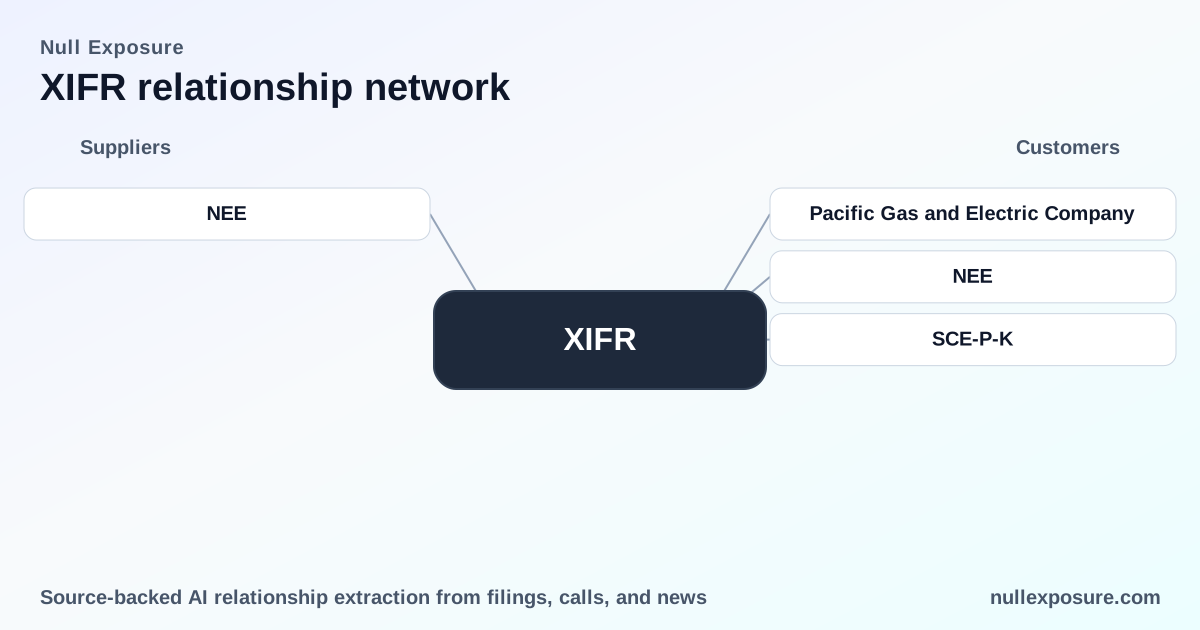
XIFR — XPLR Infrastructure: Why NextEra is more partner than vendor
XPLR Infrastructure acquires, owns and operates contracted clean-energy assets and monetizes chiefly through long-dated cash flows from those contracts plus recurring operating and management arrangements. The company outsources core execution and back-office functions to NextEra-affiliated entities under long-term agreements, capturing scale while concentrating operational risk around a single service ecosystem. Investors should value XPLR as a contract-heavy, asset-backed operator whose profitability and operational resilience are tightly coupled to its supplier relationships.
For a concise look at supplier exposure and contract signals, visit https://nullexposure.com/.
How XPLR runs the business and pays for it
XPLR's business model is built to convert contracted project economics into distributable cash flows, but it does so largely through an outsourcing posture. Operational management, engineering, construction support, IT operations (including cybersecurity) and executive staffing are provided by NextEra affiliates under a Master Services Agreement (MSA) and related arrangements. That structure lowers overhead and leverages NextEra's scale, while creating concentrated counterparty and operational risk for XPLR.
The operating economics reflect this outsourcing:
- XPLR pays a defined management fee formula to NEE Management and an annual credit-support fee to NEER for letters of credit and guarantees, although the MSA was amended in 2023 to suspend certain management fee payments for 2023–2026. (Company filings and contract excerpts, 2023–2025)
- Reported O&M spend tied to the MSA was substantial in prior years — approximately $163 million in 2022, $51 million in 2023 and $8 million in 2024 — illustrating both materiality and volatility in third-party spend. (Company disclosures)
One supplier dominates: NextEra Energy and its affiliates
NextEra Energy Resources is XPLR’s primary service provider. Through long-term service agreements, NextEra supplies operations, engineering, construction expertise, and supply-chain access that XPLR depends on to run its projects. According to an XPLR earnings call (2025Q4), these long-term agreements are a central operational arrangement for the company.
Relationship inventory — the single reported supplier relationship
NextEra Energy Resources (NEE / NEER)
XPLR has long-term service and management arrangements with NextEra and certain affiliates that deliver operations, engineering, construction support, IT and executive staffing, plus credit support through guarantees and letters of credit; these contracts support day-to-day operations and liquidity backstops. According to an earnings call (2025Q4) and company filings, XPLR benefits from NextEra’s scale in operations and supply-chain access and has contractual arrangements governing management fees and credit-support fees.
What the contract signals tell investors
The contract evidence in public disclosures provides a clear picture of XPLR’s operating posture and where investor attention should focus.
-
Contracting posture — long-term, sticky engagement. The MSA limits termination and runs through January 1, 2068 with automatic five-year renewals unless notice is provided, and requires 90 days’ written notice under limited circumstances. This is a structural lock-in that stabilizes operations but concentrates long-run dependency on NextEra. (MSA excerpts in company filings)
-
Concentration and criticality — NextEra is indispensable for core functions. Disclosures state that NextEra affiliates provide or arrange for substantially all of XPLR’s IT functions, including cybersecurity, and also supply management and executive personnel. This makes the relationship operationally critical rather than advisory. (Company filing excerpts)
-
Spend and economics — material and historically lumpy. O&M expenses tied to the MSA were reported at approximately $163M (2022), $51M (2023) and $8M (2024), with parallel credit-support-related payments recorded in the low single-digit millions in recent years; an amendment in May 2023 suspended certain payments for 2023–2026. The pattern signals both high absolute exposure in earlier years and contractual levers (amendments/suspensions) that affect near-term cash outflows. (Company disclosures, MSA amendment language)
-
Role definition — outsourcer and guarantor. NextEra fulfills multiple roles: operations manager, service provider, and credit supporter (CSCS agreement), and XPLR pays fees tied to each role. That triangular relationship means counterparty stress at NextEra would propagate across operational, financial and governance channels. (CSCS and MSA excerpts)
-
Maturity and stage — active, operational relationship. The company continues to pay (or recognize) management and credit-support arrangements under active agreements, indicating the relationship is operational today rather than a historical legacy. (Recent filings and fee disclosures)
Risk implications for investors and operators
-
Counterparty concentration is a core risk. XPLR’s reliance on a single service ecosystem amplifies operational and transition risk; any disruption at NextEra or in the ability to source its services would directly affect operations and cybersecurity posture. Investors should treat NextEra as a strategic counterparty rather than a marginal vendor.
-
Contractual protections cut both ways. Long-term agreements lock in service continuity and access to scale, but they also reduce XPLR’s flexibility to re-source and can embed pricing that is material to margins. The 2023 fee suspension demonstrates both parties’ ability to renegotiate short-term economics and the potential for fee volatility.
-
Liquidity and credit-backstop dynamics matter. The existence of credit support arrangements shifts some financing and performance risk onto NextEra’s balance sheet and pricing; fees for that support are a recurring line item investors must model under different stress scenarios. (CSCS disclosures)
If you want a deeper run-down of supplier exposures, see full coverage at https://nullexposure.com/.
Practical takeaways for investors
- Value XPLR as an asset-backed operator with outsourced execution — upside comes from contracted project cash flows, but downside is amplified by supplier concentration.
- Stress-test counterparty risk, cybersecurity dependencies and credit-support scenarios when modeling downside; NextEra’s role is operational and financial.
- Watch contractual milestones and amendments, including the post-2026 management fee status and any changes to CSCS terms, for outsized impacts on O&M and credit costs.
For a consolidated view of supplier relationships across listed infrastructure names, visit https://nullexposure.com/ and explore supplier risk analytics.
XPLR’s outsourcing to NextEra trades operational leverage for concentrated counterparty exposure. For investors, that is the defining factor to weigh against the steady revenues from contracted clean-energy assets — and it is precisely where underwriting attention should be focused. Visit https://nullexposure.com/ for ongoing supplier-position monitoring and alerts.