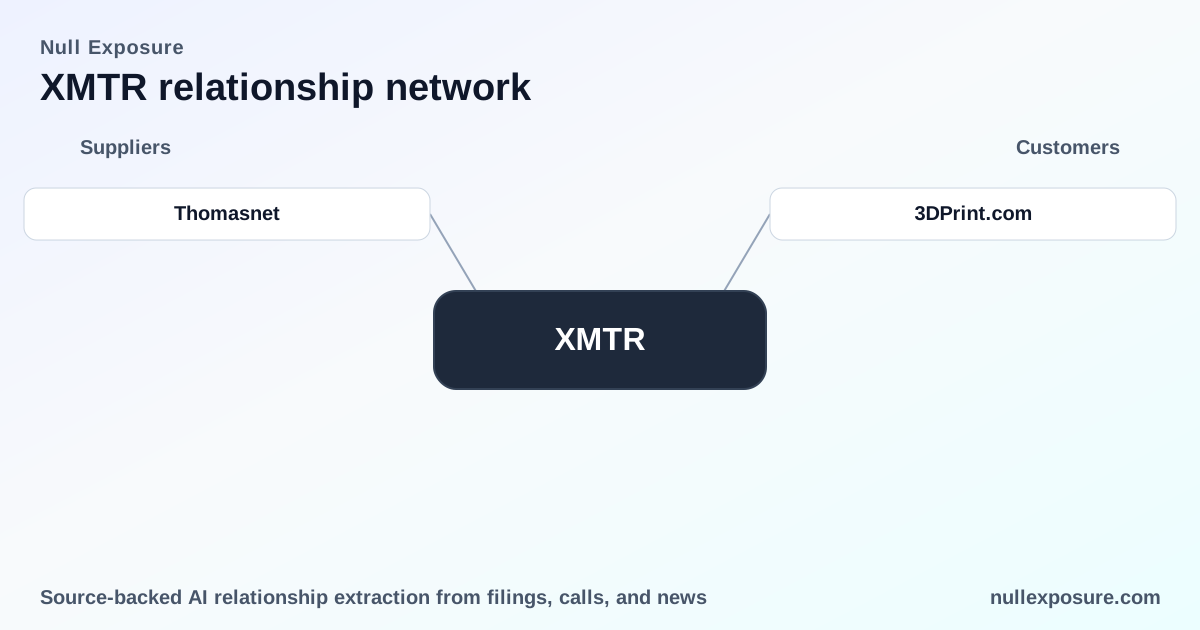
Xometry Inc (XMTR): Supplier relationships and what investors should price in
Xometry operates an AI-enabled manufacturing marketplace that connects buyers with a network of contract manufacturers and service providers, monetizing through transaction fees on routed production work, a growing supplier services business (digital marketing, data and financial services), and ancillary product sales. The company reported roughly $687M revenue TTM with supplier services contributing ~11% of revenue in 2024, making supplier relationships both a revenue driver and a risk vector for operations and margins. For active diligence, focus on supplier concentration, channel partnerships that drive supplier demand, and the contracting terms that govern supplier services revenue recognition. Learn more at https://nullexposure.com/.
How the marketplace business model converts supplier relationships into revenue
Xometry’s economics rest on two linked levers: breadth of supplier capacity to accept diverse jobs and a services ledger that converts suppliers from pure fulfillers into paying customers. The platform sources parts to thousands of small manufacturers, who execute orders and, increasingly, purchase marketing, data and financial services from Xometry. According to the company’s disclosures for the year ended December 31, 2024, supplier services represented approximately 11% of total revenue, underscoring that monetization is not limited to take-rates on orders but includes recurring and contracted services. The company reported $686.6M revenue TTM and $268.8M gross profit TTM, reflecting scale but still negative EPS and operating margin pressure as Xometry invests in growth.
Xometry’s supplier base is large and active (4,375 active suppliers in 2024, up 28%), which diversifies fulfillment risk but concentrates counterparty credit and operational exposure in thousands of small businesses that are more sensitive to economic cycles. The firm’s supplier economics are shaped by its contract posture: for supplier service contracts longer than one year, Xometry amortizes costs over an average customer life of two years for new customers, and over the renewal period (generally one year) for existing customers — an accounting policy that creates revenue longevity but requires careful monitoring of supplier churn and renewal pricing.
The Thomasnet partnership — marketing partnership that boosts supplier discovery
Xometry launched performance-based listings on Thomasnet, enabling manufacturing and industrial suppliers to promote their businesses via targeted sponsored listings on North America’s industrial sourcing platform. According to a GlobeNewswire press release distributed via The Manila Times on February 24, 2026, the initiative is intended to improve supplier visibility and customer acquisition through targeted digital placements. This relationship plugs Xometry into a prominent North American supplier discovery channel and amplifies the supplier services product set (paid listings and marketing) that generate recurring revenue. (Source: GlobeNewswire / The Manila Times, Feb 24, 2026.)
Why this matters: Thomasnet is a leading North American sourcing and supplier-discovery platform; leveraging it accelerates supplier onboarding and the conversion of suppliers into paying customers for Xometry’s services, while also exposing marketing spend and partner economics that investors should track.
Third-party dependencies, supplier profile and strategic constraints
Xometry’s operating model is defined by a set of structural constraints that shape risk and optionality:
-
Contracting posture (company-level signal): Supplier service contracts include multi-year amortization rules — costs for contracts in excess of one year are amortized over an average customer life of two years for new customers and over renewal periods for existing customers. This creates revenue smoothing but increases sensitivity to renewal behavior and upfront acquisition spend. (Company disclosure.)
-
Supplier mix and counterparty type (company-level signal): The supplier population consists predominantly of small machine shops, including numerous minority-, veteran-, and women-owned businesses, which broadens the base but raises operational exposure to the health of small manufacturers. (Company disclosure.)
-
Geography and market reach: Xometry operates with a North American focus in its sourcing and supplier discovery channels — Thomasnet’s directory is explicitly North American — while marketing and platform positioning also promote global procurement options, supporting both regional resilience and cross-border complexity. (Company disclosure and Thomasnet excerpts.)
-
Relationship roles and capacity (company-level signal): Suppliers serve as manufacturers and service providers, covering CNC machining, 3D printing, injection molding and finishing services; these are capital-intensive capabilities that are costly to replace and require long lead times. That underpins the platform’s value proposition but creates stickiness and potential supply fragility for specialized processes. (Company disclosure.)
-
Active stage and monetization (company-level signal): The relationship stage is active with thousands of suppliers using and paying for services; supplier services are an explicit revenue segment and a vector for product expansion. (Company disclosure.)
-
Segment concentration (company-level signal): Revenue mixes include a manufacturing core and a growing services segment (about 11% of revenue), which shifts the firm from pure marketplace to platform-plus-services operator — a higher-margin opportunity if scaled, but one that requires ongoing sales and account management investment. (Company disclosure.)
Relationship-by-relationship wrap (complete coverage)
Thomasnet — Xometry launched performance-based listings on Thomasnet to allow suppliers and manufacturers to purchase targeted sponsored listings, effectively extending Xometry’s supplier services into a major North American sourcing channel; this was announced via a GlobeNewswire press release reported by The Manila Times on February 24, 2026. (GlobeNewswire / The Manila Times, Feb 24, 2026.)
What investors and operators should watch next
- Monitor supplier services revenue growth and renewal rates as the primary indicator of the services upsell strategy’s health; because Xometry amortizes supplier acquisition costs over multi-year periods, abrupt churn would compress margins quickly.
- Track marketing and partner economics tied to channels like Thomasnet: conversion rates from sponsored listings into active, paying suppliers determine payback periods.
- Watch supplier capacity and geographic mix — the company’s reliance on thousands of small shops gives breadth but exposes fulfillment to regional economic shocks and equipment replacement lead times.
- Assess third-party hosting and platform risk; operational continuity depends on cloud infrastructure providers and critical integrations.
If you need ongoing tracking of partner signals and supplier risk indicators, visit https://nullexposure.com/ for monitoring and research tools.
Investment conclusion and tactical checklist
Xometry has built a two-pronged monetization model: marketplace take-rates from manufactured orders and growing supplier services that convert suppliers into recurring revenue customers. The partnership with Thomasnet concretely supports supplier discovery and paid-listing monetization, which is material to service revenue growth. Key risks for valuation include supplier churn, the durability of small-business suppliers in cyclical environments, and the cadence of converting marketing spend into durable service revenue. For operators, prioritize supplier retention programs, optimize sponsored-listing conversion funnels, and measure customer acquisition payback under the company’s amortization assumptions.
For a deeper vendor and partner risk dossier, and to integrate supplier relationship signals into investment workflows, explore the research offerings at https://nullexposure.com/.
Bold, measurable monitoring of renewal rates, partner conversion metrics and active supplier trends will determine whether Xometry’s services lift margins and justify a growth multiple or leave the business a higher-risk marketplace with thin profits.