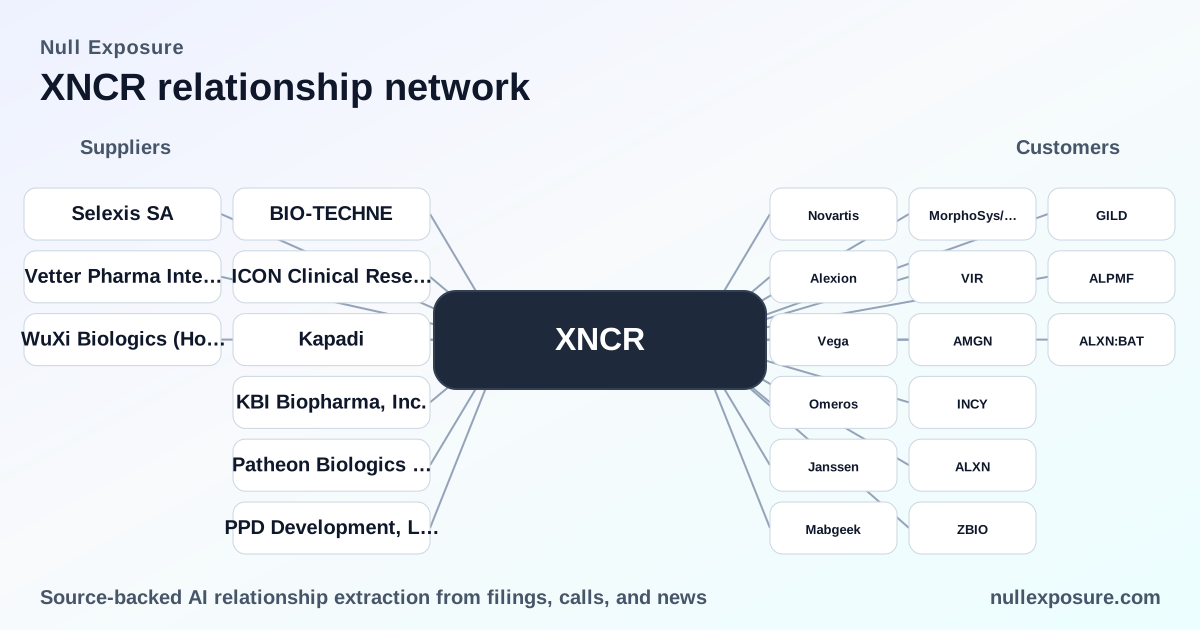
Xencor (XNCR): supplier map and operational constraints that drive clinical timelines and valuation
Xencor is a clinical‑stage biopharmaceutical company that develops cytokine and monoclonal antibody therapies and monetizes through partnered licensing deals, milestone and royalty streams, and ultimately product sales when candidates reach approval. The company runs a highly outsourced clinical and manufacturing model: Xencor retains discovery and early translational control while relying on third‑party CROs and CDMOs to execute trials and produce drug substance/product, which directly drives the company’s development pace and near‑term value realization. For a concise supplier risk score and relationship inventory, visit https://nullexposure.com/.
How Xencor operates day‑to‑day: an outsourced model with concentrated manufacturing risk
Xencor’s operating model is clear and consistent: internal discovery and IP combined with external execution. The 2024 Form 10‑K confirms two structural characteristics that investors must treat as core to valuation:
- Contracting posture: Xencor structures the business so that execution — clinical operations, manufacturing, and scale‑up — is performed by vendors. This creates predictable variable costs but transfers timing and quality risk to suppliers.
- Concentration and criticality: Management identifies five critical manufacturing suppliers whose continuity and performance determine trial timelines; any vendor change can delay trials and revenue realization.
- Relationship maturity and stage: Most supplier contracts are active for current programs; one supplier, WuXi, is explicitly described as manufacturing drug substance/product for specific programs.
- IP posture: Xencor uses in‑licensed IP and acknowledges limited control over prosecution and enforcement under some license agreements, which is a strategic exposure for program defensibility.
If you are modeling development timelines or counterparty exposure, incorporate supplier continuity and licensor control as direct drivers of R&D timeline and downside risk. For a structured view of counterparties and constraint signals, see https://nullexposure.com/.
Supplier relationships to track and why they matter
Below are the suppliers listed in Xencor’s FY2024 disclosure with a plain‑English read on their role and one concise source citation for each.
BIO‑TECHNE
Xencor holds a non‑exclusive license from BIO‑TECHNE for a recombinant monoclonal antibody reactive with human CLDN6, giving Xencor rights to use that reagent in its programs under licensing terms. According to Xencor’s 2024 Form 10‑K (FY2024), the license was entered in April 2021.
ICON Clinical Research Limited
ICON provides clinical trial services and affiliated operational support for Xencor’s studies, positioning ICON as a core CRO for trial execution. This relationship is described in Xencor’s 2024 Form 10‑K (FY2024).
Kapadi
Kapadi is contracted to provide CRO services including clinical trial management, adding capacity to Xencor’s clinical operations and monitoring functions as disclosed in the FY2024 Form 10‑K.
KBI Biopharma, Inc.
KBI performs process development, clinical scale‑up, analytical method development and formulation development for Xencor’s drug substance and product, supporting the technical transition from discovery to clinical manufacture per the FY2024 10‑K.
Patheon Biologics LLC (Thermo Fisher Pharma Services Group)
Under the Patheon agreement, affiliates within Thermo Fisher’s global Pharma Services network may perform clinical manufacturing for Xencor, giving Xencor access to a large CDMO footprint for production needs (Xencor 2024 Form 10‑K, FY2024).
PPD Development, L.P.
PPD is engaged to deliver clinical trial management and clinical development services, serving as another core CRO partner for program execution in FY2024 disclosures.
Selexis SA
Selexis has manufactured cell lines used for Xencor’s bispecific antibody candidates, an upstream bioprocess capability that underpins biologic supply for those programs (Xencor 2024 Form 10‑K, FY2024).
Vetter Pharma International GmbH
Vetter is engaged for clinical scale‑up, analytical method development and formulation development, contributing to formulation and fill/finish readiness ahead of larger‑scale manufacturing according to the FY2024 Form 10‑K.
WuXi Biologics (Hong Kong) Limited
WuXi provides manufacturing, analytical, development and other services, and is actively manufacturing drug substance and product for XmAb808, XmAb657 and XmAb942 programs — an explicit active supplier role identified by Xencor in FY2024. According to Xencor’s 2024 Form 10‑K (FY2024), WuXi’s engagement is current and program‑specific.
Constraints and what they imply for investors
Xencor’s SEC disclosure surfaces several company‑level constraint signals that should be built into risk and scenario models:
- Licensing is material to scope and freedom to operate. Xencor relies on in‑licenses for technology and acknowledges limited control over patent prosecution and enforcement under those agreements; this reduces direct control over IP lifecycle and increases program legal exposure.
- Manufacturing and suppliers are critical. Management identifies five critical suppliers for clinical drug product manufacture; supplier disruption translates directly into trial delay risk and potential cost to replace capacity.
- Outsourcing dominates operating risk. Xencor outsources manufacturing, QA, monitoring, data management and regulatory expertise, which limits fixed overhead but increases dependency on third‑party performance and contracting terms.
- Active manufacturing relationships for lead programs. The filing explicitly names WuXi as the manufacturer for several XmAb programs, establishing a live, concentrated execution link between supplier performance and Xencor’s development milestones.
These constraints are company‑level operational characteristics: concentration of manufacturing, dependency on licensors for IP enforcement, and a service‑provider operating posture. Model timelines with contingency for vendor remediation and potential re‑qualifications; assume milestone delivery is highly sensitive to third‑party capacity and regulatory inspections.
What investors should do next
- Monitor supplier continuity and regulatory inspection outcomes for WuXi, Patheon/Thermo Fisher, and other CDMOs because manufacturing disruptions will shift cash flow timing and increase cash burn.
- Factor the lack of patent prosecution control under some license agreements into your downside scenarios: licensor behavior can dilute exclusivity value.
- For a deeper counterparty risk scorecard and scenario modeling tools, visit https://nullexposure.com/ to compare supplier concentration and contract types across peers.
Xencor’s value is driven by scientific upside and the timetable to clinical inflection points; supplier execution and licensor control are the operational levers that convert science into value. For continued monitoring and a structured supplier‑risk view, see https://nullexposure.com/.