XOMA Corporation (XOMAO): Royalty aggregation with long-duration, usage-linked cashflows
XOMA operates as a biotech royalty aggregator and acquirer of future commercial payment rights, monetizing by purchasing royalty streams and receiving long-duration, usage-linked payments from marketed therapeutics. The company’s economics are driven by upfront acquisition outlays tied to mid-single-digit or fractional-percentage revenue shares and milestone components, producing a cashflow profile that is predictable when underlying drug sales scale, but exposed to counterparty and credit risk. For a concise supplier-risk briefing and ongoing coverage, visit Null Exposure.
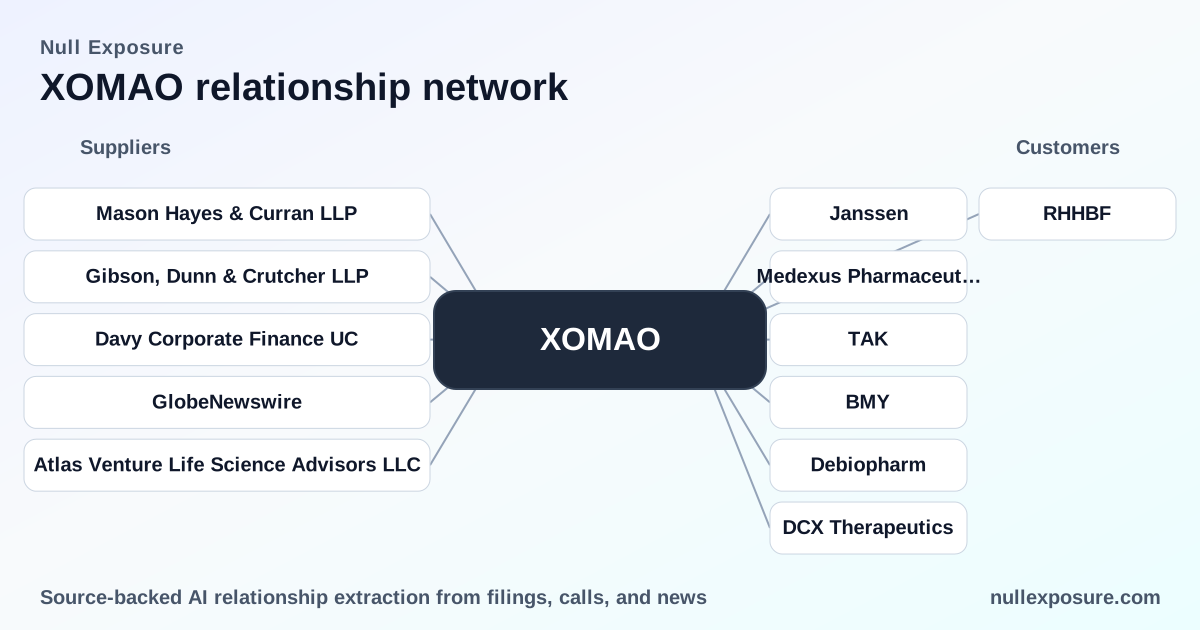
Market activity in FY2025–FY2026 makes clear that XOMA’s corporate development and advisor relationships are central to execution: legal counsel for cross‑border deals, financial advisers for acquisitions, and press distribution partners for market messaging. Below I break down the operational implications, the supplier relationships disclosed in public notices, and the contractual constraints that shape investor risk-reward.
What the recent deal flow means for investors
XOMA Royalty completed multiple portfolio transactions in late 2025 and early 2026 that underscore an acquisitive posture: it closed acquisitions (including Mural Oncology plc and Generation Bio Co. mentions) and relied on external legal and financial advisers for cross-jurisdictional execution. The economics are classic royalty-aggregator: upfront cash paid to acquire payment rights in exchange for future percentage-of-sales receipts and contingent milestones, producing usage-based, long-term revenue streams. That structure supports recurring cash receipts but concentrates downside in cases of non-collection or product underperformance.
If you want a regular feed of supplier and counterparty intelligence for XOMA and peers, see Null Exposure.
Supplier and adviser relationships disclosed in public notices
The following entries are every counterpart named in the available results for XOMA’s FY2025 activity. Each short summary includes the public source.
Gibson, Dunn & Crutcher LLP
XOMA Royalty retained Gibson Dunn as U.S. legal counsel on its acquisition activities, reflecting the firm’s role in structuring and documenting cross‑border royalty and acquisition agreements. According to a GlobeNewswire press release (Dec 5, 2025) and subsequent QuiverQuant summary (first seen Mar 10, 2026), Gibson Dunn represented XOMA Royalty on the transaction to acquire Mural Oncology plc.
Mason Hayes & Curran LLP
Mason Hayes & Curran acted as Irish legal advisor to XOMA Royalty on the Mural Oncology acquisition, handling the Irish procedural and regulatory aspects of the court-sanctioned scheme. This role is described in the GlobeNewswire announcement (Dec 5, 2025) and captured in a QuiverQuant posting summarizing the closing (Mar 2026).
Davy Corporate Finance UC
Davy Corporate Finance served as financial adviser to XOMA Royalty in the closing of the Mural Oncology transaction, providing deal advisory services tied to valuation and transaction execution. The GlobeNewswire release (Dec 5, 2025) and companion QuiverQuant coverage (Mar 10, 2026) identify Davy in this capacity.
GlobeNewswire (press distribution)
GlobeNewswire distributed XOMA Royalty’s press release announcing the closing of the Mural Oncology acquisition on Dec 5, 2025; that release is the primary public disclosure of counsel and adviser appointments and transaction completion. The company’s announcement on GlobeNewswire is the basis for multiple third‑party summaries published in March 2026.
Atlas Venture Life Science Advisors LLC
MarketScreener reported that XOMA Royalty completed an acquisition involving Generation Bio Co. from Atlas Venture Life Science Advisors and others, indicating Atlas Venture’s role as a seller or portfolio intermediary in XOMA’s expansion of payment‑right holdings. The Marketscreener item (reported Feb 05 in the underlying feed and captured in March 2026) states the completion of that acquisition.
How the contract and relationship constraints shape risk and return
XOMA’s disclosed contractual characteristics form a clear operating profile:
-
Long-term, usage-based revenue mix. The company’s acquired rights carry mid-single-digit to fractional-percentage receipts over multi‑year terms (examples include a stream on IXINITY through 2035 and a ten‑year 0.5% faricimab payment right). This generates durable revenue when underlying products perform, but revenue is inherently tied to end-market sales volumes.
-
Revenue predictability but credit sensitivity. Usage-based royalties create a predictable billing mechanism pegged to third‑party sales reporting, yet XOMA has recorded credit losses where payors or counterparties failed to deliver expected cash (the company wrote off significant purchased receivable allowances in recent periods). These impairments are an explicit company-level signal of collection risk: XOMA recorded credit losses on purchased receivables tied to named agreements (for example, a $14.0 million write-off related to an Agenus receivable and a $7.9 million write-off tied to a Talphera agreement).
-
Outsourced execution and service reliance. The business model depends on third‑party manufacturers and service providers for development-stage assets the company may acquire or syndicate; XOMA’s disclosures acknowledge reliance on contract manufacturing and outsourced clinical and assay services, implying operational dependencies beyond direct corporate control.
-
Spend and deal size profile. Public excerpts show upfront payments in the $1M–$10M band for several commercial payment purchases (examples include $6.0M for an Affitech transaction and $9.6M for an Aptevo CPPA), signaling a mid‑market deal cadence rather than megadeal scale.
-
Mixed maturity across relationships. Some streams are active and delivering material cash (commercial payments received in 2023–2024 are documented), while other arrangements are winding down or fully written off. This mixed maturity profile requires active portfolio monitoring and credit governance.
Together, these signals describe a company that operates as an acquisitive, portfolio-based royalty holder with predictable, usage-linked cashflows tempered by counterparty credit risk and the need for external legal and financial advisers on cross-border deals.
Key implications for investors and operators
- Concentration and counterparty diligence are the primary operational levers: because payouts are percentage-of-sales, a small number of high-value streams can dominate revenue, making counterparty credit profile and product market adoption critical.
- Legal and tax structuring matter, as demonstrated by the reliance on U.S. and Irish counsel for cross-border schemes—investors should factor in transaction complexity and jurisdictional enforcement when valuing acquired streams.
- Active collection governance is essential: write-offs on purchased receivables are an explicit historical loss vector that reduces IRR on acquisitions and elevates monitoring requirements.
For ongoing, supplier-focused intelligence on XOMA and peers, subscribe and monitor at Null Exposure.
Final takeaways
XOMA’s strategy delivers highly leveraged upside when underlying therapeutics scale, underpinned by long-dated usage-based receipts and supported by external legal and financial advisers for deal execution. The counterweight is credit and concentration risk, evidenced by recent write-offs and the mixed maturity of acquired payment streams. Investors evaluating XOMA should combine revenue modeling with rigorous counterparty credit assessment and active portfolio surveillance to capture upside while limiting downside.
For deeper supplier relationship profiles and to track counterparty signals in real time, visit Null Exposure.