Direxion Daily XOM Bear (XOMZ): A supplier-focused investor brief
Direxion Daily XOM Bear 1X Shares (XOMZ) is an exchange-traded product that monetizes through issuer-managed fee streams and market-making activity by providing short, tactical inverse exposure to ExxonMobil (XOM) on a daily basis. The fund operates as a trading vehicle for sophisticated investors and hedgers, relying on liquidity provided by dealers and distribution channels rather than recurring operating revenue from end customers. For investors evaluating supplier and counterparty relationships, XOMZ’s economics are driven by issuance and redemption mechanics, fee capture, and the operational resilience of the fund’s service providers. Learn more about supply-side intelligence at https://nullexposure.com/.
What XOMZ does — the business model in plain English
XOMZ is an inverse ETF listed on NASDAQ that targets a 1x inverse return to ExxonMobil on a daily basis. The product is explicitly tactical: it is designed for short-term hedging or speculative trades rather than long-term ownership. The fund’s issuer earns revenue by charging management or operating fees and benefits indirectly from secondary-market trading spreads and liquidity provision by market makers.
Operationally, this product is not a standalone operating company; it is a structured financial vehicle whose stability depends on the strength of its issuer, counterparty arrangements, and the depth of the ETF marketplace. Key commercial characteristics for investors and operators to monitor include contracting posture with liquidity providers, concentration of trading counterparties, and the maturity of operational controls around daily rebalance processes.
The single supplier relationship you need to know
Direxion
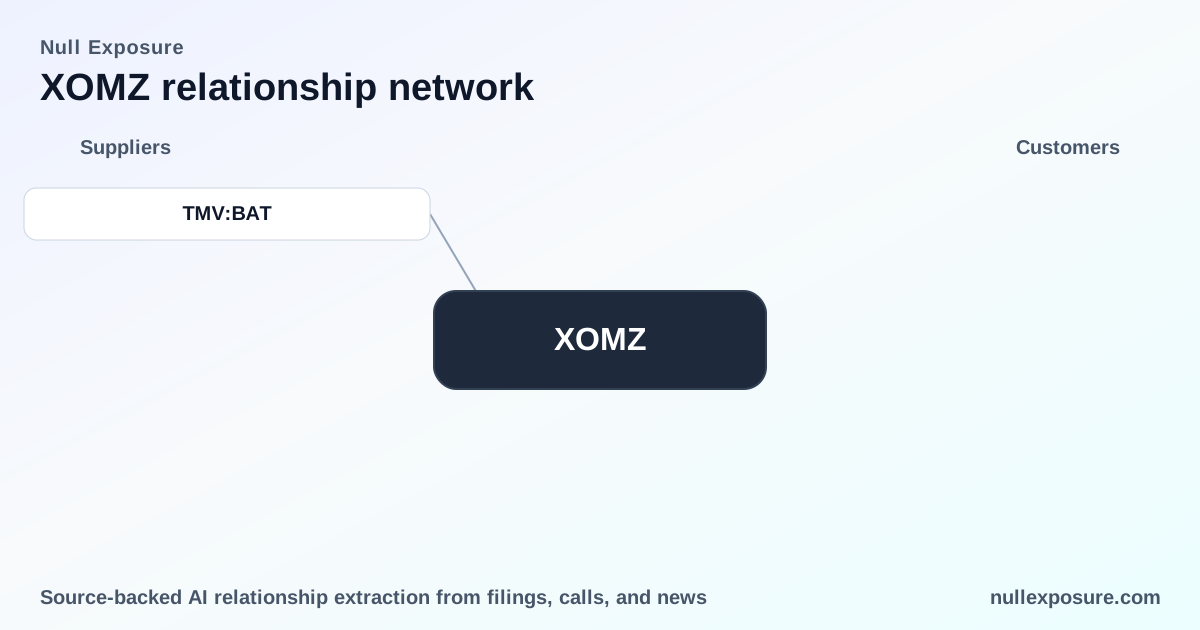
- Direxion is the issuer and manager associated with XOMZ; the firm positions leveraged and inverse ETFs as tactical tools for traders and hedgers, and markets XOMZ as the inverse vehicle for ExxonMobil exposure. According to ETF Trends (March 10, 2026), market commentary highlights Direxion’s role in supplying leveraged and inverse instruments for volatile oil price environments and references XOMZ as a means to take a bearish stance on ExxonMobil. (ETF Trends, March 10, 2026: https://www.etftrends.com/leveraged-inverse-content-hub/crude-awakening-soaring-oil-prices-bad-consumers-great-traders/amp/)
This relationship is the primary supplier tie embedded in the public record for XOMZ; the fund’s issuer is the linchpin of product governance, distribution, and operational execution.
Operational and risk constraints (company-level signals)
There are no explicit supplier constraints recorded in the available relationship data for XOMZ. That absence of documented constraints is itself informative: it signals either a clean public record on third-party supplier limits or a lack of disclosed supplier-level frictions in the sampled documents. Treat this as a company-level signal rather than a relationship-specific finding.
From an operational posture perspective, investors should treat the product as having these characteristics:
- Contracting posture: Issuer-led; core contracts are with custodians, authorized participants, market makers, and index/benchmark counterparties where applicable. These contracts determine daily creation/redemption efficiency.
- Concentration: Product concentration risk is high because the ETF targets a single underlying equity (ExxonMobil) and relies on a limited set of market counterparties for liquidity in stressed markets.
- Criticality: The fund’s critical dependencies are custody, authorized participant networks, and market-making firms that support intraday liquidity; disruptions to these services have immediate impact on tradability.
- Maturity: As an ETF product, maturity depends on the issuer’s operational controls and track record across its suite of leveraged and inverse funds rather than standalone revenue history.
For a deeper supplier risk posture and ongoing monitoring, gate your due diligence to custody arrangements and the identity/health of the authorized participants and market makers that support XOMZ. See https://nullexposure.com/ for supplier monitoring solutions and intelligence.
Market and investor implications
Investors and operators should extract three practical implications from the XOMZ structure:
- Short-term tactical use only. XOMZ’s construction and daily rebalancing ensure that its payoff profile is appropriate for intra-day to short-term strategies rather than buy-and-hold positions.
- Issuer and market liquidity are the dominant risks. Fund performance under stress will be driven more by execution and liquidity dynamics than by long-term corporate fundamentals of ExxonMobil.
- Low disclosure of supplier frictions in public filings is not the same as absence of operational risk. The record does not list contractual constraints, but standard ETF operational dependencies remain.
How to act on this as an investor or operator
- For trading desks: incorporate XOMZ as a tactical hedge subject to liquidity checks at the open and close; ensure authorized participant counterparties are available for large trades.
- For operational due diligence: focus vendor reviews on custody, prime brokers, and market makers; validate daily rebalance procedures and error-handling protocols.
- For strategic investors: treat XOMZ as a derivative exposure manufactured by Direxion, not as direct exposure to ExxonMobil’s corporate performance.
Explore supplier-focused intelligence and tailored monitoring at https://nullexposure.com/ — this is the practical next step when managing funds that depend on third-party market infrastructure.
Final takeaways
XOMZ is a tactical, issuer-managed inverse ETF whose investment usefulness and operational risk are defined by Direxion’s distribution and the liquidity ecosystem around ExxonMobil trading. The public relationship record identifies Direxion as the critical supplier; there are no explicit supplier constraints recorded in the available data, which should be interpreted as a company-level signal requiring focused operational due diligence rather than passive acceptance.
For investors and operators evaluating counterparty exposure or constructing a supplier risk program around ETF products, integrate checks on authorized participant capacity, custody robustness, and market-maker continuity into your standard playbook. For more supplier relationship intelligence and monitoring tools, visit https://nullexposure.com/.