XPEG: Supplier Relationships and What They Signal to Investors
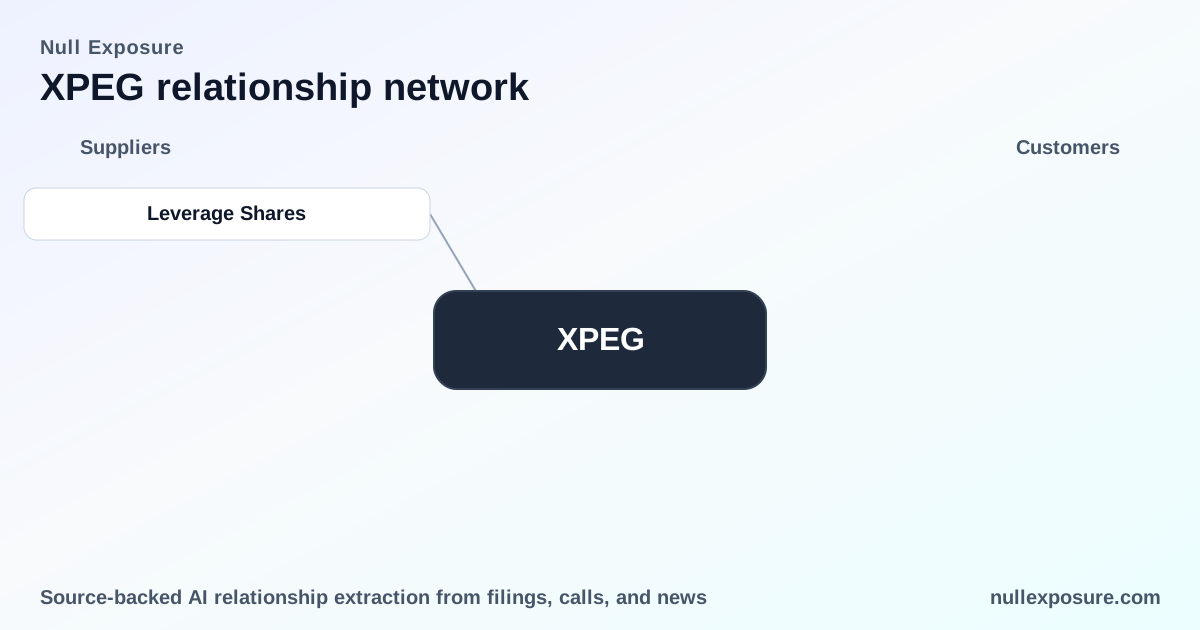
XPEG shows up in public records as a supplier with extremely limited disclosure; the lone documented tie is to a leveraged ETF product reference, suggesting XPEG monetizes through service, licensing, or fee arrangements tied to financial-product issuance rather than product retailing. For investors and operators, the key takeaway is that exposure to XPEG today is driven by idiosyncratic, low‑visibility counterparty links rather than broad market footprints — allocate diligence resources accordingly. Learn more about supplier intelligence at https://nullexposure.com/.
One clear public link — and not much else
The public trail for XPEG is sparse. The only recorded relationship in the supplier-scope results ties XPEG to an ETF issuer named Leverage Shares; the entry does not include a company profile for XPEG or any contractual detail. A QuiverQuant entry dated March 10, 2026, lists “Leverage Shares 2X Long XPEV Daily ETF” in the same context as XPEG and provides no further description (https://www.quiverquant.com/stock/XPEG/). This single mention is the complete basis for vendor-scope analysis in available records.
For a deeper supplier-risk posture or contract-level assessment, consult primary filings or engage the counterparty directly; our platform centralizes such follow-up work for institutional users at https://nullexposure.com/.
Relationship: Leverage Shares — concise investor read
Leverage Shares is listed alongside XPEG in a QuiverQuant news entry referencing the “Leverage Shares 2X Long XPEV Daily ETF”; the entry gives no company description for XPEG, so the nature of supplier services (index licensing, data feeds, tokenized exposure, or other) is not disclosed. Source: QuiverQuant news entry (March 10, 2026) — https://www.quiverquant.com/stock/XPEG/.
What the limited record implies for operating model and commercial risk
The absence of multiple, detailed supplier relationships and the lack of constraint disclosures creates a firm-level signal: XPEG operates with low public visibility and no documented, binding constraints in the supplier-scope data. That absence matters as much as the presence of relationships because it shapes diligence priorities:
- Contracting posture: The record provides no evidence of enterprise-scale, long-term contracts or centralized vendor management for XPEG; this suggests contracting is either private, bespoke, or not material enough to trigger public disclosures.
- Concentration risk: With only a single, non-descriptive linkage, investor exposure is concentrated in informational uncertainty — not in an identifiable counterparty base.
- Criticality: The link to an ETF issuer indicates potential operational or licensing importance, but the lack of detail prevents concluding whether XPEG is mission-critical to product continuity or a peripheral vendor.
- Maturity and market standing: No public constraints or descriptive filings imply either early-stage commercial relationships or deliberate opacity; neither state is directly visible from the supplier-scope dataset.
These are company-level signals driven by missing constraint data. They should be interpreted as directional: absence of evidence equals low public disclosure and therefore higher information risk for counterparties and investors.
How to prioritize diligence given the profile
Given XPEG’s low disclosure footprint, the practical investor playbook is straightforward:
- Confirm the nature of the Leverage Shares linkage — contract type, fee structure, and termination rights — before assuming revenue permanence. A single reference to an ETF product does not prove recurring revenue.
- Demand primary documents or attestations for any critical service XPEG provides to product issuers; public mentions do not substitute for contract-level controls.
- Monitor for follow-up filings or trade publications that convert anecdotal mentions into formal disclosures; a sudden flurry of issuer references would materially change concentration and counterparty risk.
If you need a structured outreach or a vendor control checklist tailored to this profile, see our investigative services at https://nullexposure.com/.
Risk factors that matter to holders and operators
- Information risk is the dominant short-term concern: with one, non-descriptive public mention, investors cannot reliably model revenue streams or counterparty exposure.
- Counterparty opacity creates operational leverage for counterparties if XPEG is indeed providing specialized services to a niche product — but current data do not prove specialization.
- Regulatory and product risk: a relationship to a leveraged ETF means product-level scrutiny or structural risks to the ETF could indirectly affect XPEG’s cash flows if fees are usage- or AUM-linked.
Track changes in issuer filings and industry press for any expansion of XPEG’s public footprint; immediate signals to watch are SEC filings by ETF issuers, prospectus updates, and issuer press releases that name vendors explicitly.
Bottom line: limited disclosure equals a higher due-diligence premium
XPEG’s public supplier record is effectively one line item tied to a Leverage Shares ETF reference, with no constraints or contract detail disclosed. That limited footprint elevates information and concentration risk; institutional investors should treat XPEG as a low-transparency vendor until corroborating documents surface. For operators, the commercial playbook is to secure primary contractual evidence before scaling exposure.
For a fast way to validate vendor links and request primary documents, visit https://nullexposure.com/. If you want help converting sparse public mentions into actionable counterparty intelligence, our platform and analyst services are designed for exactly this use case — start at https://nullexposure.com/.