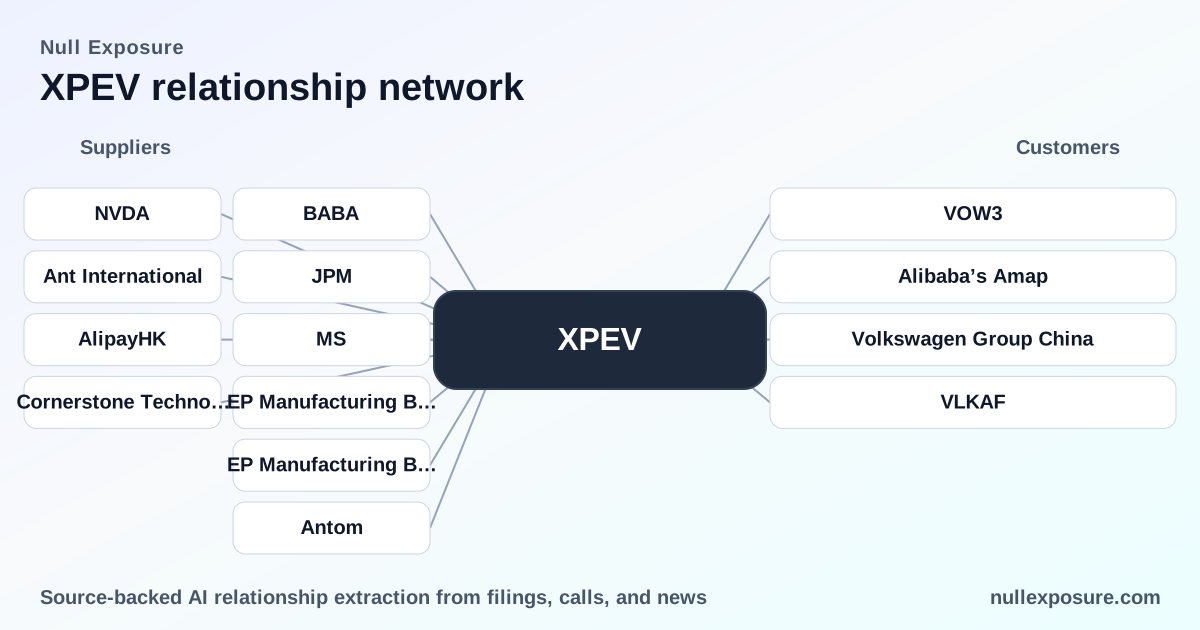
Xpeng Inc (XPEV) — supplier map and what it means for investors
Xpeng designs, engineers and sells smart electric vehicles in China and increasingly overseas, monetizing primarily through vehicle sales, software and services, and expanding ancillary revenue streams such as in‑app payments and mobility services. Its operating model combines in‑house vehicle development with a network of technology, financial and regional manufacturing partners, and recent 2026 headlines show management is leaning into partnerships to accelerate international charging payments, regional assembly and a separate flying‑car unit IPO. For a quick company view, visit https://nullexposure.com/.
What the headline relationships are and why they matter
Below I walk through every supplier/partner relationship surfaced in recent coverage and provide a concise, investor‑grade read on each. Each entry includes a plain‑English summary and a source reference.
Alibaba Group Holding Limited (BABA)
Xpeng will deploy its Robotaxi service in 2026 through Alibaba’s Amap mapping platform, integrating vehicle services with one of China’s largest consumer mapping and location networks — a distribution and platform play that supports scale in mobility services. According to Yahoo Finance reporting (first seen Mar 10, 2026), the Amap tie‑up positions Xpeng to leverage Alibaba’s consumer reach for Robotaxi route planning and user experience.
JPMorgan Chase & Co. (JPM)
Xpeng engaged JPMorgan as an adviser for a potential IPO of its flying‑car unit, signalling a formal, bank‑led path to monetize a separate mobility business and de‑risk capital allocation to the parent. Bloomberg and follow‑on coverage reported the hire in March 2026, per TradingView and Benzinga summaries (Mar 2026).
Morgan Stanley (MS)
Alongside JPMorgan, Morgan Stanley was tapped to prepare the possible Hong Kong listing of Xpeng’s Aeroht flying‑car unit, providing underwriting/advisory capabilities for a capital markets transaction. Multiple sources including The Edge Markets and TradingView referenced Morgan Stanley’s role in March 2026.
EP Manufacturing Bhd (EPMB)
Xpeng signed an agreement with Malaysia’s EP Manufacturing to assemble the G6 SUV and X9 models in Malacca, with G6 assembly slated to start by Mar 31, 2026 and X9 production targeted for May 25, 2026 — a concrete step toward regional manufacturing and lower shipping/ tariff exposure. Reuters coverage reported the deal and was cited in multiple outlets in late 2025 / early 2026.
Antom
Xpeng launched a start‑and‑stop charging payment feature in the XPENG App for Hong Kong using Antom’s global payments platform, expanding the company’s in‑app monetization and cross‑border charging capabilities. Reporting on the February 2026 feature launch noted Antom’s role in enabling unified payments (Sahm Capital / InsiderMonkey, Feb–Mar 2026).
Nvidia (NVDA)
Xpeng’s standard driver‑assistance hardware includes two Nvidia Drive Orin chips delivering 508 TOPS, indicating a critical semiconductor dependency for ADAS compute and continued reliance on Nvidia silicon for compute‑intensive autonomy workloads. GlobalChinaEV coverage (Mar 2026) stated the Drive Orin hardware configuration.
Ant International
Ant International is named as a partner to drive user reach toward Xpeng’s branded charging stations, implying marketing and ecosystem‑level cooperation to increase utilization of the company’s charging network outside mainland China. Finviz coverage described the collaboration in early 2026.
AlipayHK
In Hong Kong, Xpeng drivers can initiate and pay for charging directly from the XPENG app via AlipayHK, broadening payment rails for international users and reducing friction for charge‑station usage. Finviz and InsiderMonkey reported the AlipayHK integration during the February 2026 rollout.
Cornerstone Technologies
The in‑app payment service will cover charging stations operated by Cornerstone Technologies and roughly 1,600 public chargers, giving Xpeng an immediate physical charging footprint for its payment product to address. Finviz’s February 2026 coverage identified Cornerstone as the operator covering the initial charging inventory.
How these relationships reveal Xpeng’s operating posture and supplier profile
- Contracting posture — strategic partnerships over vertical isolation. Xpeng combines in‑house vehicle development with selective external partnerships (payments, mapping, chip suppliers, regional assemblers). That posture accelerates market reach and feature deployment while preserving capital for R&D and product development.
- Concentration and criticality — a small set of high‑impact partners. Nvidia for ADAS compute and payment partners (Antom, AlipayHK) for international charging are material to product capability and monetization, while regional assembly (EP Manufacturing) reduces logistical and tariff risk in Southeast Asia.
- Maturity and scope — transitioning from national OEM to international mobility services provider. The EP Manufacturing agreement and Hong Kong payments rollout indicate commercial scaling of manufacturing and services in 2026, while the Aeroht IPO advisory hires show corporate portfolio management maturing toward separate capital structures for high‑growth units.
- Contract tenor and switching risk — mixed. Technology suppliers like Nvidia represent high switching costs due to hardware/software integration; payments and mapping partners are lower switching‑cost, high‑reach arrangements that can be expanded or reconfigured as market needs change.
For deeper coverage of supplier exposures and how these tie into Xpeng’s balance sheet and go‑to‑market, see https://nullexposure.com/.
Investment implications — risks and upside tied to suppliers
- Upside: Payments integration and regional assembly reduce friction for cross‑border sales and non‑vehicle revenue growth; partnerships with Alibaba and Ant/Alipay open distribution channels for mobility services and charging monetization.
- Risk: Heavy reliance on Nvidia chips creates a single‑vendor technical dependency for ADAS compute; any supply disruption or price pressure in silicon markets has downstream delivery and margin implications. The Aeroht IPO process also shifts capital allocation and introduces execution risk tied to bankers and market appetite.
Bottom line and next steps for underwriting XPEV exposure
Xpeng is executing a hybrid scale strategy: retain engineering control of vehicle platforms while outsourcing payments, mapping, and regional assembly to partners that accelerate market entry and monetization. The combination reduces go‑to‑market lead times but concentrates technical risk around a small set of critical suppliers like Nvidia.
If you want an ongoing supplier risk feed and curated relationship analytics, start with the firm view at https://nullexposure.com/ — we maintain relationship tracking and investor‑grade summaries that map to valuation and operational risk. For portfolio teams assessing XPEV, prioritize semiconductor supply resilience and the commercial adoption metrics for the Antom/AlipayHK payment flows as leading indicators of international services revenue.