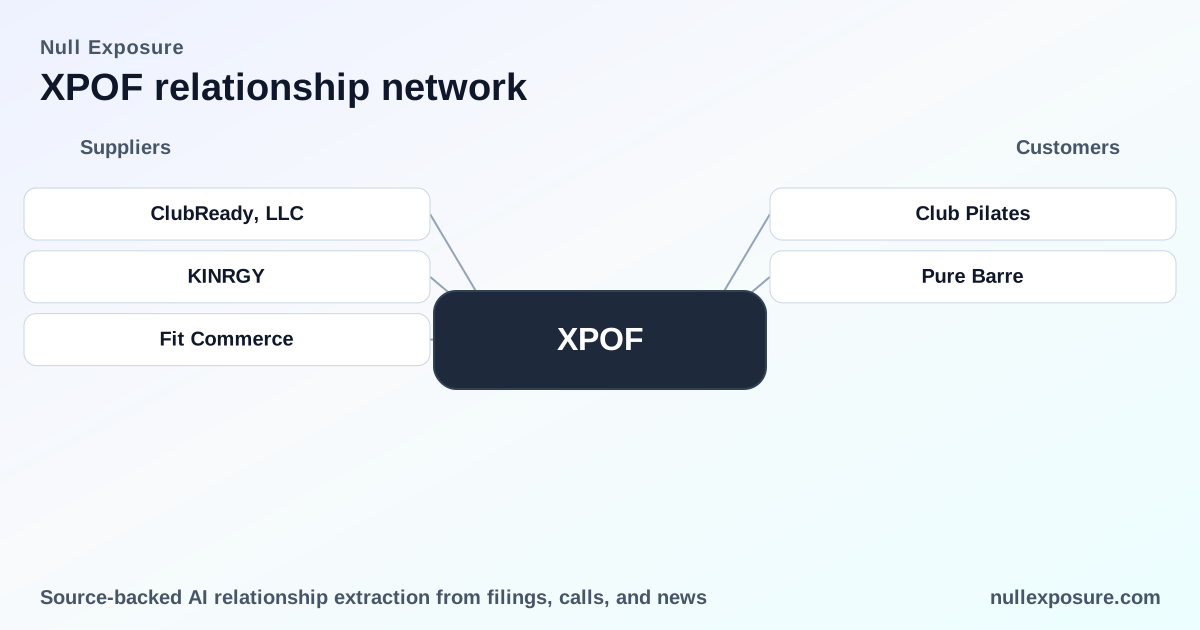
Xponential Fitness (XPOF): Supplier relationships and operational implications for investors
Xponential Fitness operates a franchised portfolio of boutique fitness concepts and monetizes through franchise fees, equipment sales to franchisees, and brand-level services that drive recurring royalty and marketing revenue. The company captures margin by franchising capital-light studios while retaining control over critical studio operations through branded systems, retail offerings, and third-party service contracts. For investors and operators, supplier relationships are central to operating continuity and margin preservation — they determine point-of-sale reliability, retail merchandising economics, and the ability to integrate acquired intellectual property into existing brands. Visit https://nullexposure.com/ for a deeper supplier-risk profile and actionable exposure analysis.
How Xponential runs the business and where suppliers fit in
Xponential scales by licensing brands (Club Pilates, CycleBar, StretchLab, AKT, etc.) to franchisees and then monetizes ancillary sales: proprietary equipment sold to studios, branded retail, and recurring royalties tied to studio revenue. The company outsources specialized functions that are operationally critical — payments, POS, retail merchandising and, increasingly, branded content/IP after targeted acquisitions. That operating posture optimizes capital efficiency but concentrates operational risk in a small set of third parties whose uptime and contractual terms directly affect revenue collection and franchisee satisfaction.
Financial context reinforces this operating model: XPOF reports roughly $315 million in trailing revenue and $91.6 million of EBITDA, with institutional ownership near 98%, which signals investor attention on execution risk and supplier governance. Analyst consensus target sits around $8.55 per share, reflecting expectations that operational leverage and stable supplier performance will determine upside.
Visit https://nullexposure.com/ to review supplier concentration and contractual tenure for investors evaluating XPOF exposure.
The three supplier relationships investors must know
XPOF discloses a small number of supplier and partner relationships with outsized operational impact. Below are plain-English takeaways, each linked to the originating disclosure.
ClubReady, LLC — the core studio systems supplier
Xponential and its North American franchisees rely on ClubReady for point-of-sale processing and multiple studio information systems, making ClubReady integral to payments, membership management and customer data flows. According to XPOF’s FY2024 10‑K, failures or termination of this relationship would materially disrupt studio operations and revenue collection. (Source: Xponential FY2024 10‑K filing.)
KINRGY — intellectual property acquisition and brand extension
Xponential acquired certain KINRGY intellectual property and will rebrand up to three existing AKT studios as KINRGY Studios, integrating dance-cardio IP into its brand suite and expanding content ownership. This move converts a third‑party fitness concept into an owned brand asset to drive studio differentiation and content-led customer retention. (Source: American Spa press release on the partnership, FY2023.)
Fit Commerce — outsourced retail merchandising partner
Xponential entered a Retail Supply Agreement with Fit Commerce to outsource merchandising operations, offloading product assortment, fulfillment and retail execution so corporate can focus on core franchising and studio operations. The contract centralizes branded retail economics and could improve gross margin on retail while shifting execution risk to a specialist vendor. (Source: TradingView summary tied to XPOF SEC 10‑Q disclosures, FY2025.)
Constraints and what they signal about the operating model
XPOF’s supplier footprint highlights several company-level operating characteristics that investors and operators must internalize:
- Contracting posture: long-term facility leases and franchise relationships. The company leases studio facilities under non-cancelable operating leases, signaling long-term fixed-cost commitments that require consistent cash flow from franchised studios to cover occupancy and support services.
- Geographic concentration: North America focus. Supplier excerpts identify North America as the primary operational geography for critical systems and equipment sales, concentrating regulatory, economic and franchise execution risk within that region.
- Critical supplier concentration. XPOF explicitly identifies dependence on a single provider for studio POS and broad information systems (ClubReady), which elevates the operational impact of supplier downtime, contract disputes, or data-security incidents.
- Role diversity: manufacturer and service-provider relationships. XPOF sells equipment sourced from third-party manufacturers to franchisees while simultaneously relying on service providers for enterprise functions; this dual supplier set requires differentiated governance (procurement and SLAs for manufacturers; uptime and data controls for service providers).
- Maturity signal: outsourcing non-core retail and acquiring IP. The Fit Commerce retail agreement and the KINRGY IP purchase signal a shift toward outsourcing execution while selectively verticalizing content that drives brand stickiness.
Where constraints explicitly name a supplier, they can be attributed directly — for example, the FY2024 10‑K names ClubReady as the provider of studio POS and information systems and classifies that relationship as critical to operations.
Investment and operational implications
Operators and investors should treat these supplier facts as actionable signals:
- Operational continuity risk is concentrated. ClubReady’s role as the single, critical studio systems provider creates outsized execution risk; investors should expect material sensitivity to any service disruption and managers should prioritize redundancy planning, contractual SLAs, and disaster recovery.
- Retail economics are being optimized through outsourcing. The Fit Commerce agreement reduces in-house fulfillment friction and could improve retail gross margin, but it transfers dependence to an external vendor; monitoring merchandising KPIs post-transition will be essential.
- IP ownership increases strategic optionality. Acquiring KINRGY IP and converting AKT studios into KINRGY Studios increases control over content monetization and reduces licensing friction, a positive for long-term franchise differentiation and margin capture.
- Balance-sheet and lease commitments demand steady studio cash flow. Long-term leases and franchise economics require disciplined studio openings and retention; any failure in the POS or retail supply chain directly pressures the P&L.
Key actions for investors and operators:
- Demand transparent SLAs and contingency plans for ClubReady-like providers.
- Track retail KPIs closely after Fit Commerce onboarding to confirm margin benefits.
- Evaluate IP integrations for churn and studio-level economics impact.
- Stress-test lease and royalty cash flows under supplier disruption scenarios.
For a detailed supplier-risk scorecard and to model counterparty failure scenarios, visit https://nullexposure.com/ and request an exposure briefing tailored to XPOF.
Bottom line and next steps
Xponential’s franchising model creates scalable revenue streams but concentrates operational leverage in a handful of third parties: ClubReady (critical POS and data systems), Fit Commerce (retail execution) and KINRGY (newly acquired IP for brand expansion). Investors should value the company’s asset-light growth and IP-driven differentiation while pricing in supplier concentration risk and lease commitments that amplify downside in operational disruptions.
Operators should prioritize vendor governance and contingency planning; investors should monitor vendor SLA performance, retail margin trends post-Fit Commerce, and franchise-level metrics as KINRGY integrates. For an investor-grade supplier exposure assessment and contract-tenure analysis, see https://nullexposure.com/ — obtain the structured supplier view that informs position sizing and operational due diligence.