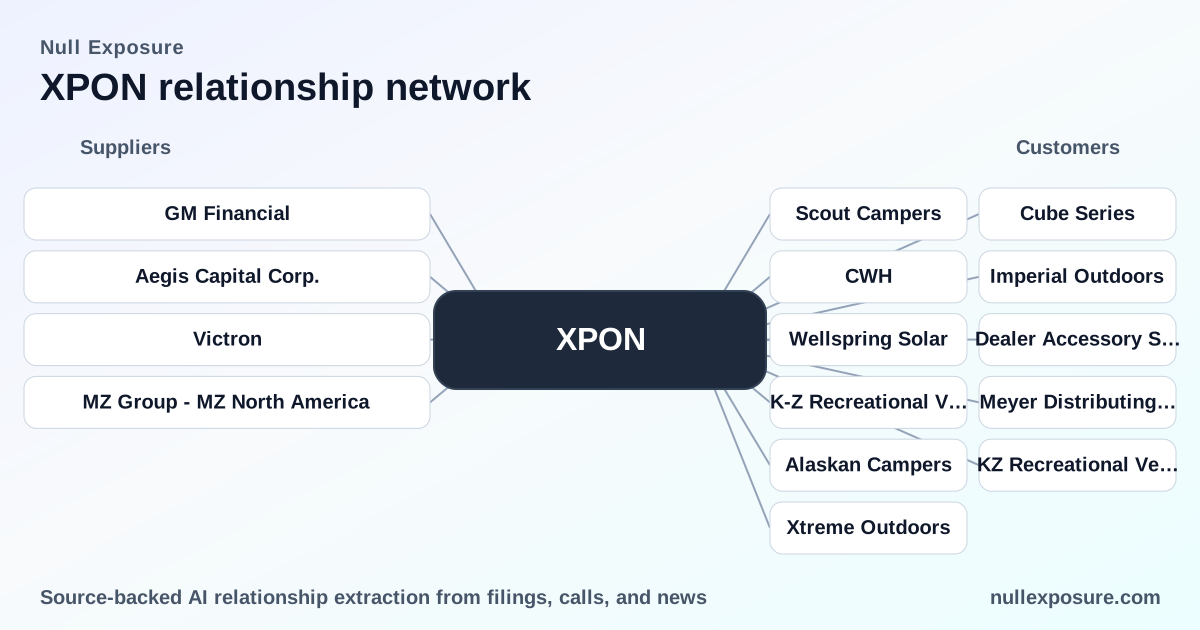
Expion360 (XPON) — supplier relationships and what they mean for investors
Expion360 is a niche battery and energy storage manufacturer that designs, assembles, and sells high-performance lithium-ion systems for RV, marine and off-grid markets. The company monetizes through product sales and system integration services, plus opportunistic equity financing when needed; supplier and financing partnerships therefore directly influence gross margins, inventory cycles and capital structure. For investors, supplier concentration, geographic sourcing and short-term purchasing posture are the primary operational levers that drive near-term margin volatility and execution risk.
If you want a concise supplier-risk snapshot, start at the homepage: https://nullexposure.com/.
Business model snapshot: how supply links to revenue and risk
Expion360 sells complete battery systems and positions itself as a systems integrator—not simply a cell reseller—which allows the company to capture higher per-unit gross profit through hardware, software and assembly services. Revenue is product-driven (Revenue TTM roughly $8.4M per the latest filings) while gross margins are sensitive to raw material and cell costs; management discloses that raw materials account for over half of cost of goods sold, making supplier dynamics a fundamental profit driver.
The company does not maintain long-term purchase contracts with cell manufacturers; purchases are made on a purchase-order basis. That contracting posture compresses fixed commitments but increases exposure to spot-price swings in cells and raw materials. For an investor evaluating XPON supply risk, the most material dimensions are: sourcing geography (Asia plus a European secondary source), supplier role (third-party manufacturers), and the short-term nature of agreements. If you want the full provider map, see https://nullexposure.com/.
All named relationships in public records — what each partner does for XPON
Below are every relationship surfaced in public filings and press releases, presented with a plain-English description and source note.
-
GM Financial — Expion360 carries three notes payable to GM Financial for vehicles as of December 31, 2024, indicating vehicle-related financing obligations on the balance sheet that create an operating liability. This is documented in the company’s FY2024 Form 10‑K.
Source: Expion360 FY2024 Form 10‑K (year ended Dec 31, 2024). -
Aegis Capital Corp. — On December 12, 2025, Expion360 executed an At‑The‑Market (ATM) Issuance Sales Agreement with Aegis Capital as sales agent to offer up to $15 million of common stock, establishing a ready equity financing channel to raise capital as needed. This was disclosed in a company press release reported on The Globe and Mail in FY2025.
Source: Press release reported via The Globe and Mail (Dec 12, 2025). -
Victron — Management stated on the Q2 2025 earnings call that Expion360 is a master Victron distributor and that the company services the entire system sold to customers, not just the battery, which reinforces a distribution and systems-integration relationship with Victron equipment.
Source: Q2 2025 earnings call transcript reported by The Motley Fool (Aug 2025). -
MZ Group – MZ North America — MZ Group is listed repeatedly as Expion360’s external investor-relations firm across multiple FY2025 and FY2026 press releases and corporate announcements, serving as the company’s primary media and investor-relations contact. Multiple press releases and newswire postings in FY2025–FY2026 cite MZ Group contact details.
Sources: Company press releases distributed via The Globe and Mail, QuiverQuant and EnergyDigital/GloBeNewsWire (FY2025–FY2026).
What the supplier constraints signal about operational exposure
Expion360’s supplier profile is defined by several company-level constraints that shape strategic risk and execution:
-
Short-term contracting posture: Purchases are completed on a purchase-order basis with no long-term purchase agreements, which enables flexibility but elevates exposure to cell-price volatility and availability. Evidence for this is in the company’s public filings describing purchase-order purchasing and scaling of order volumes.
-
Geographic sourcing concentrated in Asia with a European secondary: The company confirms manufacturing partnerships in Asia for batteries and cells, while maintaining a secondary European supplier for LFP cells. That geographic split reduces single-region dependency but leaves the company exposed to Asia-centric supply-chain risk and shipping timelines.
-
Raw materials are critical to cost structure: Management estimates raw materials account for more than half of COGS, which makes commodity price movements and supplier bargaining power critical to gross-margin outcomes.
-
Third-party manufacturing relationships are active: The company relies on multiple third‑party manufacturers in Asia to produce cells and assemblies; management reports increasing purchase order volumes and qualifying for volume-based discounts, indicating active supplier engagement but not long-term contracted security.
These constraints are company-level signals drawn from filings and disclosures; they are not attributed to any single named supplier unless specifically stated in the excerpt.
Why these relationships matter to investors
-
Capital flexibility versus margin certainty: The ATM agreement with Aegis establishes a capital-raising backstop that reduces liquidity risk, but reliance on equity dilution is a governance consideration for investors. The MZ Group IR relationship amplifies market messaging and can affect investor access and narrative control.
-
Operational continuity and gross-margin sensitivity: The combination of Asia manufacturing, a European LFP alternate and short-term purchase orders means Expion360 can react to supply disruptions but cannot lock in long-term, low-cost supply. Investors should treat raw-material price exposure and cell availability as the largest near-term risk to reported gross margins.
-
Non-supplier financing and service relationships: Vehicle financing through GM Financial adds modest financed-asset liabilities; distribution relationships such as with Victron are strategically important for market reach and system sales margins.
If you want a deeper supplier-risk dossier or a custom supplier concentration analysis, visit https://nullexposure.com/ to request tailored coverage.
Practical takeaways and actions for investors
- Track procurement disclosures in quarterly reports for changes to purchase‑order volumes and the identity of Asia-based manufacturers; any move toward multi-year supply agreements would reduce execution risk materially.
- Monitor ATM usage and dilution under the Aegis agreement for capital trajectory and shareholder impact; periodic press releases will disclose sales under the facility.
- Watch raw-material pricing and shipping lead times as the primary determinant of short-term margin swings given raw materials represent over half of COGS.
For investors evaluating XPON supplier exposure, the operational story is straightforward: active third‑party manufacturing, Asia-centric sourcing with a European backup, short-term purchase orders, and material raw‑cost sensitivity. These are the levers that will determine whether revenue growth translates into durable profitability.
If you want ongoing alerts and supplier-level updates for Expion360, sign up or explore our coverage at https://nullexposure.com/.