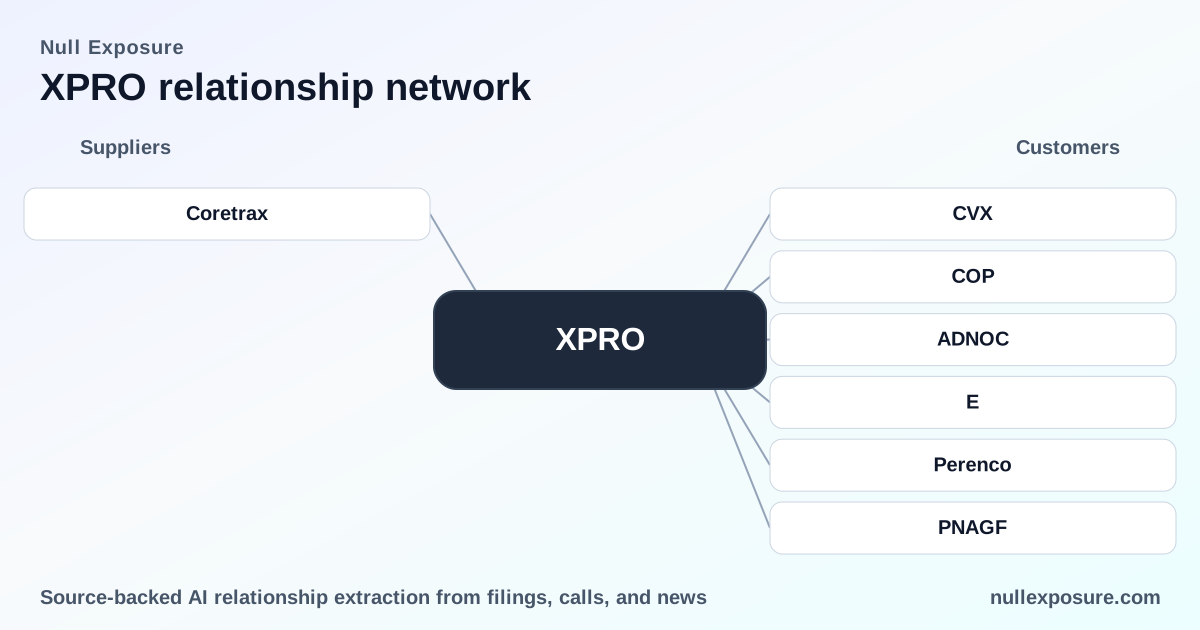
Expro (XPRO) — supplier landscape, strategic takeaways, and what investor-operators should watch
Expro is an energy services supplier that monetizes through equipment sales, field services and technology deployments to upstream oil & gas operators, leveraging both organic product lines and targeted technology acquisitions to expand its addressable market. The company converts capital investment into deployed tools and contracts that generate recurring service revenue and equipment sales, with recent acquisitions and technology rollouts positioned to lift margins and competitive positioning. For investors evaluating supplier relationships, the critical lens is capital intensity, integration of acquired technologies, and the pace at which those technologies convert into higher utilization and EBITDA. Learn more about portfolio monitoring and supplier exposure at https://nullexposure.com/.
How Expro makes money and what that means for partners and investors
Expro’s financial profile shows material scale with capital-intensive operations: trailing revenue of roughly $1.61 billion and EBITDA of $309.6 million, with a market capitalization near $1.87 billion. The company’s operating margin (6.35%) and profit margin (3.22%) reflect an industry-typical compression while recent analyst coverage implies upside (forward P/E ~12.0 vs trailing P/E ~36.6). Quarterly metrics show strain on growth—quarterly revenue down ~12.5% Y/Y and quarterly earnings down ~74.8% Y/Y—signaling cyclical exposure to upstream activity.
Key operating-model characteristics you should treat as company-level signals:
- Capital intensity and equipment orientation. Expro invests heavily in equipment used directly in customer operations; its 2024 capital expenditures were $143.6 million, with roughly 90% allocated to equipment that supports customer activity—evidence the business demands ongoing capex to preserve revenue capacity.
- Contracting posture is equipment-and-service hybrid. Revenue is driven by a mix of discrete equipment sales and contracted services; this results in episodic revenue tied to drilling and intervention cycles as well as recurring revenue where service agreements are in place.
- Concentration and criticality. The company supplies specialized tools that are critical to well operations; customers treat Expro’s technologies as operational enablers, which supports pricing power when utilization is high but also concentrates demand risk.
- Maturity and margin trajectory. Expro operates in a mature segment of oilfield services where margin gains are incremental and often driven by scale, technology rollouts, and improved fleet utilization.
These company-level signals should inform counterparty diligence: verify contract duration, replacement cadence for deployed equipment, and the extent to which new technologies are embedded into customer operating procedures. For further supplier intelligence and exposure scoring visit https://nullexposure.com/.
Coretrax: the single explicit supplier relationship in scope
Expro’s public news flow records an operational relationship with Coretrax in FY2026. According to a March 10, 2026 item, Expro expanded technologies acquired from Coretrax into 31 countries and deployed the XRD Spider, a tool the company highlights as improving operational efficiency and expected to drive EBITDA margin improvements (news report on Intellectia, 2026: https://intellectia.ai/news/stock/expro-launches-innovative-solus-single-valve-system). This is a product-integration relationship where Coretrax-originated technology is being scaled internationally under Expro’s commercial engine.
Implication in plain terms: Expro is not just acquiring intellectual property; it is commercializing and geographically scaling Coretrax technologies in service of margin expansion and competitive differentiation. The rollout across 31 countries signals a deliberate push to monetize the acquisition via existing sales and field-service channels.
What the Coretrax tie means for operational strategy
The Coretrax integration is a tactical lever for improving fleet efficiency and increasing EBITDA per deployed asset. The combination of capital deployment (equipment purchases and manufacture) and targeted tech rollouts means Expro’s returns will be driven by utilization uplift and successful integration into customers’ operating cycles. Investors should treat technology acquisitions as strategic multiplier events only if adoption is measurable and repeatable across geographies.
Monitor these KPIs to validate the strategy:
- Rate of international deployments and corresponding utilization increases.
- Realized margin movement at the product line level post-integration.
- Replacement/upgrade cadence tied to the company’s capex program.
Constraints and what they signal about Expro’s supplier posture
Expro’s public disclosures place it solidly in a high spend-band. The company reported total capital expenditures of $143.6 million for the year ended December 31, 2024, with approximately 90% used for the purchase or manufacture of equipment that directly supports customer-related activities (company filing, 2024). This is a company-level constraint that signals annual capital commitment above $100 million, reinforcing that Expro is a supplier whose scale and competitive position are dependent on continuous capital deployment and equipment availability.
From an investor-operator perspective, that constraint implies:
- Capital replacement risk—equipment-intensive suppliers require consistent reinvestment to sustain revenue.
- Supplier criticality—partners dependent on Expro-provided tools are exposed to its maintenance and manufacturing cycles.
- Operational leverage—successful deployment of acquired technologies can move the margin needle, but it requires tangible capex and field integration.
Risk profile and monitoring checklist for investors
Expro’s strengths are balanced by sector risks and short-term growth headwinds. Key risk factors:
- Cyclical oil & gas demand and rig activity that directly impact utilization.
- Recent negative quarterly revenue and earnings growth, which increases sensitivity to oilfield activity recovery.
- Reliance on successful technology commercialization to convert acquisitions into meaningful margin improvement.
Checklist to track every quarter:
- Utilization rates by product and geography.
- Capex run-rate versus stated equipment deployment targets.
- Revenue contribution and margin delta attributable to Coretrax-originated products.
- Contract mix changes—length and terms of service agreements versus spot sales.
Bottom line and next steps
Expro is a capital-intensive energy services supplier executing a strategy that combines equipment manufacture, global service delivery, and targeted technology rollouts such as the Coretrax integration. The company’s scale and capex commitment are strengths for long-term competitiveness; the near-term investment case turns on successful adoption of new tools and recovery in upstream activity. For a deeper look at exposure across suppliers and to benchmark Expro against peers, visit https://nullexposure.com/.
If you manage counterparty risk or allocate capital to energy services, prioritize verification of deployment metrics and capex execution tied to technology rollouts; detailed supplier dashboards are available at https://nullexposure.com/.