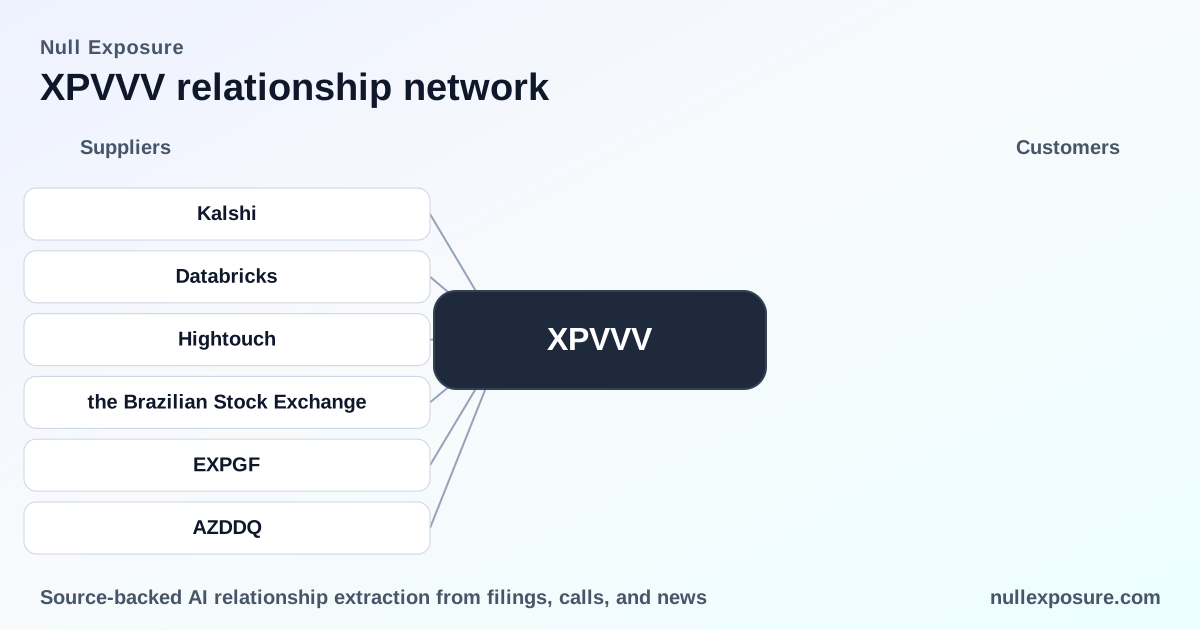
XPVVV: The supplier map that underwrites XP Inc.’s product expansion
XP Inc. operates a multi-vertical financial marketplace in Brazil, monetizing through brokerage commissions, asset-management and advisory fees, product distribution, and client-relationship services delivered at scale. Its commercial model pushes product innovation outward through partnerships while centralizing data, cloud, and execution capability—creating recurring revenue leverage from both retail and institutional flows. Investors should view XP’s supplier relationships as strategic extensions of distribution, data, and cloud infrastructure rather than incidental vendor contracts.
Explore deeper supplier intelligence at https://nullexposure.com/.
How XP is stitching partners into a scalable product engine
XP’s recent public disclosures show a clear operating posture: platform-first, cloud-native, and partnership-driven. The company outsources specialized technical capability (data platform, activation tooling, cloud capacity) while keeping distribution and regulatory engagement in-house. That contracting posture amplifies speed to market for new products but concentrates operational criticality on a small set of enterprise providers.
- Concentration and criticality: Reliance on major platforms like Databricks and Azure signals an enterprise-grade stack where uptime and data governance are mission-critical.
- Outsourced specialization: Partnerships for new product categories (prediction markets via Kalshi) shift product design and risk management to third parties while XP retains client relationships and local regulatory control.
- Data and activation maturity: The presence of second-party data vendors and activation tools points to a sophisticated martech and AI pipeline used to convert insights into client-level engagement.
Learn more about how these supplier signals affect counterparty risk at https://nullexposure.com/.
Supplier map: what each relationship contributes (concise takeaways)
Kalshi — new product distribution partner
XP International will distribute Kalshi’s regulated prediction-market contracts in Brazil, handling local distribution, client relationships, and regulatory interfaces while Kalshi supplies trading technology and risk-management design. Source: multiple press reports on the March 2026 partnership (Finance Magnates, GamingIntelligence, Neofeed, Next.io).
Databricks — the data science and governance foundation
XP selected Databricks as the core platform for data science and governance, enabling development of advanced machine-learning models with built-in security and model management. Source: Databricks customer page for XP Inc. (Mar 2026).
Hightouch — activation of model outputs to ad platforms
XP uses Hightouch to push predicted investment signals from its models to advertising and activation platforms, closing the loop between analytics and client acquisition. Source: Databricks customer description of XP’s stack (Mar 2026).
The Brazilian Stock Exchange — second-party market data for models
XP plans to ingest second-party data from the Brazilian Stock Exchange to enhance AI models, indicating direct market-data partnerships to improve signal quality. Source: Databricks customer page referencing partner data sources (Mar 2026).
Experian — credit and consumer data augmentation
XP will incorporate Experian second-party data to enrich customer models and underwriting/targeting workflows, demonstrating reliance on established consumer-data vendors. Source: Databricks customer page (FY2026).
Azure — cloud infrastructure provider
Azure is listed as XP’s Platform Cloud, representing the underlying compute and hosting layer for its analytics and distribution systems. Source: Databricks customer page noting “Platform Cloud : Azure” (Mar 2026).
What these relationships tell investors about XP’s operating model
XP’s supplier set is compact and strategic: a cloud backbone (Azure), a unified data and ML platform (Databricks), ad/activation tooling (Hightouch), data partners (Experian, B3), and an external specialist for a new asset class (Kalshi). That structure delivers rapid product rollout capability while concentrating operational and reputational risk in a few third parties.
Key business-model characteristics:
- Contracting posture: XP centralizes customer-facing and regulatory functions while outsourcing specialized infrastructure and product-engine components—this is a deliberate, scalable trade-off that reduces time-to-market for new products.
- Concentration risk: A small number of tier-one suppliers underwrite core capabilities; service interruptions or contractual disputes with those suppliers would have outsized effects on model training, customer engagement, and cloud compute.
- Strategic criticality: Partners like Databricks and Azure are mission-critical for analytics and uptime; Kalshi is strategically critical for distribution of a new product line but operationally isolated.
- Maturity signals: Use of second-party data, Delta Sharing and clean-room references indicates advanced data-governance practices and mature model-deployment processes.
Investment and operational implications — be precise about the risks and levers
- Opportunity: The Kalshi partnership opens a new retail product sleeve that can monetize XP’s large client base and distribution reach without heavy tech build from XP, improving revenue diversification. Source: Kalshi–XP press coverage (Mar 2026).
- Execution risk: Data-platform and cloud dependency create single points of failure; investors should track SLAs, contractual terms, and any regulatory limitations on cross-border data flows. Source: Databricks and Azure platform references (Mar 2026).
- Regulatory and reputational vectors: Distributing a novel product like prediction markets elevates regulatory oversight and reputational exposure; XP’s decision to house local regulatory interactions mitigates but does not eliminate that risk. Source: Finance Magnates explanation of role split with Kalshi (Mar 2026).
- Commercial leverage: Hightouch and second-party data partnerships show XP is focused on conversion efficiency—improving customer acquisition economics and lifetime value. Source: Databricks customer narrative (Mar 2026).
If you want a supplier-risk brief tailored to XP’s cloud and data stack, examine contract concentration and recovery playbooks at https://nullexposure.com/.
Tactical recommendations for investors and operators
- Request disclosure on vendor SLAs, termination clauses, and data residency arrangements for Databricks and Azure. These contracts determine real operational resilience.
- Monitor regulatory dialogue and market uptake metrics for the Kalshi product rollout; the early adoption curve will define revenue contribution and reputational trajectory.
- Validate data-governance controls and partner-access logs for second-party data ingestion from Experian and the Brazilian Stock Exchange to confirm model integrity and compliance.
For a structured supplier due-diligence checklist and ongoing monitoring, visit https://nullexposure.com/.
Bottom line
XP’s supplier footprint reflects a clear strategic thesis: keep distribution and regulatory control, outsource specialized tech and product engineering to best-in-class partners, and use second-party data to refine monetization. This setup accelerates product delivery and commercialization while concentrating operational risk in a handful of suppliers—an attractive trade for growth investors so long as contractual protections and resiliency practices are strong. Investors should prioritize transparency around vendor contracts, SLAs, and regulatory contingency planning as the company rolls new products into market.