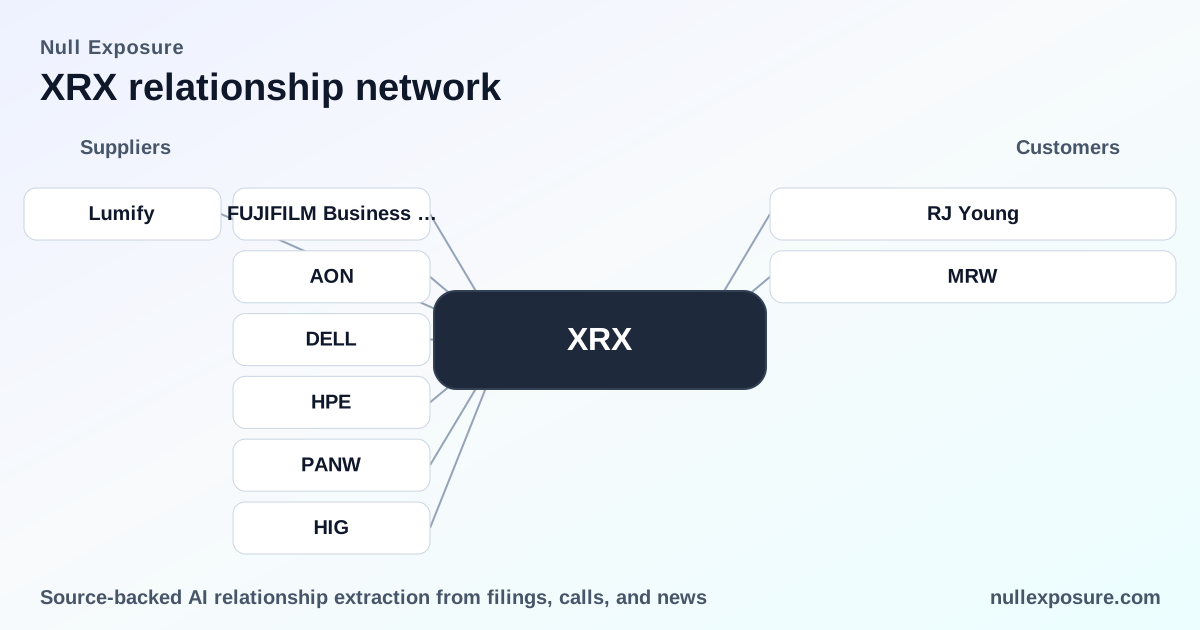
Xerox (XRX) supplier map: what investors need to know now
Xerox is a workplace-technology company that generates revenue through device sales, consumables and growing managed/consumption services, while relying on a mix of large OEM suppliers, channel partners and third‑party service providers to assemble and operate its solutions. For investors, the critical read-through is not just revenue trends but supplier concentration, contracting posture and how third‑party relationships support Xerox’s shift to software and consumption models. Learn more about supplier risk and coverage at https://nullexposure.com/.
Quick operational thesis
Xerox monetizes through three interlocking streams: hardware and parts sales, recurring consumables and service/managed offerings. That business model places outsized importance on a handful of suppliers for parts and on external technology and insurance providers for risk management and platform delivery—so supplier concentration, short payment terms and outsourced services are direct drivers of margin volatility and operational risk.
Who Xerox buys from — concise relationship notes
Below are every supplier relationship flagged in public filings and recent disclosures, summarized in plain English with source context.
FUJIFILM Business Innovation Corp.
Xerox purchased large volumes of parts and supplies from FUJIFILM, totaling $886 million in 2024, $933 million in 2023 and $1,175 million in 2022, indicating a material procurement relationship and concentration in consumables and parts supply. This figure comes from Xerox’s FY2024 Form 10‑K disclosure.
Aon
Aon is referenced as the broker in connection with Xerox’s cyber insurance arrangements, implying Xerox uses Aon for placement and risk transfer services. This detail was mentioned on Xerox’s 2025 Q4 earnings call and reiterated in subsequent media coverage of the call.
Dell
Xerox referenced Dell’s Apex devices and service models as part of its technology stack, signaling use of Dell hardware and consumption-based service options to support Xerox’s IT and customer solutions. This came up during the 2025 Q4 earnings call.
HPE (Hewlett Packard Enterprise)
Xerox noted movement toward consumption models such as HPE GreenLake, reflecting adoption of HPE’s managed/consumption platform for on‑premise and hybrid infrastructure needs. This supplier mention was disclosed on the 2025 Q4 earnings call.
Palo Alto Networks
Xerox cited Palo Alto Networks for advanced detection technology and continuous monitoring—an explicit relationship that supports Xerox’s cybersecurity posture and managed security capabilities. The reference appears in the 2025 Q4 earnings call and in a subsequent news transcript covering that call.
The Hartford
The Hartford provides cyber insurance coverage to Xerox, a risk‑transfer layer that complements active security controls and is brokered through Aon according to comments on the 2025 Q4 earnings call and related press coverage.
Lumify
Xerox disclosed a relationship with Lumify for cyber response services and SOC (security operations center) support, indicating an outsourced incident‑response capability layered on top of Palo Alto’s detection tools. This was mentioned in post‑call reporting on the Q4 2025 earnings transcript.
(Each of the above relationships is documented in Xerox public disclosures: the FUJIFILM amounts were stated in the FY2024 10‑K; the technology, insurance and security partners were discussed on the company’s Q4 2025 earnings call and covered in media transcripts of that call.)
What the constraints tell investors about Xerox’s operating model
Xerox’s supplier disclosures and related constraint signals create a coherent operational picture:
- High spend concentration: The FY2024 10‑K explicitly shows Fujifilm supply spend in the hundreds of millions annually—this is a clear concentration risk that affects parts availability and COGS volatility.
- Short-term contracting posture: Xerox references billing and payment terms that require payment within 45 days after statements in some commercial arrangements, signalling a short-term pay/credit cycle in parts of its working capital and financing footprint.
- Hybrid vendor roles: Company statements that it “works with various manufacturing and distribution partners” register as combined manufacturer/distributor relationships—Xerox’s supply chain blends in‑market distribution with outsourced manufacturing inputs.
- Outsourced service model and maturity: Xerox has offshored and outsourced functions (naming examples such as TCS and HCL), indicating mature use of third‑party service providers for non‑core operations and a strategic tilt toward outsourcing to reduce fixed costs.
- Security and insurance as layered defenses: Multiple vendor links (Palo Alto Networks, Lumify, The Hartford, Aon) show Xerox treats cybersecurity as a combination of technology, managed SOC services and insurance coverage rather than an internal-only capability.
Together these constraints depict a company operating with material supplier concentration, short-term supplier/payment exposures, and a mature outsourcing posture that reduces fixed cost but increases third‑party dependency.
Investor implications — risks and opportunities
- Concentration risk is tangible and measurable. The Fujifilm spend bands make parts/supplies a potentially single‑point pressure on margins if negotiations or supply disruptions occur. Monitor supplier diversification or contingency inventory strategies.
- Working capital and supplier financing matter. Short payment windows and invoice financing practices can compress cash flow and increase financing costs when demand or margins deteriorate.
- Security ecosystem reduces pure internal capital burden but increases operational interdependence. Reliance on Palo Alto, Lumify and a brokered Hartford policy via Aon creates a layered defense but also aggregates cyber-risk management outside core operations, which investors should assess against incident readiness and insurance terms.
- Shift to consumption models creates revenue predictability but changes supplier dynamics. Partnerships with Dell and HPE for consumption offerings show Xerox is aligning product delivery to recurring revenue models; this reduces transactional revenue but increases dependence on vendor platforms and contract terms.
If you want a deeper supplier risk profile or a consolidated supplier concentration report, visit https://nullexposure.com/ to request tailored analysis.
How operators and investors should act
- For operators: prioritize supplier diversification for critical parts, and negotiate longer-term terms or contingency supply agreements with major suppliers like Fujifilm.
- For investors: track supplier spend disclosures and any signs of renegotiation in future 10‑K/10‑Q filings and listen closely to earnings‑call language around parts availability and insurance coverage.
- For analysts: integrate supplier concentration and outsourcing signals into stress scenarios for margins, working capital and incident response costs.
For ongoing coverage and supplier‑level screening tools, explore services at https://nullexposure.com/.
Final takeaway
Xerox runs a capital‑light delivery model supported by concentrated parts procurement, outsourced service providers, and a layered cybersecurity/insurance stack. That structure reduces fixed costs and supports the company’s shift to managed and consumption offerings, but it also creates supplier concentration and short‑term contracting risks that directly impact margins and operational resilience. For continued monitoring, visit https://nullexposure.com/ and subscribe to supplier concentration updates.