XTNT: Supplier relationships, operating posture, and what investors need to know
Xtant Medical Holdings monetizes by selling regenerative-medicine implants and surgical biologics to orthopedic and neurological surgeons, while expanding vertical control through targeted acquisitions of production assets and complementary hardware businesses. The company earns product margin on distributed implants and recurring consumables, and extracts incremental EBITDA through integration of acquired inventory and manufacturing operations. For investors evaluating supplier risk and partner exposure, Xtant’s model is acquisition-led manufacturing plus clinical distribution, not a pure distributor, and that distinction drives counterparty criticality and contractual posture. For a deeper supplier-risk view, visit Null Exposure.
How Xtant runs the supply chain and why it matters to returns
Xtant operates as a hybrid manufacturer/distributor: it sources biologics and allografts, integrates outsourced manufacturing where strategic, and sells finished systems and implants into hospitals and ASC channels. Revenue is a function of procedure volumes, product mix (hardware versus biologics), and the company’s ability to internalize production costs through acquisitions. That operating posture produces higher gross margins when integration succeeds and greater operational leverage — and it concentrates risk where supplier continuity or acquired assets are material.
Key commercial characteristics investors should internalize:
- Contracting posture: Xtant negotiates both supplier purchases and asset acquisitions; the business assumes specified liabilities in asset deals, signaling readiness to carry transitional risk through M&A (company disclosures on Surgalign Holdings show assumed liabilities tied to an asset purchase).
- Concentration and criticality: The company relies on a limited set of biologics and hardware suppliers; supplier disruptions translate quickly into product flow constraints and revenue variability.
- Maturity and integration risk: Recent acquisitions — transfer of production operations and hardware businesses — indicate a transition from pure distribution toward integrated manufacturing, carrying one-time integration costs and inventory accounting effects that influence adjusted EBITDA.
A company-level signal from the filings: audit-related fees reported at roughly $764k place certain external spend lines in the $100k–$1M band, consistent with a mid-sized, transaction-active healthcare supplier with significant external professional-service use.
Explore supplier analytics and deal-level implications at Null Exposure for a structured diligence playbook.
Supplier and transaction map: concrete relationships investors must price
This section covers each supplier or transaction referenced in Xtant’s public materials. Each entry includes a plain-English takeaway and a concise source citation.
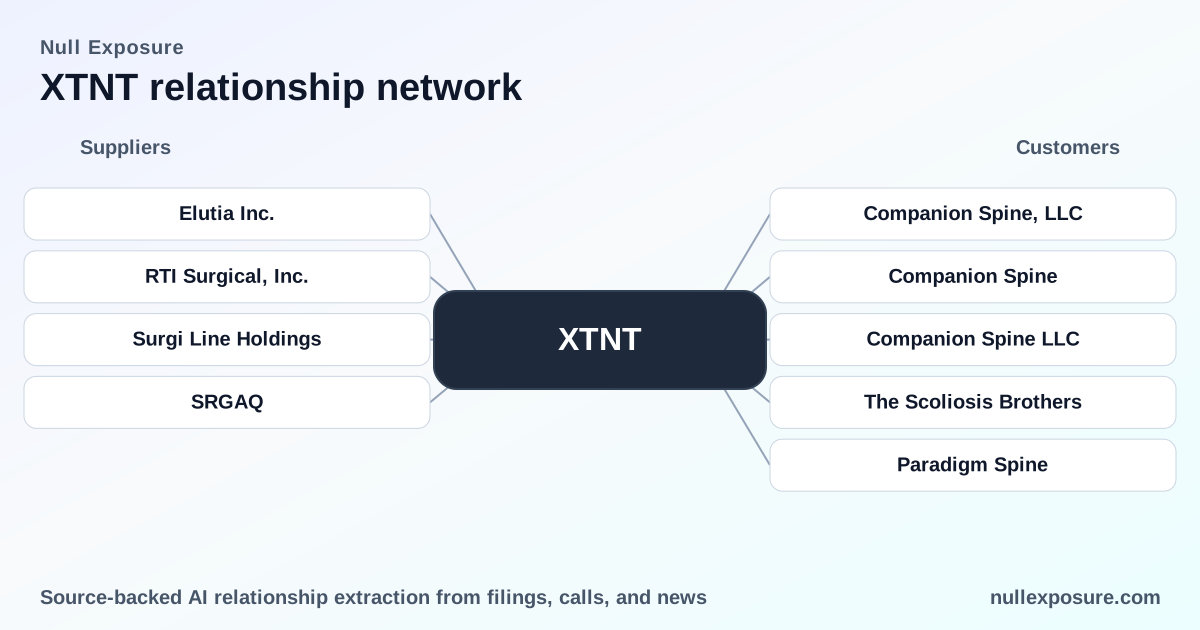
Elutia Inc.
Elutia, formerly Aziyo Biologics, was a key supplier of viable bone matrix stem cells until July 2023, when the vendor voluntarily recalled its viable bone matrix products and suspended shipments across donor lots; that event created an upstream supply interruption for Xtant’s biologics offerings. Source: Xtant 2024 Form 10‑K (FY2024) detailing supplier recall and shipment suspension.
RTI Surgical, Inc.
Xtant acquired the nanOss production operations from RTI Surgical on October 23, 2023, bringing a previously outsourced production line in-house and signaling a move to internalize manufacturing for that product family. Source: Xtant 2024 Form 10‑K (disclosure of the October 23, 2023 acquisition).
Surgi Line Holdings
Beginning in 2024, Xtant changed its adjusted-EBITDA treatment to stop excluding the phased bargain purchase gain related to inventory sell-through from the Surgi Line Holdings hardware and biologics acquisition, indicating that the accounting impact of that purchase now flows through adjusted operational metrics. Source: Q3 2025 earnings call transcript reported by InsiderMonkey (FY2025 commentary on adjusted EBITDA treatment).
Surgalign Holdings / Surgalign
Xtant purchased substantially all of Surgalign’s hardware and biologics business in a $5 million transaction and, as part of the asset purchase agreement dated June 18, 2023, assumed specified liabilities, reflecting a willingness to accept legacy operational obligations as part of strategic consolidation. Source: Xtant 2024 Form 10‑K (asset purchase agreement disclosures) and a RadiologyBusiness report (2023 news on Surgalign's sale of hardware and biologics business).
What these relationships signal about operational risk and opportunity
The combination of a supplier recall (Elutia), targeted acquisitions of production operations (RTI’s nanOss), and asset purchases that transfer liabilities (Surgalign and Surgi Line) produces a clear operating pattern: Xtant is building supply-chain control through acquisition while accepting transitional liabilities that compress near-term free cash flow and complicate adjusted-EBITDA comparability. Investors should price three linked effects into valuation models:
- Revenue smoothing risk from supplier concentration: a supplier recall for a biologics input directly impacts near-term sell-through and can depress realized revenue until fill-in supply or internal production ramps.
- Integration and accounting volatility: the firm’s change in adjusted-EBITDA treatment for Surgi Line inventory and acquisition accounting for Surgalign reveal that earnings metrics will reflect one-time and phasing effects for multiple quarters.
- Upside from verticalization: acquiring production operations (nanOss) is a structural margin opportunity if Xtant realizes manufacturing cost reductions and reduces third-party dependence.
For prioritized due diligence, focus on inventory aging and purchase accounting notes, manufacturing ramp timelines for nanOss, and counterparty continuity plans for biologics inputs.
For more structured supplier exposure intelligence and contract templates for buyer protections, visit Null Exposure.
Investment implications and risk checklist
- Operational leverage is increasing. Integration of production assets will magnify margins when utilization rises; expect higher margin volatility during the transition window.
- Supplier concentration is a near-term risk. The Elutia recall is an explicit example of supplier-criticality; contingency sourcing and inventory buffers matter materially for quarterly revenue stability.
- Accounting and EBITDA comparability require scrutiny. Adjusted EBITDA excludes or includes bargain purchase gains differently over time; focus on cash flow, not adjusted metrics, to assess underlying performance.
- Contract risk is explicit. Asset purchases that include assumed liabilities transfer legacy exposures to Xtant; that is a strategic choice that reduces purchase price but increases operational obligation.
Bottom line and next steps
Xtant is executing a clear strategy: shrink reliance on third-party production through acquisitions while accepting transitional liabilities and short-term accounting noise. That creates a profile of higher operational leverage with concentrated supplier risk that is resolvable if manufacturing integration succeeds.
If you are evaluating XTNT as a supplier counterparty or an investment, prioritize verification of manufacturing ramp plans, inventory accounting schedules, and contingency supply arrangements. For curated supplier-risk intelligence and acquisition impact modeling, return to Null Exposure for detailed templates and vendor maps.