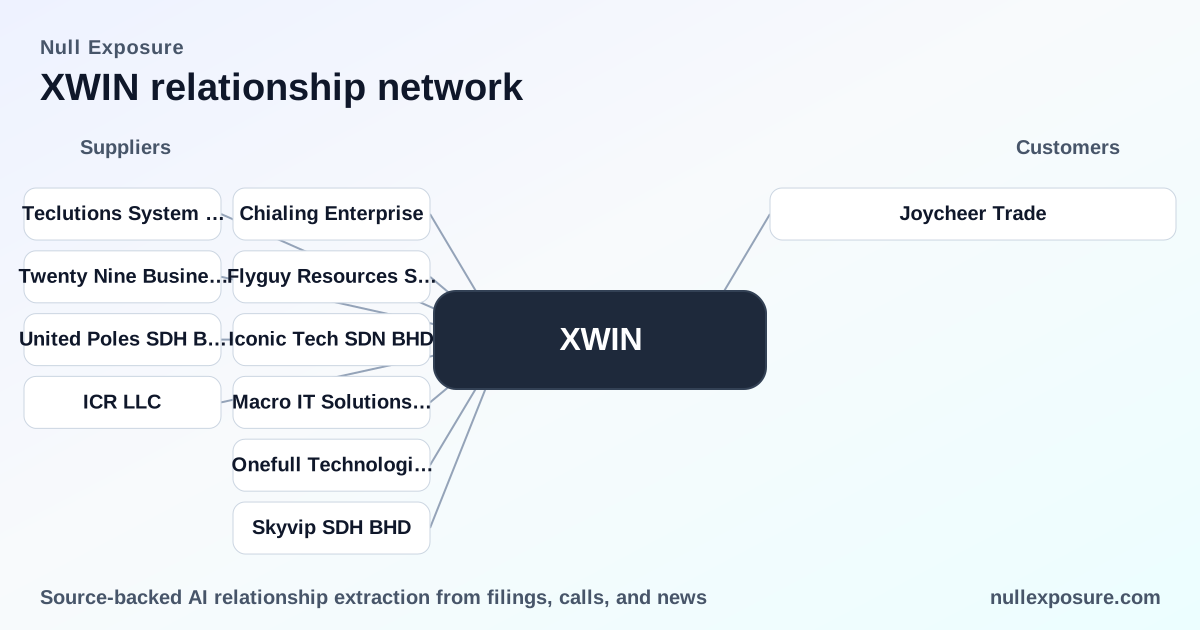
XMax Inc. (XWIN) — Supplier footprint, contract posture, and what the FY2024 filings mean for investors
XMax Inc. sells residential and commercial furniture and related digital services to middle and upper-middle income customers; the business model monetizes through product sales of finished goods sourced from third‑party manufacturers and through software/consulting offerings tied to its Nova Living DesignXperience platform. The FY2024 disclosures show a supplier network built around discrete slab and stone purchases in APAC, short duration sourcing arrangements, and measurable advances to vendors — a procurement profile that drives working capital needs and operational risk that investors should price into valuation and liquidity planning. For a consolidated view of supplier exposures and further supplier-mapping tools, visit https://nullexposure.com/.
How XMax sources and pays: the operating model in plain terms
XMax outsources finished‑goods production and certain services rather than vertically integrate manufacturing. The FY2024 10‑K states finished goods are sourced from third‑party manufacturers, with typical receipt lead times of four to six months and third‑party manufacturing contracts generally annual or shorter in duration. That contracting posture produces two structural characteristics: short‑term supplier commitments that limit long‑term price protection, and working capital pressure reflected in multi‑million dollar supplier advances. The company also purchases software/IT services for its Nova Living platform under time‑limited consulting agreements, which creates recurring but discrete service expenses rather than capitalized platform ownership.
For analysts and operators evaluating counterparty risk, these are actionable signals: short contract terms increase supplier flexibility but transfer inventory and timing risk back to XMax; APAC concentration compresses the supplier base geographically; and advances to suppliers represent locked capital that impacts liquidity. Learn more about supplier relationship analytics at https://nullexposure.com/.
Vendor-by-vendor: disclosures investors should read
Below are every supplier or relationship disclosed in the FY2024 filings and associated news items, summarized directly from XMax filings and public reporting.
- Chialing Enterprise — Nova Samoa will purchase Light Transmitting Slate Stone from Chialing for $825,000, disclosed in XMax’s FY2024 10‑K as a contractual purchase arrangement. (FY2024 10‑K)
- Flyguy Resources Sdn Bhd — Nova Samoa will purchase Transparent Marble Slabs from Flyguy Resources for $810,000, reported as a vendor purchase in the FY2024 Form 10‑K. (FY2024 10‑K)
- Iconic Tech SDN BHD — Nova Samoa will purchase Background Light Slabs from Iconic Tech for $945,000, listed among material purchases in the FY2024 10‑K. (FY2024 10‑K)
- Macro IT Solutions SDH BHD — Nova Samoa will purchase Ultrathinstone from Macro IT Solutions for $813,750, disclosed as a procurement commitment in the FY2024 10‑K. (FY2024 10‑K)
- Onefull Technologies SDN. BHD. — Nova Samoa will purchase Porcelin Slabs from Onefull Technologies for $925,000, specified in the FY2024 10‑K vendor schedule. (FY2024 10‑K)
- Skyvip SDH BHD — Nova Samoa will purchase Transparent Marble Slabs from Skyvip for $900,000, recorded in the FY2024 10‑K. (FY2024 10‑K)
- Teclutions System SDN. BHD. — Nova Samoa will purchase Light Transmitting Slate Stone from Teclutions for $940,000, included among FY2024 supplier commitments in the 10‑K. (FY2024 10‑K)
- Twenty Nine Business Solutions Sdn. — Nova Samoa will purchase Background Light Slabs from Twenty Nine Business for $742,500, disclosed in the FY2024 10‑K. (FY2024 10‑K)
- United Poles SDH BHD — Nova Samoa will purchase Ultrathinstone from United Poles for $940,000, listed as a purchase commitment in the FY2024 10‑K. (FY2024 10‑K)
- ICR LLC — Identified as the investor relations contact in press coverage of XMax’s FY2025 convertible promissory note transaction, referenced in a QuiverQuant news item covering the $5 million convertible note agreement. (QuiverQuant news report on FY2025 transaction)
Each of these entries is taken directly from the FY2024 Form 10‑K or associated news reporting and represents the full set of supplier and contact disclosures in the supplied results.
What these relationships reveal about concentration and spend
The disclosed vendor invoices cluster in the $742k–$945k range per contract, which signals a repeatable per‑order spend band consistent with the company's constraint classification of suppliers in the $100k–$1m band. Separately, the 10‑K reports advances to suppliers totaling $4,689,148 as of December 31, 2024, which is an explicit working capital commitment that investors must treat as non‑cash collateral for future inventory receipts. The filings also note the majority of purchases come from Asia, establishing a clear geographic concentration that creates exposure to logistics, tariff, and currency volatility.
Operational constraints that matter to valuation
- Contract length and flexibility: Contracts are typically annual or shorter with goods received within four to six months, producing recurring procurement cycles and limited long‑term price protection. This contracting posture requires active supply chain management and elevates the importance of vendor continuity for product flow.
- Role of suppliers: The company classifies many counterparties as manufacturers and service providers; XMax relies on third‑party producers for finished goods and on consultants for IT/system maintenance tied to its Nova Living DesignXperience. That mix reduces fixed capital intensity but increases vendor criticality.
- Spend and liquidity profile: The presence of supplier advances and mid‑six‑figure purchase commitments demonstrates material working capital absorption and coordination risk across multiple vendors rather than a single dominant supplier.
- Maturity and activity: Multiple one‑year service agreements and recorded consulting fees in FY2024 show an active, short‑term supplier ecosystem rather than long‑dated strategic partnerships.
These constraints combine into a predictable risk vector: short-term, APAC‑centered manufacturing relationships that elevate working capital and operational risk, which should be reflected in cost of capital assumptions and scenario stress tests.
Investment implications and risk checklist
For investors and operators, the FY2024 supplier disclosures produce a concise checklist:
- Liquidity sensitivity — advances to suppliers are material; maintain scenario plans for extended lead times.
- Geographic concentration — APAC sourcing concentrates exposure to regional supply shocks and logistics costs.
- Contract flexibility vs. price volatility — short contract terms allow renegotiation but provide limited protection against input cost inflation.
- Operational dependency — reliance on third‑party manufacturers requires strong vendor oversight and contingency sourcing.
If you need a deeper counterparty map or a consolidated exposure report, start with high‑quality supplier intelligence and working capital stress testing at https://nullexposure.com/.
Bottom line and next steps
XMax’s FY2024 disclosures present a clear procurement pattern: mid‑range per‑order supplier commitments, APAC concentration, short contract durations, and meaningful supplier advances that tie up cash. Those characteristics define where operational execution and liquidity discipline become the central drivers of near‑term investor returns. For portfolio managers and supply‑chain teams, the immediate priorities are stress‑testing working capital, validating alternate sourcing, and tracking vendor payment terms against inventory receipt windows.
To commission a tailored supplier exposure brief or to integrate these supplier signals into valuation models, visit our home page and request a demo at https://nullexposure.com/.