22nd Century Group (XXII): Supplier relationships, distribution push, and what it means for investors
22nd Century Group operates at the intersection of engineered tobacco and consumer packaged goods: the company designs and grows reduced-nicotine tobacco and commercializes smokeable and smokeless tobacco products, while expanding into hemp and cannabis channels to broaden addressable markets. XXII monetizes through product sales and licensing of its plant genetics and proprietary agronomy, with distribution relationships that convert its R&D into retail revenue. For investors, the thesis is straightforward: commercial traction in retail and controlled supply contracts are the levers that convert XXII’s science-driven IP into recurring revenue, and recent distribution moves materially change near-term revenue scale and retail availability.
Explore supplier and distribution data at https://nullexposure.com/ for deeper due diligence.
What XXII actually sells and how the business makes money
22nd Century sells two related things: agricultural outputs (low‑nicotine tobacco leaf and seed genetics) and branded consumer products (smokeable and smokeless tobacco under controlled formulations, plus entry products for hemp/cannabis markets). Revenue derives from direct product sales to wholesalers and retail chains and from licensing or contract-grown arrangements for proprietary plant traits. The firm’s most important operating characteristics are its contracting posture with growers and retail distribution partnerships that determine inventory flow and shelf presence.
Financial snapshot that shapes commercial risk: XXII reports TTM revenue of $20.3M and a negative EBITDA of $11.8M, reflecting investment in commercialization and limited scale, while market capitalization is in the low millions and institutional ownership is low. These metrics make distribution relationships and supplier contracts disproportionately important to near-term performance.
Visit https://nullexposure.com/ for supplier-level analytics and relationship monitoring.
Recent commercial relationship: national roll of Pinnacle VLN and moist snuff
A GlobeNewswire press release carried on QuiverQuant on March 10, 2026 reports a national retail rollout: 22nd Century is launching new Pinnacle VLN (very low nicotine) and moist snuff products across approximately 1,700 stores in 27 U.S. states, aimed at driving consumer trial and shelf penetration. This move signals a tactical shift from pilot deployments to broader retail presence and should increase near-term top-line visibility as distribution ramps. (Source: GlobeNewswire press release distributed via QuiverQuant, March 10, 2026.)
How suppliers and growers fit into the operating model
Company disclosures state: "We obtain our reduced nicotine tobacco leaf from third party-growers, primarily in multiple states in the United States who are under direct contracts with us." Treat this as a company-level operating signal: XXII uses contracted growers rather than vertically integrating all agricultural production. That contracting posture drives several implications for investors:
- Contracting posture: Direct contracts with U.S. growers create predictable raw‑material access without capital-intensive farm ownership, enabling lighter balance sheet intensity but increasing counterparty dependency.
- Geographic concentration: The supplier base is primarily U.S.-based across multiple states, which reduces international supply risk but concentrates exposure to U.S. agricultural conditions and regulatory environments.
- Criticality and maturity: Grower relationships are operationally critical—leaf supply is an input that cannot be substituted quickly without affecting product quality and regulatory compliance. The presence of direct contracts suggests moderate maturity in supplier management compared with ad-hoc sourcing.
- Supplier concentration risk: Contracts with a limited regional grower base increase supplier-concentration vulnerability during adverse weather, pest events, or local regulatory changes.
These constraints are company-level signals and determine whether distribution gains convert to sustainable margins once supply scales with broader retail deployment.
Why the Pinnacle VLN rollout matters to investors
The announced expansion into 1,700 stores in 27 states is a material commercial milestone for a company with XXII’s scale. Key takeaways:
- Revenue scaling: Broader retail coverage accelerates sell-through potential and supports recurring reorder economics once product-market fit is established.
- Margin leverage: If shelf velocity reaches breakeven volumes, fixed commercialization costs dilute across higher sales, improving operating leverage on an otherwise negative EBITDA base.
- Visibility of demand: Retail rollouts provide concrete, high‑frequency metrics (sell‑through, reorder rates) that shorten the feedback loop between marketing spend and revenue realization.
At the same time, investors should treat distribution expansion as execution-dependent: retail placement does not guarantee sustained consumer adoption, and success hinges on retail promotion, pricing, and reliable leaf supply under existing grower contracts.
Relationship-by-relationship catalog (complete)
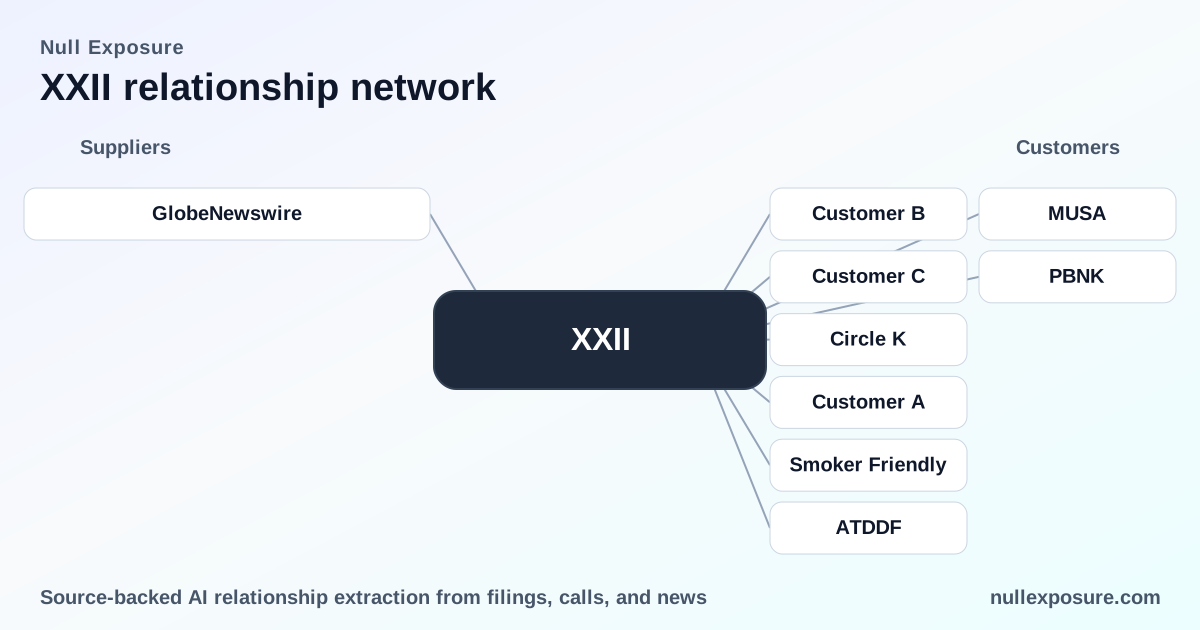
GlobeNewswire / QuiverQuant (press release, March 10, 2026): 22nd Century announced rollout of new Pinnacle VLN and moist snuff products into roughly 1,700 stores across 27 states, signaling a national distribution push for its very‑low‑nicotine and smokeless product lines. (Source: GlobeNewswire press release carried by QuiverQuant, March 10, 2026.)
This is the full set of supplier/distribution relationships identified in the reviewed materials.
Financial posture and what to watch next
Given TTM revenue of $20.3M and negative EBITDA of $11.8M, the company must convert distribution scale into sustainable margins to justify a higher valuation. Monitor three operational and financial indicators closely:
- Sell-through and reorder rates from the 1,700-store rollout—these are the earliest hard indicators of durable demand.
- Grower contract performance and any changes to sourcing footprints; disruptions in contracted U.S. supply would directly pressure product availability.
- Unit economics for Pinnacle VLN and moist snuff (gross margin per SKU) as retail pricing and promotional activity evolve.
Additionally, institutional ownership is modest (≈12%) and the float is small, increasing the potential for volatility if distribution news changes sentiment.
Bottom line and recommended actions
22nd Century’s current strategy converts proprietary plant genetics into consumer products through contracted agricultural supply and retail distribution partnerships. The recent Pinnacle VLN and moist snuff rollout is a concrete step from laboratory/IP toward retail-scale revenue. Investors should treat the rollout as a pivotal execution event: track retail sell-through, supplier performance, and SKU-level margins to determine whether this distribution gains translate into durable financial improvement.
For ongoing tracking of supplier links, retail expansions, and relationship-level signals, visit https://nullexposure.com/ and review the supplier monitoring tools that aggregate these exact disclosures.
Next steps for investors: watch the next two quarters for reorder patterns and supplier confirmations, and use supplier‑level intelligence to stress-test continuity of leaf supply under direct contracts. For more supplier-focused research and alerts, go to https://nullexposure.com/.