Exzeo Group (XZO): Supplier relationships and what they signal for investors
Exzeo Group provides turnkey insurance technology and operations to carriers and agents, monetizing through recurring platform fees, outsourced operations services and distribution partnerships that generate premium-related revenue. The company combines software-enabled servicing with white‑label distribution, and its recent market debut relied on a classic investment‑bank syndicate to access public capital — a mix that makes supplier relationships both operationally important and strategically visible to investors. For a quick overview of supplier risk and counterparty profiles, visit https://nullexposure.com/.
Business model in one line: high-margin services plus distribution economics, scaled through carrier partnerships and capital markets access.
Why supplier relationships matter for Exzeo’s model
Exzeo’s revenues sit at the intersection of operations outsourcing and insurance distribution, so suppliers split into two functional buckets: capital markets partners that provide market access and liquidity, and insurance counterparties that feed product volume and underwriting capacity. That split drives the company’s contracting posture and concentration risk: transactional relationships with banks around discrete events (e.g., IPO) coexist with strategic, revenue-driving alliances in product distribution.
No supplier-specific contractual constraints were disclosed in the sourced materials; at the company level, public information highlights several operating-model signals: very high insider ownership (86% of shares), low institutional ownership (9%), a recent IPO process in FY2025, strong profitability (operating margin ~52%), and revenue of $221.3M TTM. Those items together indicate a profitable, founder-controlled business transitioning to broader market scrutiny while remaining concentrated and potentially illiquid for outside investors.
For investors wanting ongoing monitoring of Exzeo’s supplier posture, see https://nullexposure.com/ for vendor and counterparty intelligence.
The investment banks that ran the offering — who does Exzeo rely on for access to capital?
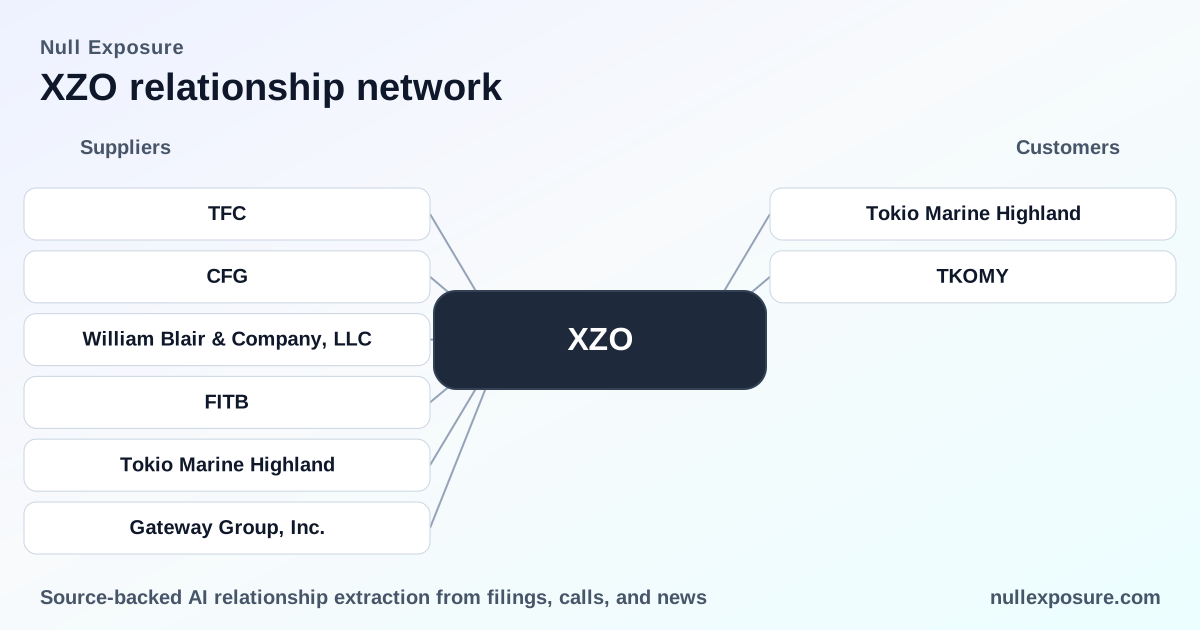
- Truist Securities: Truist acted as the lead left bookrunner in Exzeo’s initial public offering, indicating it took the primary role in syndicate management and price discovery during the deal (GlobeNewswire, Oct 16, 2025).
- Citizens Capital Markets: Citizens served as a joint active book-running manager alongside William Blair, sharing responsibility for order allocation and investor outreach in the IPO (GlobeNewswire, Oct 16, 2025).
- William Blair & Company, LLC: William Blair was disclosed as a joint active book-running manager on the offering, reinforcing a syndicate mix of regional and specialist underwriting capacity (GlobeNewswire, Oct 16, 2025).
- Fifth Third Securities: Fifth Third Securities participated as a co‑manager on the syndicate, providing additional distribution reach and retail/institutional placement support (GlobeNewswire, Oct 16, 2025).
These bank relationships are transactional but critical at inflection points: the IPO allocation and aftermarket support influence liquidity and investor composition. The presence of multiple active bookrunners and a co‑manager suggests a conventional syndicate structure rather than a single‑bank concentration.
The strategic distribution relationship that expands product reach
- Tokio Marine Highland: Exzeo entered a distribution partnership to offer TMH2O, Tokio Marine Highland’s primary residential flood insurance product, through Exzeo’s channels; this expands Exzeo’s product suite into flood risk and directly ties revenue growth to partner premium flow (reported by ReinsuranceNews and discussed in SimplyWall, FY2026 coverage).
This is a strategic bilateral relationship: Tokio Marine Highland supplies product and underwriting capacity while Exzeo delivers reach and distribution mechanics. For a company that scores high on operating margin and profitability, adding flood insurance distribution changes the revenue mix and increases dependency on third‑party underwriting capacity for specialty lines.
Investor communications — who handles the message?
- Gateway Group, Inc.: Gateway Group was listed as the investor relations contact in the IPO release, suggesting Exzeo outsourced IR functions to a specialized firm during the public offering process (GlobeNewswire, Oct 16, 2025).
Using an external IR firm is standard for newly public companies and signals a focus on institutional outreach and market messaging as Exzeo builds coverage and trade volume.
What these relationships collectively imply for risk and upside
Exzeo’s supplier footprint is small but consequential. Key investor takeaways:
- Concentration and criticality: A handful of partners — notably Tokio Marine Highland on the insurance side and a small syndicate of banks on the capital markets side — drive distribution and liquidity. That concentration amplifies both upside (rapid scaling via partner channels) and downside (partner termination or underwriting pullback).
- Contracting posture: Relationships appear a mix of strategic commercial alliances (insurance product distribution) and event‑driven banking engagements (IPO syndicate). This implies predictable operational dependence on commercial counterparties and episodic dependence on capital markets firms.
- Maturity and financial strength: Exzeo reports robust margins and positive EBITDA (operating margin ~52%; EBITDA ~$113.2M on $221.3M revenue TTM), which supports the case that supplier engagements are commercially justified and cash‑supported rather than subsidized for growth. Profitability reduces counterparty payment risk, but does not eliminate concentration risk.
- Governance and liquidity signals: 86% insider ownership and only 9% institutional ownership create potential liquidity constraints and governance concentration; investors should expect insiders to retain meaningful control over counterparty selection and strategic direction.
- Execution risk around distribution expansion: Adding a flood product through Tokio Marine Highland broadens addressable market but ties results to partner volume and underwriting cycles; track premium growth metrics and any exclusivity clauses in subsequent disclosures.
Actionable next steps for investors
- Monitor partner‑level metrics: premium volume from Tokio Marine Highland and any filings that disclose material distribution or exclusivity terms.
- Watch share‑holder composition and insider disposition post‑IPO; substantial insider holdings can constrain float and amplify volatility.
- Evaluate liquidity and analyst coverage progression: more active institutional ownership would reduce trading volatility and provide market validation for supplier strategy.
For ongoing supplier intelligence and to track new relationship disclosures, consult https://nullexposure.com/. If you want a vendor-focused diligence package on Exzeo and its counterparties, start here: https://nullexposure.com/.
Exzeo’s supplier set is concentrated but aligned with its business model: banks to enable access to capital and a select group of insurance partners to drive premium flow. The company’s strong margins and profitable operations provide a cushion for execution, but concentration and insider control are the primary governance and liquidity risks investors must price into any thesis. For a deeper dive into counterparty exposure and real‑time relationship alerts, visit https://nullexposure.com/ and request the supplier dossier.