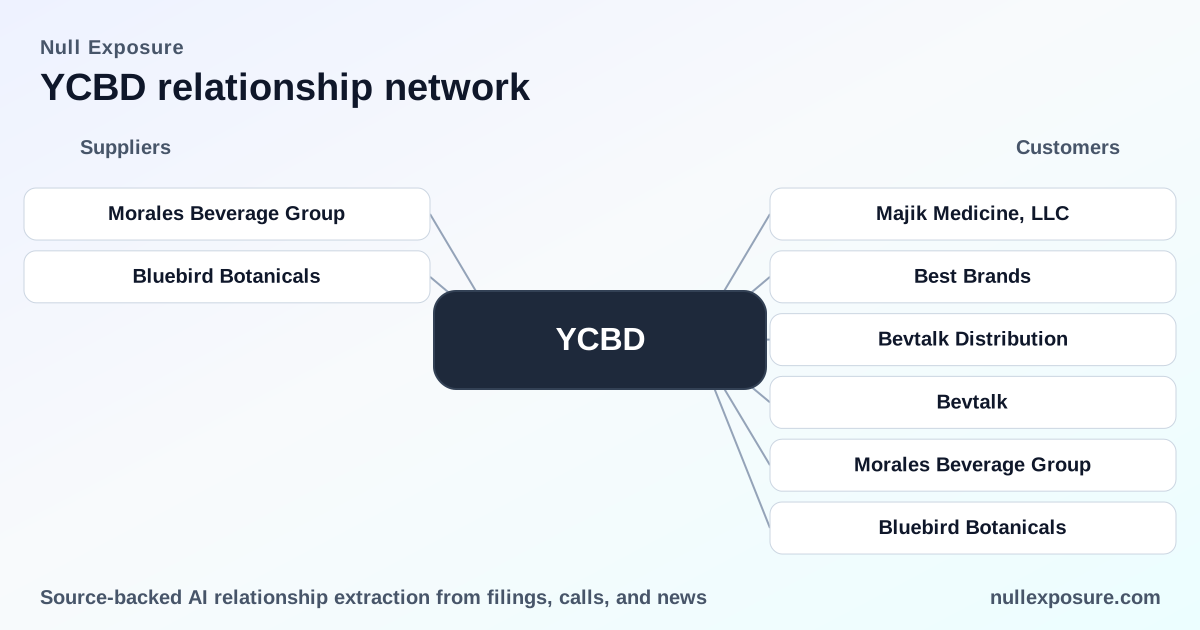
cbdMD (YCBD): supplier relationships, operating posture, and what investors should price in
cbdMD is a vertically oriented consumer-health company that designs, manufactures (in-house and via third-party contractors), and distributes cannabidiol (CBD) products, monetizing through direct-to-consumer e-commerce, wholesale distribution partners, and brand acquisitions that expand retail reach. The company’s recent deals — a state-level distribution pact and an asset purchase of a legacy CBD brand and online marketplace — are tactical moves to accelerate top-line traction while relying on a hybrid manufacturing and third‑party payments model that concentrates operational risk in a small set of critical suppliers and service providers. For investors and operators, the key question is whether these relationship moves scale revenue cost‑effectively given a modest market capitalization and a thin profitability profile.
Explore supplier intelligence and relationship analytics at Null Exposure.
How cbdMD structures supply and manufacturing — what the filings say
cbdMD discloses a framework contracting posture for its critical manufacturing relationships: master manufacturing agreements and quality assurance terms govern specifications, testing, deviation handling, and corrective action. That demonstrates a deliberate contracting stance designed to mitigate manufacturing variability while maintaining flexibility to shift production across partners under a governed framework. The company also describes a hybrid manufacturing model, combining in-house production oversight with third‑party contract manufacturers to scale and respond to regulatory expectations.
Geographically, raw hemp inputs are sourced from U.S.-grown hemp under federal and state programs, which reduces cross-border supply risk but concentrates agricultural and regulatory exposure in North America. Operationally, the company uses multiple third‑party payment processors to handle internet sales, signaling reliance on external service providers for the customer‑facing commerce stack.
Key company-level signals derived from disclosures:
- Contract discipline: master manufacturing agreements and quality assurance controls indicate mature contracting for critical suppliers.
- Critical supplier dependence: core manufacturing relationships are designated as critical, implying meaningful operational exposure if a partner fails.
- North America sourcing: all hemp-derived cannabinoids are U.S.-sourced, reducing import risk but increasing vulnerability to domestic regulatory shifts.
- Hybrid production: in-house control paired with outsourced manufacturing allows scale but requires robust supplier governance.
- External payments reliance: commerce depends on several third-party processors.
These are company-level constraints and should be evaluated as part of supplier due diligence rather than being tied to any single named partner.
Two relationships you must evaluate now
Morales Beverage Group — distribution partnership in Louisiana
cbdMD expanded its Herbal Oasis distribution footprint by partnering with Morales Beverage Group to distribute Oasis statewide in Louisiana, prioritizing channels oriented toward modern alcohol alternatives and functional social beverages. This is a distribution-first relationship intended to accelerate retail presence in a specific state market (PR Newswire via Morningstar, March 2026).
Bluebird Botanicals — asset purchase to bolster brand and direct retail
cbdMD executed an Asset Purchase Agreement to acquire substantially all assets of Bluebird Botanicals, including brand, online CBD marketplace, trademarks, inventory, and certain other assets while assuming certain liabilities; the acquisition is a strategic horizontal consolidation to capture an established online audience and SKU set (TradingView, March 2026).
Why these relationships matter for investors and operators
Both moves reflect dual levers of growth: distribution reach through third‑party beverage channels and inventory/brand acquisition to boost direct retail presence. The Morales Beverage Group arrangement is a low-capex expansion channel that offloads distribution logistics to an established beverage distributor, accelerating shelf presence without necessarily increasing manufacturing capacity. The Bluebird Botanicals purchase is an inorganic growth play that brings immediate inventory and brand equity, but it also imports working capital needs and assumed liabilities.
Financial context that frames risk and return (latest quarter ended 2025-06-30 unless noted):
- Revenue TTM ≈ $19.0M with gross profit roughly $11.6M, signaling retail traction but limited scale.
- Market capitalization ≈ $6.6M and negative EBITDA (-$0.64M), indicating the company trades at a small equity base where single deals materially affect balance sheet composition.
- Profitability metrics are mixed: trailing PE 1.45 but forward PE 714.29; operating margin is negative and return on equity is strongly negative, underscoring sensitivity to integration costs and working capital from acquisitions.
- Concentration and governance risks: a hybrid manufacturing model governed by master agreements is a strength, but critical supplier dependence raises operational continuity risk should a partner fail qualification or face regulatory restrictions.
Operational implications:
- Distribution partnerships like Morales can drive rapid retail adoption without commensurate capital investment, improving turnover if shelf velocity is proven.
- Brand and inventory acquisitions like Bluebird are accretive only if integration captures cross-sell, lowers marginal customer acquisition cost, and inventory is managed without excessive write-downs.
- Payment processor reliance and North America hemp sourcing reduce certain geopolitical risks while exposing the company to domestic regulatory shifts in hemp/CBD law.
Explore deeper supplier relationship analysis and alerts at Null Exposure.
What investors and operators should watch next
- Integration cadence for Bluebird Botanicals: track inventory aging, SKU rationalization, brand migration, and any assumed liability disclosures in subsequent filings. Successful integration will be visible in improved gross margins and ecommerce retention metrics.
- Shelf velocity in Louisiana: monitor sell-through data tied to Morales Beverage Group distribution; fast sell-through converts distribution into durable revenue growth.
- Manufacturing continuity and quality metrics: given that critical manufacturers are governed by master agreements, watch for any reported deviations, corrective actions, or supply interruptions that could interrupt SKU availability.
- Working capital and credit signals: acquisitions increase inventory and liabilities; investors should watch cash flow from operations and balance sheet leverage given the company’s small market cap.
- Regulatory developments in U.S. hemp law: North America sourcing reduces import risk but increases exposure to shifts in federal or state hemp/CBD interpretation.
Bottom line: a small-cap roll-up with execution risk
cbdMD is executing a hybrid playbook: scale distribution quickly via partners and scale customer reach via brand acquisitions. That strategy can deliver high leverage if integration is disciplined and manufacturing frameworks hold. Conversely, the company’s modest market cap, negative operating margins, and dependence on a small number of critical manufacturing and service relationships amplify execution risk. Investors and supply-chain operators should treat new partnerships and acquisitions as operational inflection points that require active monitoring.
For supplier-level due diligence, relationship tracking, and alerts on emerging contract risk, visit Null Exposure to review supplier maps and disclosure-driven intelligence.