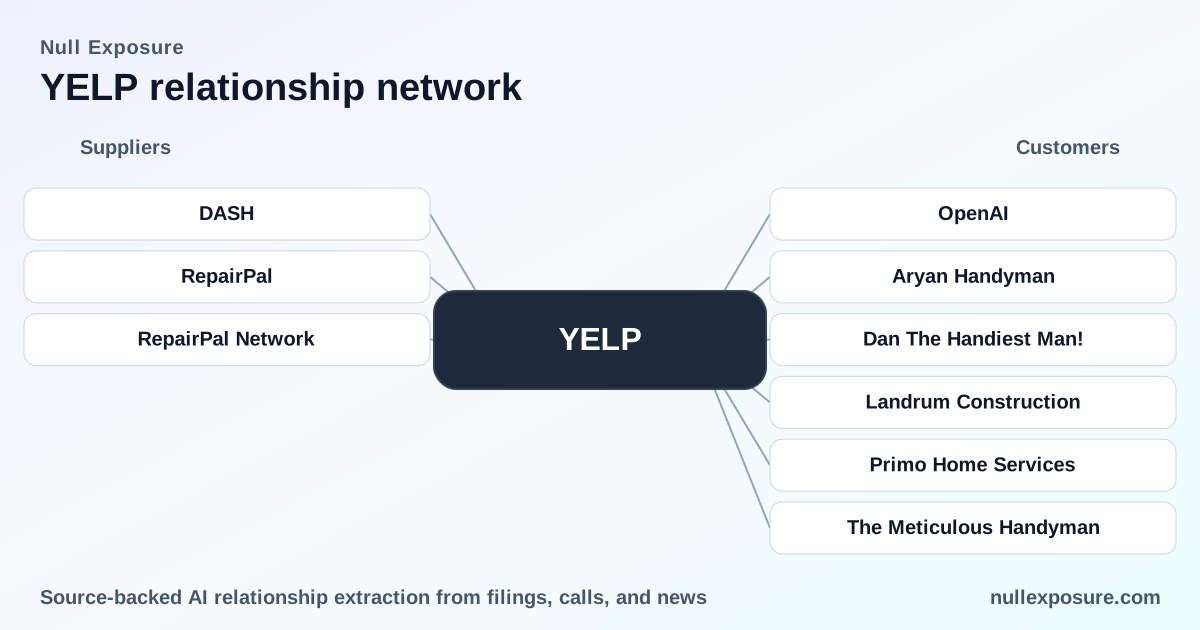
Yelp supplier relationships: DoorDash, RepairPal, RepairPal Network — what investors need to know
Yelp runs a discovery-to-action local platform that connects consumers to businesses and monetizes primarily through paid business advertising and transaction-enabling integrations. Recent disclosures and earnings-call reporting show management executing on a strategy to close the gap between discovery and conversion—expanding food ordering via third-party fulfillment partners and embedding booking systems for service verticals—while continuing to sell CPC and multi-location ad products. For investors assessing counterparty and supplier risk, the supplier roster is small but strategic: integration partners drive revenue activation, while enterprise SaaS vendors support core operations. Explore deeper analysis or supplier monitoring at https://nullexposure.com/.
Quick take: business model implications of these supplier ties
Yelp’s commercial model is twofold: advertising revenue from merchants (CPC and multi-location products) and transactional revenue unlocked by integrations (food ordering, bookings). The partnerships disclosed in FY2026 earnings commentary illustrate how Yelp converts engagement into monetizable actions: expanding the food-ordering footprint through DoorDash and tightening booking workflows via RepairPal integrations. Financially, the company shows scale with Revenue TTM ≈ $1.46B and EBITDA ≈ $205M, and valuation multiples consistent with a cash-generative digital marketplace (Trailing P/E ~10.6, EV/Revenue ~0.76). These metrics underpin supplier risk tolerance: Yelp can invest in integrations that lift advertiser ROI and retention.
If you want ongoing supplier intelligence and risk scoring for Yelp or comparable platforms, start here: https://nullexposure.com/.
Vendor management and operational constraints: what filings disclose
Yelp’s public compliance signals indicate a formal vendor management posture. Management states they maintain a vendor management program to govern cybersecurity and operational risk for third-party service providers such as AWS, Oracle and Workday; this is a company-level control and not tied to any single commercial partner. That disclosure implies contracting maturity: Yelp treats core infrastructure and enterprise applications as critical outsourced services, enforcing oversight and risk mitigation. For investors, that matters because it reduces single-point operational risk but also reveals dependency on major cloud and enterprise software providers for uptime and data processing.
Key operational signals:
- Contracting posture: formal vendor management and oversight for major service providers.
- Concentration: infrastructure concentration on large cloud and SaaS vendors (explicitly named).
- Criticality: infrastructure and enterprise applications are mission-critical; disruptions would have platform-level impact.
- Maturity: documented vendor governance indicates an established procurement and security framework rather than ad-hoc relationships.
Supplier map: the relationships you need to evaluate
Below are every supplier/partner relationship reported in the FY2026 coverage and supporting sources, with concise summaries for investor review.
DoorDash — expanding food ordering reach
Yelp reports it expanded its food ordering network by adding hundreds of thousands of new restaurants through a partnership with DoorDash, positioning DoorDash as a distribution and fulfillment partner that materially scales Yelp’s order flow capability. This was described in the FY2026 earnings commentary covered in Q4 2025 earnings-call transcripts reported March 10, 2026. (See The Globe and Mail/Motley Fool and InsiderMonkey coverage of the March 10, 2026 earnings-call transcript.)
RepairPal — booking integration to close discovery-to-action
Yelp integrated RepairPal’s booking system into its platform, enabling users to book auto-repair services directly from Yelp listings and enhancing conversion in the automotive vertical. This integration was explicitly mentioned during the FY2026 earnings commentary and surfaced in the same March 10, 2026 earnings-call reporting. (Referenced in InsiderMonkey and The Globe and Mail/Motley Fool coverage.)
RepairPal Network — a named advertising/partner product
Yelp lists RepairPal Network as a component of its advertising and services product set—positioning it alongside CPC Ads and multi-location products to monetize service-focused inventory. The company described RepairPal Network as part of its free and paid business products in FY2026 earnings coverage, as reported by Intellectia.ai covering the Q4 2025 results. (See Intellectia.ai, March 10, 2026.)
What these relationships mean for revenue and risk
These partnerships are revenue accelerants rather than one-off vendors. DoorDash scales marketplace liquidity for food ordering, directly increasing transaction volume and advertiser value; RepairPal integrations convert discovery into bookings for service categories and feed additional advertising inventory and metrics for Yelp’s salesforce. From a risk perspective:
- Revenue concentration risk is business-model dependent: Yelp’s advertising base remains the primary revenue driver, but transaction-enabling partners introduce incremental, high-frequency monetization.
- Counterparty risk is mitigated by diversification of partners and productization: Yelp is not relying on a single supplier to deliver bookings across verticals; the company bundles partner-enabled functionality into sellable ad products.
- Operational risk still resides with core infrastructure providers (AWS/Oracle/Workday), per vendor-management disclosures; these are company-level risks with potential platform-wide consequences if not managed.
Signals for investors and operators to watch
- Monitor growth in orderable listings and booking completions tied to DoorDash and RepairPal integration metrics; these are leading indicators of monetization lift.
- Track contract terms and revenue share disclosures in subsequent filings or earnings commentary to quantify partnership economics.
- Validate vendor-management execution through disclosure of third-party incidents or remediation actions involving named infrastructure vendors.
For investors evaluating counterparty exposure and operational resilience, nothing replaces continuous monitoring—if you want ongoing supplier-risk signals and contract-level analysis for companies like Yelp, visit https://nullexposure.com/.
Bottom line and next steps
Yelp’s supplier relationships disclosed in FY2026 are strategic, designed to convert discovery into transactions and to package those outcomes for advertisers. DoorDash and RepairPal extend Yelp’s addressable monetization, while the company’s vendor-management program signals mature operational controls for core infrastructure. These factors together support an execution-focused monetization thesis that justifies Yelp’s current financial profile, while leaving watchpoints around partner economics and infrastructure concentration.
To get supplier-specific risk profiles and alerts for YELP and comparable platform businesses, sign up or learn more at https://nullexposure.com/.