YEXT: Supplier Relationships, Contracting Posture, and What Investors Should Price In
Yext operates a digital presence platform that organizes brand information in a centralized knowledge graph and distributes that content across first- and third‑party channels through a broad Publisher Network. The company monetizes primarily through subscription and recurring licensing for its platform, supplemented by fees tied to publisher arrangements and professional services; corporate actions in 2026 also involved dealer managers and tender‑offer service providers. For investors, the key question is how predictable and durable those recurring revenue streams are, given the mix of short‑ and multi‑year supplier contracts and the operational leverage of the Publisher Network.
Learn more about supplier intelligence at https://nullexposure.com/.
How Yext’s supplier footprint drives revenue and cost behavior
Yext’s platform economics hinge on its ability to keep content synchronized across hundreds of distribution points while managing the costs of the network that enables that reach. The company’s disclosures show a mix of supplier contract tenors: many Publisher Network application providers have one‑year terms but some arrangements extend for several years, and Yext classifies those Publisher Network relationships as service and application provider arrangements that feed cost of revenue. This results in a hybrid contracting posture—operational flexibility from short‑term arrangements coupled with pockets of longer-term commitments that stabilize service delivery.
The supplier role labeled by Yext is explicitly operational: the Publisher Network is not merely an auxiliary partner but a set of service providers that execute content delivery and related services, which makes the network a functional part of Yext’s cost base and a contributor to customer experience. Investors should price both the upside from scale as clients add listings across channels and the downside of vendor cost volatility if key publisher economics shift.
The actual supplier relationships on record
Below are the supplier and service relationships surfaced in recent filings and media coverage, with concise investor‑oriented summaries.
-
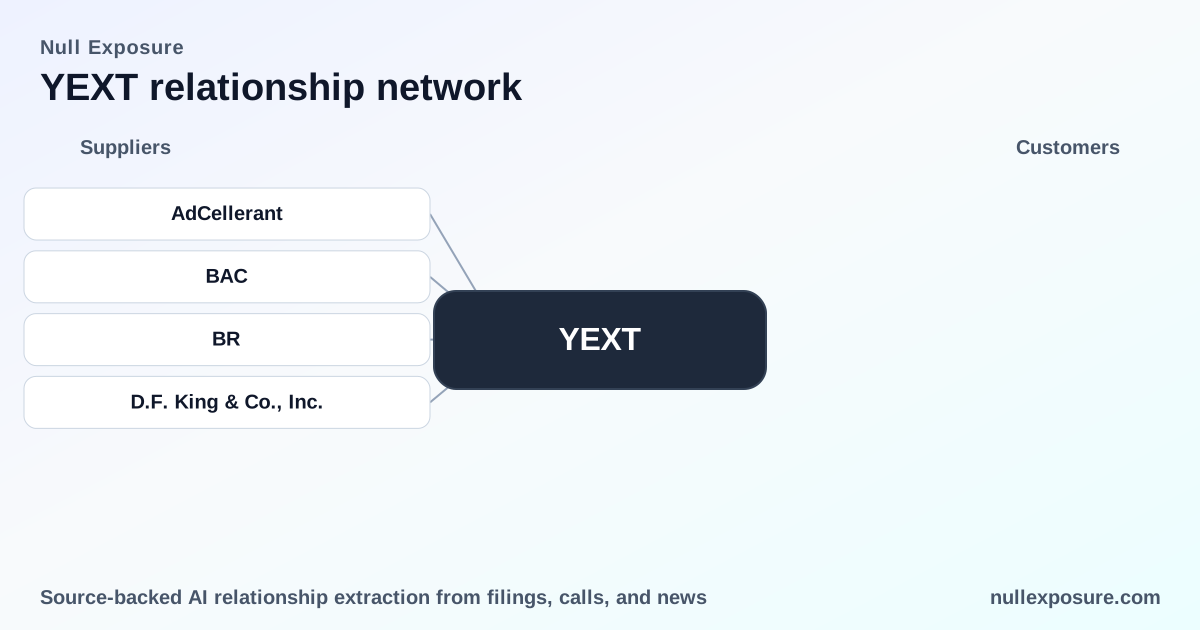
AdCellerant — Yext entered a strategic partnership to help customers manage and optimize brand visibility, positioning AdCellerant as a channel to extend Yext’s Publisher Network and delivery capability; this was announced in news coverage in March 2026. (Sahm Capital, March 2026; Finviz, March 2026).
Key takeaway: this is a commercial channel/implementation partner that supports customer outcomes and distribution reach. -
BofA Securities, Inc. — BofA served as dealer manager for a Yext corporate action, and the company directed banks and brokers to contact BofA as part of the tender process; this appears in corporate tender documentation published in March 2026. (Yahoo Finance reporting on Yext announcement, March 2026).
Key takeaway: BofA’s role signals capital markets activity—an organized liquidity or tender event requiring institutional underwriting or dealer coordination. -
Broadridge Corporate Issuer Solutions, LLC — Broadridge acted as the depositary for a Yext tender offer and reported the number of shares tendered to date in the public notice; this was disclosed in the tender‑offer announcement in March 2026. (Yahoo Finance, March 2026).
Key takeaway: Broadridge’s involvement is administrative for equity processing and is a standard vendor exposure during corporate actions. -
D.F. King & Co., Inc. — D.F. King was named the information agent for the same tender offer, providing investor communications and information services for the transaction as disclosed in March 2026. (Yahoo Finance, March 2026).
Key takeaway: D.F. King’s mandate is communications and recordkeeping for the tender, reflecting engagement with full‑service transaction vendors.
What the constraints tell us about operating risk and maturity
Yext’s supplier constraints, drawn from company disclosures, are best read as company‑level signals about contracting and operational posture rather than as attributes of any single vendor.
-
Contracting tenor: Yext combines short‑term publisher contracts (generally one year) with some multi‑year agreements, which provides tactical flexibility for product evolution while retaining pockets of long‑term stability for core delivery partners. This structure reduces long‑term vendor lock‑in risk but creates revenue renewal risk at the short end.
-
Service provider model: The Publisher Network is described as a network of over 200 service and application providers whose arrangements feed cost of revenue; many large providers operate on unpaid or variable terms. That low fixed‑cost model can enhance margins as Yext scales, but it also makes execution dependent on third‑party behavior and commercial terms that are not wholly under Yext’s control.
-
Maturity and concentration: The combination of numerous small‑term relationships and a few larger, unpaid providers implies operational maturity but also potential concentration risk in execution: a handful of major publishers could materially affect distribution or pricing if contract economics change.
Investor implications: what to watch and how to act
Yext’s supplier relationships reveal two primary investor levers: recurring revenue durability and corporate capital allocation.
-
On the revenue side, the Publisher Network is mission‑critical—it underpins value for enterprise customers and therefore retention and expansion. Investors should monitor renewal rates, any disclosures of publisher pricing changes, and how Yext offsets variable publisher fees through pricing or product enhancements.
-
On the corporate side, the presence of BofA, Broadridge, and D.F. King in March 2026 indicates active capital management, likely a tender offer or similar return‑focused event; investors should price the near‑term impact on shares outstanding and the balance sheet. (See Yext tender announcement reporting, March 2026.)
For deeper supplier risk analysis and continuous monitoring, visit https://nullexposure.com/.
Tactical due diligence checklist for investors
Focus your next 90 days of diligence on these points:
- Renewal cadence and churn trends tied to publisher distribution coverage and any single‑provider dependencies.
- Contractual disclosure of unpaid or variable commission structures that affect gross margin volatility.
- Outcomes of the 2026 tender and any subsequent capital‑structure moves that shift shareholder value capture. (Corporate tender disclosures reported March 2026.)
Actionable next step: verify renewal terms and any material publisher concentration in Yext’s next quarterly or annual filing.
Learn more about supplier‑level implications and monitoring at https://nullexposure.com/.
Bottom line
Yext’s supplier footprint is a mix of operational partners that drive delivery and transaction vendors that support corporate actions. The Publisher Network is both a growth enabler and a source of operating leverage, but its hybrid short‑ and multi‑year contracting creates a renewal risk profile investors must underwrite. Corporate‑action vendors involved in the March 2026 tender confirm active capital management that will influence near‑term shareholder value. For investors focused on durable SaaS economics and supplier risk, the interplay between flexible publisher agreements and occasional longer‑term vendor commitments is the central dynamic to model.