YHC supplier relationships: what investors should know
YHC operates as a branded beverage platform that sources, markets and distributes premium spirits and wines through a network of retail partners and product handlers. The company monetizes through product sales on the platform, fees tied to distribution and order fulfillment, and by structuring funding commitments that support inventory procurement — a hybrid commercial and financing model that amplifies gross margins while creating counterparty concentration risks.
If you want a consolidated view of YHC’s supplier exposures and contractual posture, start here: https://nullexposure.com/
Two counterparties that matter, in plain language
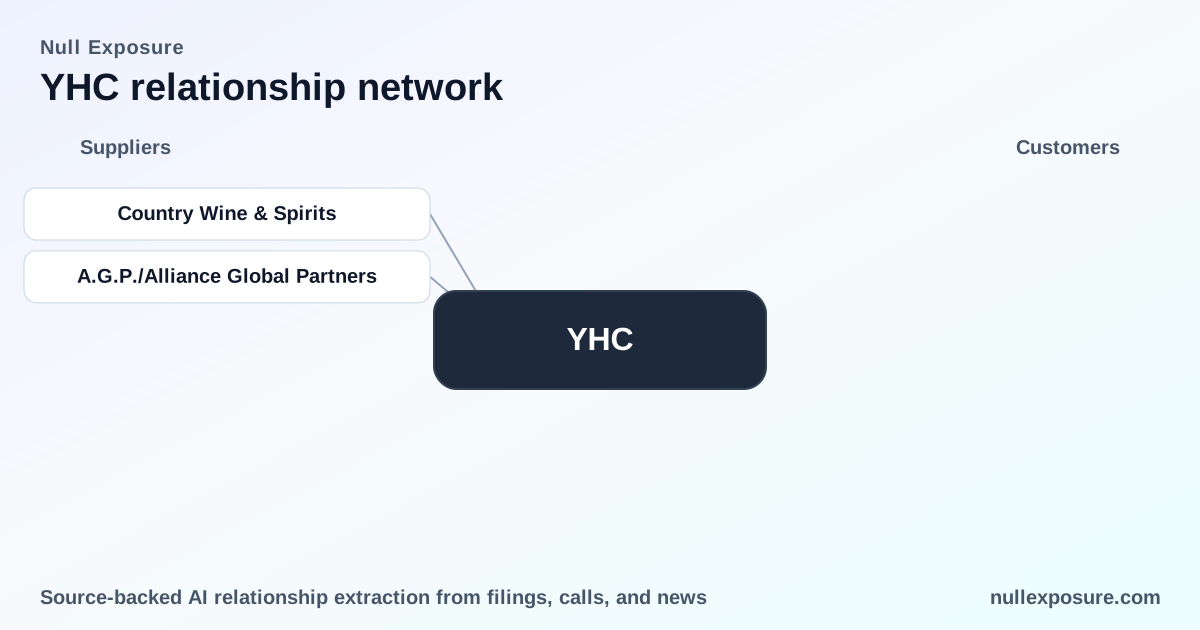
Country Wine & Spirits and A.G.P./Alliance Global Partners are the two supplier‑scope counterparties surfaced in the coverage set. Each relationship plays a distinct role: one is a retail content partner for premium products; the other is an investment‑bank placement agent tied to capital raising. Below I walk through each relationship from the press coverage and link to the underlying items for your diligence.
Country Wine & Spirits — a retail partner for premium inventory
Country Wine & Spirits is referenced as an esteemed retail partner supplying emerging, premium and luxury spirits, wines and champagnes that are delivered through the company’s platform. Press releases tied to the company’s registered offering note Country Wine & Spirits as a named retail partner for product distribution on the platform (see example press release from March 2026 on USA Today). Source: press release, March 2026 — https://www.usatoday.com/press-release/story/21759/lqr-house-announces-652-million-registered-direct-offering/
A.G.P./Alliance Global Partners — sole placement agent for a capital raise
A.G.P./Alliance Global Partners is cited repeatedly as the sole placement agent on a registered direct offering, a capital markets relationship that supports YHC’s financing and liquidity activities. Multiple press releases from March 2026 list A.G.P./Alliance Global Partners in this role; for a representative copy see the Lansing State Journal notice. Source: press release, March 2026 — https://www.lansingstatejournal.com/press-release/story/967686/lqr-house-announces-652-million-registered-direct-offering/
How the company’s supplier and financing contracts shape the business
The public excerpts and filing evidence identify several company‑level operational characteristics that directly affect supplier risk and commercial durability:
-
Contracting posture: framework funding commitments. The company entered a Funding Commitment Agreement that obligates it to provide a minimum annual funding amount to a designated Product Handler (KBROS) to enable inventory purchases from approved vendors. The commitment mechanism is structured as a funding framework rather than a direct purchase contract, which creates ongoing contingent cash requirements tied to inventory procurement cycles (per company filing excerpts dated November 1, 2023).
-
Concentration and sole‑source production. The company sources at least one branded product (SWOL Tequila) from a sole supplier who is an individual-based producer in Guadalajara, Mexico, and contracts with a local manufacturer in Mexico for production. This structure creates single‑point supply risk for specific SKUs and heightens the operational dependence on a small group of external manufacturers.
-
Critical service providers: product handling and fulfillment. KBROS functions as the company’s Product Handler under a Product Handling Agreement and receives monthly compensation plus reimbursable shipping and handling fees, making KBROS a critical service provider for order fulfillment and revenue recognition. For the year ended December 31, 2024, the company recorded $480,000 in cost of revenue to KBROS, indicating material transactional flows through this handler.
-
Maturity and legal outcome signals. The company’s relationship posture is mixed: filings indicate both active contractual commitments (Product Handling and Funding Commitment Agreements entered November 1, 2023) and a termination or settlement event — the company executed a settlement and release with KBROS and its controlling stockholder in October 2024 for $4.1 million. That settlement suggests the underlying relationship required remediation and cash outflow, which has direct P&L and liquidity implications.
-
Spend scale and balance‑sheet exposure. The evidence shows the company’s committed funding quantum operates at a meaningful scale: a minimum funding commitment of $2.5 million annually under the Funding Commitment Agreement, with settlement and accrual activity in the low‑millions (the October 2024 settlement for $4.1 million). For modeling, treat these as recurring contingent funding needs plus potential one‑time remediation costs.
These are company‑level signals pulled from the publicly disclosed excerpts, not attributions to the retail or placement parties unless those parties are explicitly named in the excerpt.
If you want a single screen that aggregates these relationship signals and contract excerpts, see the platform home page for YHC supplier coverage: https://nullexposure.com/
Financial and operational implications for investors
-
Revenue mix and margin leverage. The platform model — selling third‑party branded premium products and collecting fulfillment fees — creates upside to gross margins when volume scales but depends on consistent inventory funding and reliable product handlers. Interruption in funding or handler services compresses throughput and can materially affect short‑term revenue.
-
Liquidity and cash‑flow risk linked to funding commitments. The combination of minimum annual funding obligations ($2.5 million) and historical settlement payouts ($4.1 million) point to cash‑flow volatility. Investors should treat these commitments as enterprise‑level liabilities that can accelerate under stress.
-
Operational concentration. The presence of sole suppliers and a small set of product handlers makes the platform operationally concentrated; loss or dispute with any key handler or manufacturer has outsized revenue and cost consequences.
-
Capital markets linkages. The placement agent relationship with A.G.P./Alliance Global Partners indicates the company relies on external capital raises to supplement operations and liquidity, which ties operational continuity to access to equity or direct offering markets.
Mid‑research call to action: For deeper supplier mapping and to download an exportable relationship matrix for YHC, go to https://nullexposure.com/
What to watch next (diligence checklist)
- Confirm the current status of the Funding Commitment Agreement and whether the company maintains any active funding obligations following the October 2024 settlement.
- Validate production continuity for SWOL Tequila and other sole‑source SKUs; identify alternative manufacturers or dual‑sourcing plans.
- Review monthly and annual payments to the Product Handler (KBROS) and any replacement arrangements post‑settlement.
- Monitor capital‑raising activity under A.G.P./Alliance Global Partners for dilution and timing of cash infusions.
Bottom line for investors
YHC’s platform is commercially compelling — connecting premium retail partners with branded inventory and monetizing both product sales and distribution services — but its operating model embeds material counterparty concentration and contingent funding risk. The documented funding commitment mechanics, the presence of sole producers, and an expensive settlement in 2024 should be treated as active risk factors for near‑term cash flows and operational continuity.
If you are evaluating supplier exposure across a portfolio or require a consolidated evidence pack for YHC counterparties, access our supplier coverage hub here: https://nullexposure.com/