Yunji (YJ): Supplier map and what it means for investors
Yunji operates a social-commerce retail platform that distributes products through its Yunji application and web pages embedded in major Chinese social platforms; the company monetizes primarily through retail sales and platform services tied to those distribution channels. This supplier review focuses on the vendor and channel relationships disclosed in public reporting and media, highlighting governance changes and channel dependencies that directly affect operational risk and investor value.
If you want a clean, auditable view of supplier links for investment diligence, visit https://nullexposure.com/ for the full supplier intelligence hub.
A concise takeaway for investors
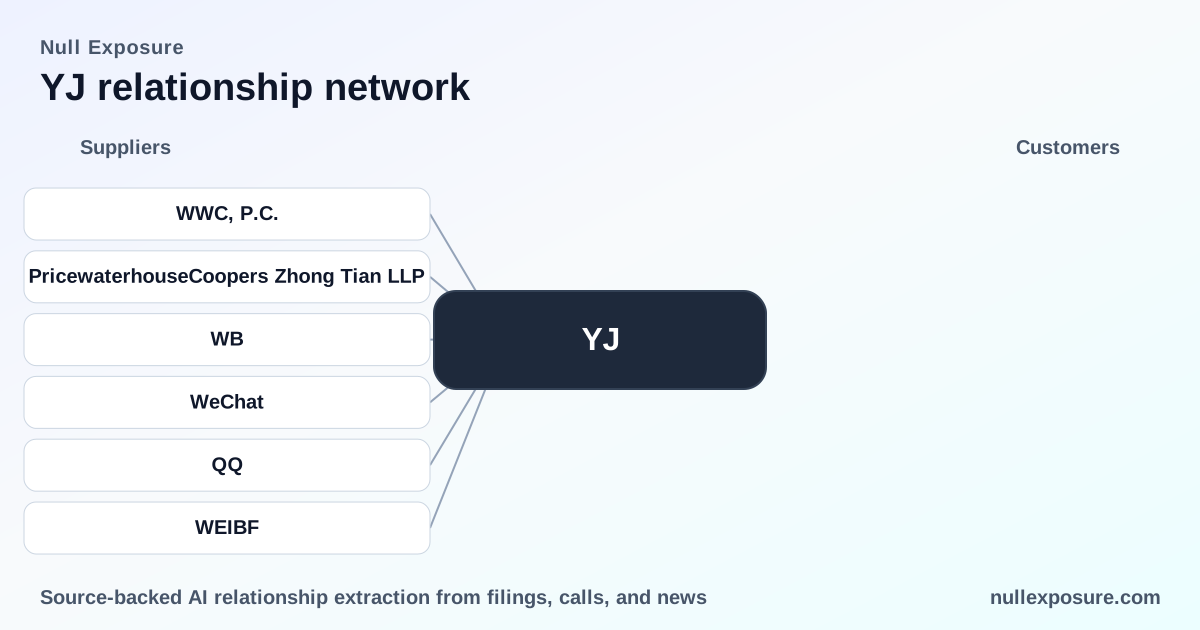
Yunji’s supplier footprint is concentrated in two functional areas: auditing/governance (accounting firms) and distribution (social platforms: WeChat, QQ, Weibo). The audit transition from PricewaterhouseCoopers Zhong Tian to WWC, P.C. is a governance event with short-term reporting implications, while distribution through major social networks is a structural feature of the business model that drives reach but introduces platform dependence.
Audit partner swap: PwC dismissed, WWC, P.C. appointed
Yunji’s board and audit committee approved the dismissal of PricewaterhouseCoopers Zhong Tian LLP as the independent registered public accounting firm and appointed WWC, P.C. effective May 22, 2025. This change was disclosed in a company announcement captured in FY2026 reporting. According to the Intellectia filing, the appointment of WWC, P.C. is effective for the fiscal year ending December 31, 2025, and replaces PwC Zhong Tian in the same action. (Source: company announcement posted via Intellectia, FY2026)
PricewaterhouseCoopers Zhong Tian LLP was the auditor dismissed in the same board action; the company noted the dismissal and replacement in the FY2026 disclosure. Investors should treat the change as a governance and control signal that requires monitoring of subsequent filings for any audit qualifications or changes in disclosure cadence. (Source: company announcement posted via Intellectia, FY2026)
Distribution channels: WeChat, QQ, Weibo — the commercial arteries
Yunji distributes its products principally through the Yunji Application and web pages embedded on major Chinese social platforms, including WeChat. Multiple articles documenting Yunji’s channel strategy identify WeChat as a primary conduit for product listings and customer acquisition. (Source: Yahoo Finance coverage on Yunji, FY2025; InsiderMonkey note on Yunji’s distribution, FY2025)
QQ serves as another core distribution channel for Yunji’s retail flow, used to host Yunji web pages and reach user segments within Tencent’s ecosystem. Reports referencing Yunji’s commercial strategy list QQ alongside WeChat and Weibo as central platforms for product distribution. (Source: InsiderMonkey analysis and Yahoo Finance reporting on Yunji, FY2025)
Weibo complements Yunji’s distribution mix by providing social discovery and promotional reach; reporting identifies Weibo as one of the major networks where Yunji hosts web pages for product exposure. Weibo is cited in multiple FY2025 stories describing Yunji’s multi-platform distribution approach. (Source: InsiderMonkey analysis and Yahoo Finance reporting on Yunji, FY2025)
What these relationships mean operationally
- Channel concentration and criticality: Yunji’s reliance on WeChat, QQ, and Weibo for distribution makes these platforms critical to top-line traffic and customer acquisition. This is a commercially efficient model — it leverages existing user bases — but creates single-ecosystem exposure that can amplify regulatory or platform-policy risk.
- Contracting posture and maturity signal: The public disclosures do not include detailed supplier contract terms, but the pattern of operating through major social platforms signals typical platform-level commercial arrangements (integration and traffic-share mechanics rather than bespoke, high-margin supplier contracts). This suggests operational maturity consistent with platform-first distribution, but also limited negotiating leverage versus the platform owners.
- Governance and audit implications: The change in external auditor is a governance event; while auditor swaps are not uncommon, they require attention to potential reporting adjustments and to the reasons disclosed in subsequent filings. Treat audit changes as a short- to medium-term monitoring item for disclosure quality and financial restatements.
Constraints and company-level signals
The public relationship feed contains no explicit supplier constraints in the captured disclosures (no contract expiries, exclusivity clauses, or penalty excerpts were reported in this collection). Presenting this as a company-level signal: no explicit contractual constraints were reported in the sample, which reduces immediate visibility into supplier-side concentration risk beyond the platform dependency already visible. Investors should treat this absence as a data gap to be closed by direct diligence — request contract terms and platform agreements to quantify concentration and exit risk.
Investment implications and risk checklist
- Governance watch: The auditor replacement (PwC Zhong Tian → WWC, P.C.) is the most material discrete event in the supplier map; investors should review subsequent SEC-equivalent filings and any audit memoranda for changes to internal control opinions or emphasis-of-matter notes. (Source: Intellectia, FY2026)
- Platform dependency risk: Distribution through WeChat, QQ, and Weibo is a core operational dependency; changes in platform policies, traffic algorithms, or fee structures would directly hit customer acquisition costs and revenue realization. (Source: InsiderMonkey and Yahoo Finance, FY2025)
- Concentration and negotiating leverage: The nature of the disclosed relationships implies limited fragmentation of distribution spend but concentrated exposure to a small set of platform owners, increasing systemic supplier concentration risk at the commercial level.
If you need a structured supplier risk report or line-item contract intelligence for Yunji, start your diligence at https://nullexposure.com/ — we curate supplier footprints that support valuation and operational risk analysis.
Final read: action items for investors and operators
- Request the engagement letters and audit transition disclosures tied to the PwC/WWC change to confirm reasons and any restatement risk.
- Secure copies of platform agreements or representative terms for WeChat, QQ, and Weibo integrations to quantify traffic dependence and fee exposure.
- Monitor upcoming financial statements for any audit qualifications or disclosures about distribution performance tied to the three platforms.
For more supplier-centric diligence and a visual map of these relationships, visit https://nullexposure.com/ — the page consolidates supplier and channel intelligence for investor decision-making.
In sum, Yunji’s supplier footprint is narrowly focused but strategically decisive: governance is in transition at the auditor level, and distribution is concentrated within Tencent and Sina-owned social ecosystems. Investors should prioritize audit disclosures and platform contract terms when updating valuations or running scenario stress tests.