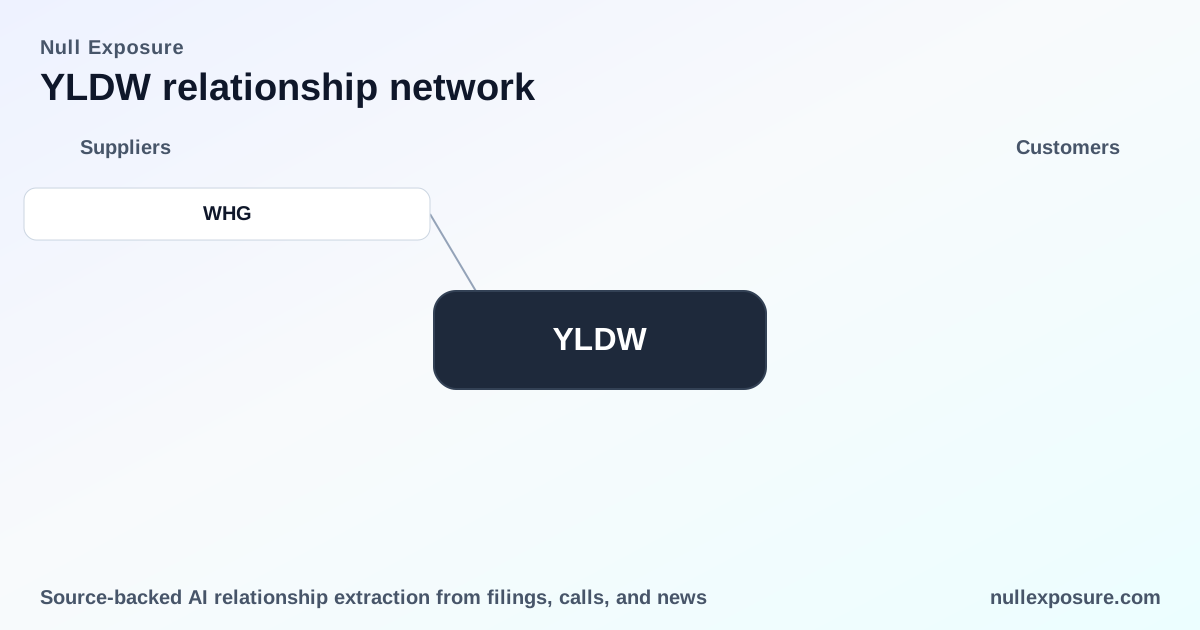
YLDW: How the new Enhanced Income Opportunity ETF plugs into supplier relationships investors should track
YLDW is an exchange-traded product launched by Westwood Holdings Group (WHG) under the name Enhanced Income Opportunity ETF; it generates revenue for the sponsor through asset-based management fees and distribution scale as AUM grows. For investors and operating teams assessing supplier exposure, YLDW functions as a product line supplied by Westwood — the sponsor, distributor and likely portfolio manager — so sponsor economics, distribution reach, and early asset traction drive commercial viability.
Explore deeper supplier intelligence at https://nullexposure.com/ to map counterparties and concentration risk.
One relationship dominates the footprint — the sponsor is the supplier
Westwood Holdings Group, Inc. (WHG) — Westwood is the sponsor and launch vehicle for YLDW, reporting the launch in its FY2026 commentary and citing the ETF as part of an expanded ETF platform now exceeding $200 million in ETF assets. According to a GlobeNewswire press release reported by The Manila Times on February 14, 2026, Westwood explicitly identified YLDW as its Enhanced Income Opportunity ETF and included the product in its FY2026 results commentary. This single relationship captures the operational supplier dynamic for YLDW: Westwood supplies the product, governs portfolio construction, and captures fee revenue as the fund scales.
What that single relationship implies for operating model and monetization
- Contracting posture: With Westwood acting as sponsor, the operating model is classic issuer-driven ETF economics — Westwood controls investment strategy and product terms, and revenue accrues via management and distribution fees tied to AUM. The sponsor relationship is the primary commercial contract underpinning YLDW.
- Concentration and criticality: The supplier map is concentrated: one identified sponsor relationship indicates high counterparty concentration where Westwood is critical to YLDW’s continued operation and distribution.
- Maturity: The fund is at an early commercial stage; the cited AUM (> $200 million across the platform) signals initial uptake but not scale economics. Early-stage AUM constrains fee income and makes short-term performance and distribution execution pivotal.
- Commercial levers: Growth will depend on distribution partnerships, fee competitiveness, and risk-adjusted yield delivery; Westwood’s platform expansion suggests deliberate product layering to capture yield-focused investor flows.
These characteristics are company-level signals derived from the relationship feed and reporting: the relationship list contains Westwood as the sole supplier, and no supplier constraints were documented in the feed.
Relationship detail (concise, investor-ready)
- Westwood Holdings Group, Inc. (WHG) — Westwood launched YLDW, the Enhanced Income Opportunity ETF, as part of its expanded ETF platform and reported that its ETF platform exceeds $200 million in ETF assets in FY2026 results commentary. Source: GlobeNewswire press release covered by The Manila Times, February 14, 2026.
Risks to monitor and why they matter to counterparties
Concentration risk is the dominant short-term concern. With Westwood the sole supplier identified, any operational, regulatory, or reputational stress at the sponsor would directly disrupt YLDW’s management and distribution. Early-stage AUM means limited fee revenue and a narrow margin for distribution underperformance; the product must scale to justify fixed operating costs and earn meaningful revenue for the sponsor.
Operationally, confirm the following before underwriting or integrating YLDW as a supplier:
- Contract terms that govern fund governance, redemption mechanics, and sponsor termination rights.
- Distribution agreements and placement channels that will drive AUM growth.
- Fee schedule and the break-even AUM level to achieve positive contribution margin for Westwood.
A practical next step for operators is to validate sponsor contractual protections and distribution commitments to understand how tied supplier revenue and obligations are to short-term AUM performance.
Explore supplier mapping and concentration analytics at https://nullexposure.com/ for a structured view of counterparties and contract levers.
Opportunity signals investors should price in
There is clear upside if Westwood executes on distribution and the fund captures sustained inflows: ETF fee economics scale quickly once critical mass is achieved, and a differentiated enhanced-income positioning can attract yield-seeking investors in a persistent income environment. Westwood’s explicit push to expand its ETF lineup signals strategic commitment to the channel, which supports long-term monetization potential.
Bottom line and recommended next steps
YLDW’s supplier relationship is simple and concentrated: Westwood is the sponsor and the controlling supplier. That simplicity creates both clarity and risk — clarity because sponsor responsibilities are centralized, risk because counterparty concentration and early AUM levels make near-term outcomes binary. For investors and operators evaluating exposure, the priority is to validate sponsor contracts, distribution pathways, and performance targets that will drive AUM growth.
For a disciplined view of supplier risk and to map potential second-order counterparties, visit https://nullexposure.com/ and start a focused supplier assessment. Conduct document-level review of sponsor agreements and distribution commitments before increasing exposure to YLDW.