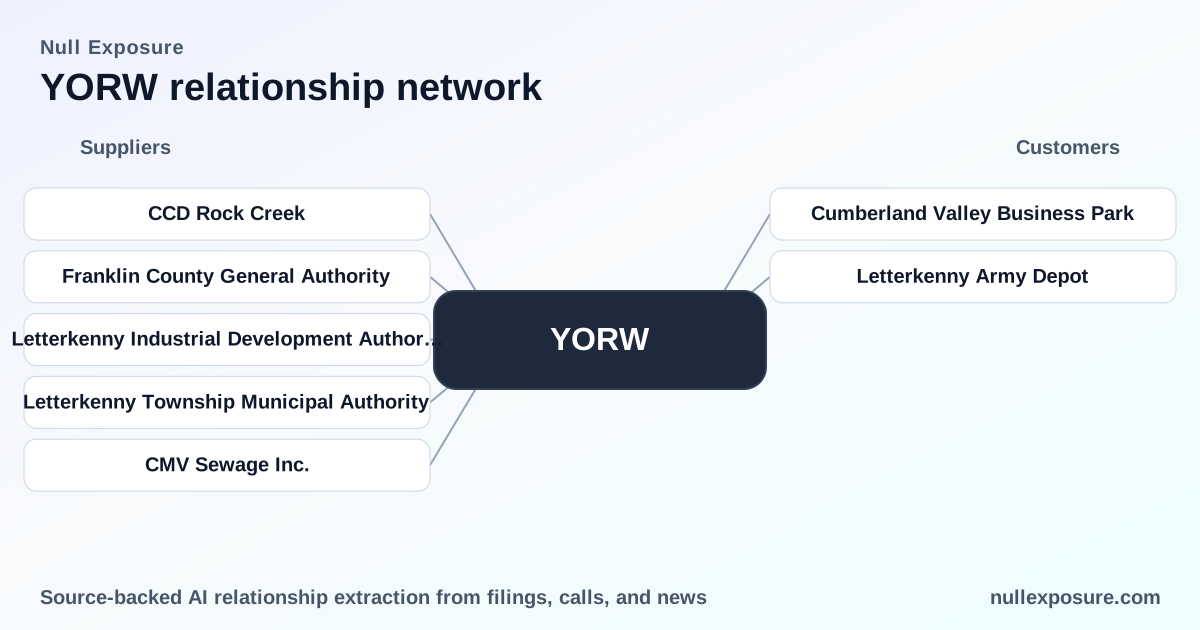
York Water (YORW) supplier map: an acquisitions-led utility footprint
Thesis — York Water builds scale by buying local water and wastewater systems and converting them into regulated utility revenue streams. The company acquires assets from developers and municipal authorities, integrates operations, and monetizes through utility rates and expanded customer bases under state regulatory frameworks. Acquisition-driven network expansion and steady regulated cash flow are the core commercial drivers investors should track. For deeper supplier-risk and counterparty intelligence, visit https://nullexposure.com/.
Why these supplier relationships matter for investors
York Water’s supplier footprint is not a roster of vendors in the traditional sense; it is a trail of asset sellers and legacy operators whose facilities York buys and then operates under utility tariffs. That contracting posture — asset purchases from private developers and municipal authorities — means the company’s supply-side risk is concentrated in acquisition integration, legacy liabilities, and regulatory acceptance of rate base expansion rather than in commodity procurement volatility.
The record in the supplied results shows multiple discrete transactions spanning 2020–2026, which signals a repeatable M&A playbook focused on small municipal and community systems across Pennsylvania counties. These transactions expand customer counts and service footprints while adding operating responsibility for wastewater as well as potable water. For more granular counterparty records and supplier diligence, see https://nullexposure.com/.
Deal-by-deal readouts (plain English, source-linked)
CCD Rock Creek
York Water purchased the water and wastewater facilities serving the Amblebrook Gettysburg community from developer CCD Rock Creek, expanding its footprint across York, Adams and Franklin counties as part of multiple 2020 transactions. According to the York Dispatch (Dec 4, 2020) and a WaterWorld press release covering the FY2020 activity, the acquisition was among several deals that year to grow municipal coverage (York Dispatch, Dec 2020; WaterWorld, FY2020) — https://www.yorkdispatch.com/story/news/local/2020/12/04/york-water-co-acquires-water-and-wastewater-systems-adams-county/3825362001/ and https://www.waterworld.com/water-utility-management/press-release/14188596/york-water-company-acquires-amblebrook-gettysburg-water-and-wastewater-systems.
Franklin County General Authority
York Water closed on purchasing water and sewer systems that were jointly owned by Letterkenny Industrial Development Authority and the Franklin County General Authority, adding municipally-owned assets to its regulated base in 2022. This transaction was announced in a company news release and reported by Public Opinion Online in 2022 (Public Opinion Online, Sept 2022) — https://www.publicopiniononline.com/story/news/local/2022/09/02/york-water-company-buys-franklin-county-water-sewer-systems-pennsylvania/65464239007/.
Letterkenny Industrial Development Authority
The same 2022 closing included assets co-owned by the Letterkenny Industrial Development Authority, transferring local system ownership to York Water and consolidating service under a single regulated operator. Public Opinion Online detailed the joint-ownership transfer and closing in September 2022 (Public Opinion Online, Sept 2022) — https://www.publicopiniononline.com/story/news/local/2022/09/02/york-water-company-buys-franklin-county-water-sewer-systems-pennsylvania/65464239007/.
Letterkenny Township Municipal Authority
York Water had previously acquired the wastewater assets of the Letterkenny Township Municipal Authority in 2020, integrating one of eight wastewater systems the company operates for roughly 5,800 customers in the region. The Public Opinion Online coverage references that 2020 acquisition as part of York Water’s systematic purchases (Public Opinion Online, reporting on FY2022 context) — https://www.publicopiniononline.com/story/news/local/2022/09/02/york-water-company-buys-franklin-county-water-sewer-systems-pennsylvania/65464239007/.
CMV Sewage Inc.
York Water announced an acquisition of wastewater collection and treatment assets serving the Chanceford Crossing community from CMV Sewage Inc., which had operated the utility for three decades before the transfer. Local reporting in 2026 quotes CMV’s owner on the handover and confirms York Water’s assumption of service operations (ABC27, FY2026) — https://www.abc27.com/local-news/york/york-water-company-acquires-wastewater-collection-assets/amp/.
What the relationship map implies about operating posture and risks
These supplier relationships collectively illustrate an acquisition-first operating model: York typically buys completed systems from developers or takes over municipally owned utilities, then converts those assets into rate-base earning operations. That posture produces a set of consistent business-model characteristics:
- Contracting posture: Asset purchases and closings rather than short-term vendor contracts; integrations are one-off but recurring. The company’s counterparties are sellers (developers, authorities, small private operators), not long-term suppliers of consumables.
- Concentration and criticality: Exposure is geographically concentrated in Pennsylvania counties but diversified across many small systems; the services acquired are essential infrastructure (water and wastewater), which elevates operational criticality and regulatory oversight.
- Maturity and repeatability: Transactions from 2020 through 2026 show a repeatable pipeline for small-system consolidation; this is a mature inorganic growth channel that complements regulated rate-base economics.
- Visibility into contract terms: The supplied results do not include purchase agreement terms, indemnities, or long-term service contracts, which is a company-level signal indicating limited public visibility into post-closing liabilities and seller warranties across these deals.
Because the constraints data returned no explicit contractual limits or supplier covenants for YORW, investors should treat absence of disclosed constraints as a governance and disclosure consideration rather than as a risk-free indicator.
Investment implications and actionable points
York Water’s strategy delivers predictable regulated cash flows alongside moderate M&A execution risk. Key takeaways: acquisitions increase rate base and customer counts; seller composition (developers, municipal authorities, small private operators) reduces counterparty credit risk but raises integration and legacy-liability considerations; regulatory approval processes determine the pace at which acquired assets translate into higher allowed returns.
For investors and operators conducting diligence:
- Validate the extent and nature of post-closing warranties and environmental liabilities in historical purchase agreements.
- Monitor regulatory filings and rate cases where acquired assets are folded into the rate base.
- Track the cadence of small-system acquisitions to model future growth and capex needs.
For a structured supplier-risk report and continuous monitoring of YORW counterparties, explore the full service offering at https://nullexposure.com/.
Final verdict and next steps
York Water runs a disciplined, acquisition-led utility strategy: buy small systems, integrate operations, and monetize through regulated rates. The supplier relationships profiled—developers, municipal authorities, and small private operators—support a low-counterparty-credit-risk profile but create exposure to integration costs and legacy liabilities that are not visible in public summaries. For a deeper, transaction-level readout and to subscribe to ongoing counterparty monitoring for YORW, visit https://nullexposure.com/.