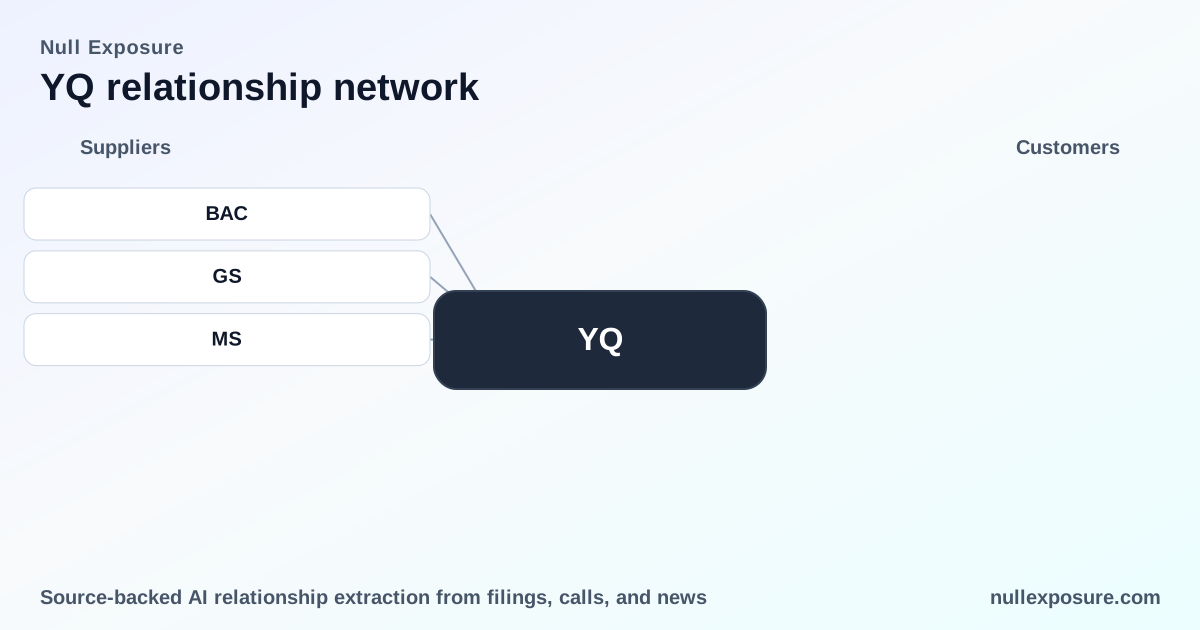
YQ supplier relationships: underwriters, concentration and what investors should price in
YQ operates as an issuer that leverages global capital markets partners to execute financing events; it monetizes through its ongoing business operations while relying on external underwriters to deliver access to public and private capital. The supplier footprint visible here is transaction-centric: investment banks engaged as joint bookrunners provide distribution, pricing and underwriting services that directly enable YQ’s capital-raising activity — a vital operational lever for growth and liquidity. For a concise view of YQ’s supplier posture and next steps for investor diligence, visit https://nullexposure.com/.
Operational snapshot and what the relationship set implies
The public signals available identify a short list of elite capital markets firms acting as transaction suppliers to YQ. This is a financing-led supplier model: the firms named deliver underwriting and bookrunning capabilities, not long-term product supply. That structure drives a distinct set of commercial characteristics:
- Contracting posture: Transactional and event-driven — engagements are structured around discrete capital raises and standard underwriting agreements rather than multi-year supply contracts.
- Concentration and counterparty profile: Concentration is moderate by design — major banks jointly share bookrunner duties, spreading execution risk while concentrating counterparty exposure within large global institutions.
- Criticality: High for near-term financing outcomes — these suppliers control distribution, pricing and execution, so their performance directly affects YQ’s financing costs and timing.
- Maturity and stability: High — the named suppliers are well-capitalized, regulated banks with deep markets expertise, lowering operational counterparty risk.
Note on available company-level intelligence: the company overview returned a rate-limit notice from a provider, so corporate background detail is limited in this feed. Separately, no contract-level constraints were returned for YQ; the lack of explicit constraint data is a company-level signal indicating limited visibility into negotiated terms and covenants from this source. If you want a more complete supplier dossier, start here: https://nullexposure.com/.
Supplier relationships in the record — what was found
The results include three named firms that function as bookrunners/underwriters on a financing for YQ. Each relationship is brief and transactional in the public item cited.
-
BofA Securities — BofA Securities is listed as one of the joint bookrunners on the deal, sharing underwriting and distribution responsibilities with global peers. According to Renaissance Capital’s news item published March 10, 2026, BofA was a named joint bookrunner on the transaction (Renaissance Capital, 2026) — https://www.renaissancecapital.com/IPO-Center/News/73577/Chinese-education-technology-group-17-Education-and-Technology-Group-sets-t.
-
Goldman Sachs (Asia) — Goldman Sachs (Asia) served as a joint bookrunner alongside Morgan Stanley and BofA Securities, providing regional and institutional distribution capabilities for the offering. Renaissance Capital’s March 10, 2026 report lists Goldman Sachs (Asia) as a joint bookrunner on the deal (Renaissance Capital, 2026) — https://www.renaissancecapital.com/IPO-Center/News/73577/Chinese-education-technology-group-17-Education-and-Technology-Group-sets-t.
-
Morgan Stanley — Morgan Stanley is cited as a co-bookrunner on the same offering, contributing underwriting capacity and syndicate placement. The same Renaissance Capital notice dated March 10, 2026 names Morgan Stanley as one of the joint bookrunners (Renaissance Capital, 2026) — https://www.renaissancecapital.com/IPO-Center/News/73577/Chinese-education-technology-group-17-Education-and-Technology-Group-sets-t.
Taken together, these three relationships form the entire supplier list returned against the "supplier" scope in this feed. The common role across all three is underwriting and distribution: a concentrated, high-criticality supplier set for capital markets execution.
What investors should price and prioritize in diligence
Underwriting relationships inform financing cost, repricing risk and execution certainty. For an investor or operator evaluating YQ, focus on the following priorities:
- Execution terms and commitments: Confirm whether underwriting was done on a firm-commitment basis or as a best-efforts syndicate; firm commitments materially reduce execution risk but increase sponsor exposure.
- Fee structure and economics: Determine underwriting fees, greenshoe/overallotment provisions, and any tied advisory fees that affect net proceeds to YQ.
- Lock-ups and secondary market impact: Review share lock-up periods and selling restrictions that influence post-offering float and price stability.
- Conflicts and allocation: Investigate any cross-selling or placement obligations that could affect pricing or preferential allocation to other clients.
- Regulatory and geopolitical overlays: For deals involving regional desks (for example, Goldman Sachs (Asia)), understand regulatory complexity and any approvals that could delay closings.
A short operational checklist:
- Obtain the underwriting agreement or term sheet.
- Verify underwriting commitment type and size.
- Confirm fee schedule, greenshoe details and allocation policy.
- Map dealer relationships to syndicate capacity and investor reach.
- Reconcile any absence of contract constraints with primary diligence documents.
Risk framing and portfolio implications
Concentration in elite underwriters reduces execution risk but concentrates counterparty exposure among large financial institutions — acceptable for most investors but not a diversification substitute if capital-raise frequency is a major operational dependency. Because the suppliers are transaction-based, the most significant risk is not supplier insolvency but execution failure — pricing slippage, weak investor demand, or regulatory barriers that delay or shrink proceeds.
The absence of returned contract constraints is a material diligence gap. Without contract-level terms, investors must assume limited visibility into fees, indemnities, and post-closing obligations until provided with primary documents.
Next steps for active investors
Request underwriting agreements and the syndicate prospectus; quantify potential downside scenarios (e.g., pricing down-round vs. postponed raise); and validate that bank selection aligns with the target investor base for the security in question. For a broader toolkit and supplier intelligence, begin your next review at https://nullexposure.com/.
Conclusion and action
Key takeaway: YQ’s visible supplier footprint is focused, high-quality and transaction-centric — three global banks acting as joint bookrunners are central to any near-term capital strategy. That structure is advantageous for distribution but requires immediate contract-level diligence to understand fees, commitments and post-offering mechanics. If you want a deeper supplier risk profile and contract-level insights, start at https://nullexposure.com/ and request the full supplier due diligence package.