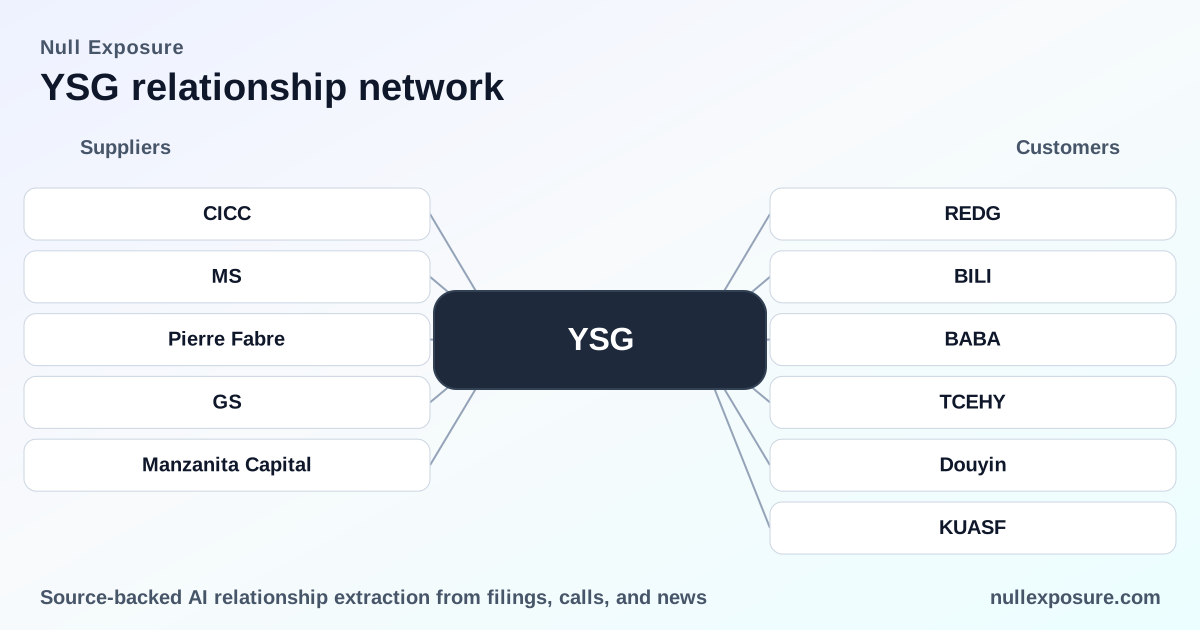
YSG: Supply-side relationships and what they mean for investors
YSG operates as a brand-focused consumer supplier that acquires prestige skincare and premium beauty assets and monetizes them through retail distribution, brand marketing, and portfolio roll-ups that expand gross margin and channel reach. The company’s commercial model combines organic sales of owned brands with balance-sheet-driven expansion (acquisitions) and occasional capital markets engagement that leverages relationships with global investment banks and strategic sellers. For a concise map of counterparties and implications, visit https://nullexposure.com/.
How YSG’s operating model drives revenue and risk
YSG’s economics are straightforward: owning higher-margin prestige brands increases average selling price and customer lifetime value, while an expanded brand roster reduces single-brand concentration and opens new wholesale and travel-retail channels. The firm finances growth through a mix of retained cash, M&A activity, and public capital markets transactions — hence the visible role of investment banks in its corporate lifecycle. That mix creates a business that is simultaneously distribution- and brand-driven: distribution channels (e-commerce, retail, wholesale) convert brand equity into cash, while acquisitions accelerate top-line scale and margin accretion.
- Contracting posture: acquisitive and strategic, focused on buying established prestige labels to accelerate portfolio sophistication.
- Concentration: ownership of multiple premium labels reduces single-brand dependence but raises integration execution risk.
- Criticality: branded assets are mission-critical — supply chains, supplier agreements and brand heritage matter to end-customer pricing power.
- Maturity: activity indicates a company transitioning from pure digital challenger to an omnichannel consumer goods operator with increased complexity in supplier, manufacturing and distribution contracts.
If you want an investor-grade supplier map and ongoing monitoring of relationship shifts, see https://nullexposure.com/ for more detail.
Counterparty map — the relationships you need to watch
Goldman Sachs
Goldman Sachs served as one of the lead underwriters on the company’s U.S. market transaction tied to the Perfect Diary debut, putting the firm in a primary capital-markets role and signaling access to top-tier bookrunners. Source: Kr-Asia report on the Perfect Diary NYSE debut (Mar 10, 2026).
Morgan Stanley
Morgan Stanley joined Goldman Sachs as a lead underwriter on the same financing event, giving YSG a second major global investment bank relationship that supports liquidity and investor distribution for public offerings. Source: Kr-Asia report on the Perfect Diary NYSE debut (Mar 10, 2026).
CICC
China International Capital Corporation (CICC) acted alongside the global banks as a lead underwriter, providing local-market underwriting and distribution capabilities important for Sino-U.S. listings and investor placement. Source: Kr-Asia report on the Perfect Diary NYSE debut (Mar 10, 2026).
Pierre Fabre
YSG acquired the premium French skincare brand Galénic from Pierre Fabre, a transaction that materially raised the company’s exposure to Western prestige skincare and added heritage product lines to its portfolio. Source: WWD feature on the Yatsen acquisition of Galénic (reported Mar 10, 2026) and a follow-up profile in HAPPI (FY2024).
Manzanita Capital
YSG entered a definitive agreement to buy the prestige skincare brand Eve Lom from Manzanita Capital, giving the company direct control of a globally recognized, high-margin skincare label and wholesale/retail distribution footholds. Source: BeautyMatter coverage of the Eve Lom acquisition (reported Mar 10, 2026) and corroborated in a HAPPI profile (FY2024).
What the relationship map says about YSG’s supplier posture
The disclosed relationships show two distinct but complementary supplier dynamics. First, the presence of major investment banks (Goldman Sachs, Morgan Stanley, CICC) signals established capital-market access and institutional underwriting capacity — critical when scaling via public markets or managing large financing tranches. Second, the acquisitions from industry owners (Pierre Fabre, Manzanita Capital) reveal an M&A-led supply strategy: YSG is sourcing finished-brand inventory, intellectual property and heritage product formulas rather than relying solely on in-house brand incubation.
Implication: the company’s supplier risk is concentrated around brand integration, regulatory compliance for acquired SKUs, and maintaining channel relationships post-acquisition. Financial partners mitigate funding risk; strategic sellers deliver brand equity — both are essential to the operating model.
Constraints and company-level signals
The provided data contains no explicit contractual constraints records for YSG in the supplier scope. As a company-level signal, that absence means public-source constraint data did not flag supplier-side legal or contractual limits in this batch; however, the business model itself imposes structural constraints:
- Integration risk: rapid acquisitions require harmonizing supply chains, reformulating and relaunching SKUs across markets.
- Channel contracts: higher reliance on wholesale and travel-retail partners makes distribution agreements a gating factor for growth.
- Capital dependency: continued M&A and marketing-led expansion implies ongoing reliance on market access and banking relationships.
These constraints are company-level inferences drawn from observable behavior (acquisitions and underwriting partnerships), not from explicit contract excerpts.
Investment implications — what to watch next
- Operational execution is the key variable. Acquisitions unlock margin but require supply-chain consolidation and brand stewardship to protect price points.
- Banking relationships reduce capital friction. The trio of underwriters demonstrates public markets access that supports larger financing steps or follow-on public offerings.
- Integration success will determine upside. If YSG preserves brand equity and distribution post-close, margin expansion is plausible; execution failures translate into inventory write-downs or channel pullback.
- Counterparty concentration is moderate but meaningful. A small set of strategic sellers and a small set of lead banks control critical parts of YSG’s expansion pathway.
If you are evaluating YSG as a supplier counterparty or portfolio holding, prioritize diligence on integration plans, contractual terms with distribution partners, and the strength of bank syndication for future financings. For a deeper supplier risk assessment and monitoring of these relationships, visit https://nullexposure.com/.
Final takeaways and next steps
YSG’s supplier landscape is characterized by acquisition-driven growth and direct ties to top-tier underwriters, creating a business that is capital-efficient in scaling brand equity but execution-sensitive. Investors and operators should treat brand integration and distributor contract terms as primary value drivers.
For ongoing coverage and a detailed supplier-risk dashboard tailored for investors, go to https://nullexposure.com/.