YSX Tech: supplier relationships that matter for investors
YSX Tech monetizes a technology-enabled suite of specialty business services focused on the automotive ecosystem — combining insurance distribution, supply‑chain finance and joint physical-service initiatives — and generates revenue through service fees and cross‑selling to dealer and fleet partners. The company completed an IPO in December 2024 to raise working capital and broaden its investor base, and it now relies on a mix of capital‑markets partners, investor‑relations services and strategic commercial alliances to scale distribution and financing products.
For ongoing monitoring of corporate counterparties and market signals visit https://nullexposure.com/.
Where YSX stands today: capital, ownership and operating posture
YSX is a small‑cap, newly public company with significant insider alignment and limited institutional ownership. As of the latest public filings the company reports market capitalization of roughly $36 million, revenue of $78.4 million (TTM) and a modest net margin (~6%), which together imply a business that is revenue‑rich for its market cap but still early on public‑market maturity. Insider holders control ~60% of shares, while institutional ownership is about 1.6%, and the public float is limited; these ownership dynamics drive higher potential volatility and governance concentration, but also create strong founder alignment with long‑term execution.
The company’s contracting posture is that of an issuer scaling commercial relationships post‑IPO — underwritten and counseled in the U.S. market, supported by retained IR services, and pushing product expansion through strategic partners in automotive services and finance. This combination underscores a near‑term agenda focused on distribution growth and liquidity stabilization rather than large M&A or capital‑intensive expansion.
Supplier and service relationships that define near‑term execution
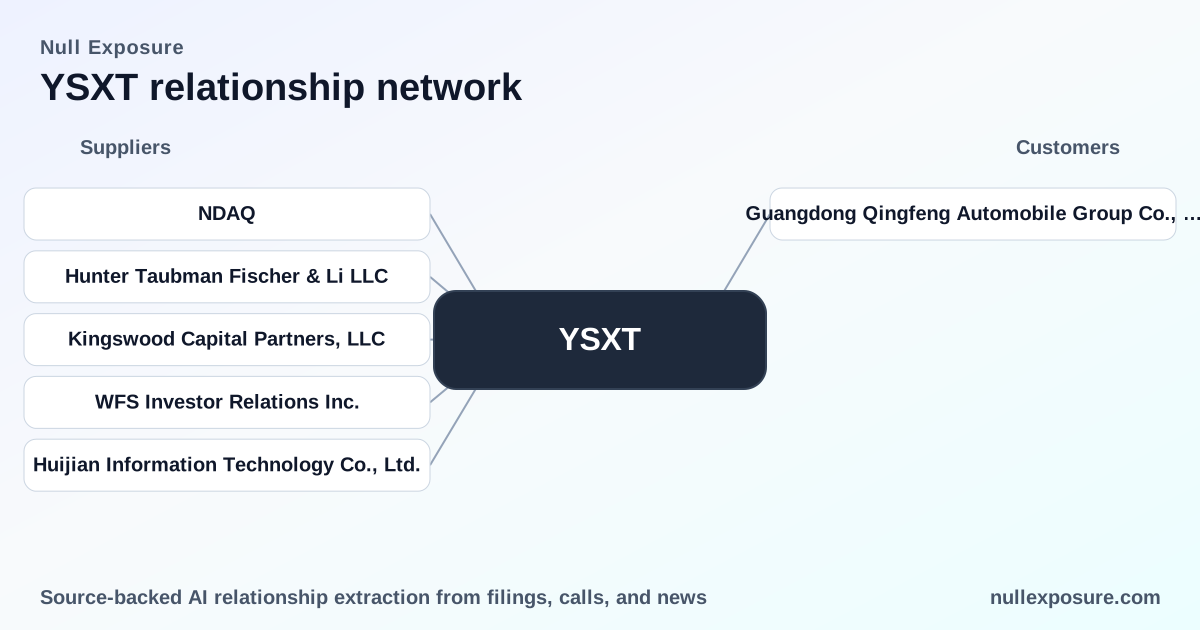
Below are the reported counterparties that are currently shaping YSX’s execution plan and market presence. Each relationship is stated plainly with the source of the disclosure.
-
Nasdaq Capital Market — YSX’s ordinary shares began trading on Nasdaq on December 18, 2024, providing the company with a U.S. listing venue and the liquidity infrastructure crucial to aftermarket trading and capital access, according to a company press release on GlobeNewswire (Dec. 19, 2024).
-
Hunter Taubman Fischer & Li LLC — YSX engaged Hunter Taubman Fischer & Li as its U.S. securities counsel for the IPO, positioning the firm as legal advisor on U.S. regulatory and offering matters, as noted in the IPO coverage reported by QuiverQuant and repeated in the company press release (FY2025/FY2024 announcements).
-
Kingswood Capital Partners, LLC — Kingswood acted as the sole book‑runner for the offering, handling placement and distribution of the IPO shares and underwriting logistics, as described in both the GlobeNewswire announcement and media coverage of the closing (Dec. 2024 / FY2024 filings).
-
WFS Investor Relations Inc. — The company lists WFS Investor Relations (Janice Wang contact) as its retained investor‑relations provider across multiple company disclosures and interim financial announcements, indicating an outsourced IR strategy to manage communications with U.S. and Hong Kong/China investors (company press releases for FY2025 and FY2026).
-
Huijian Information Technology Co., Ltd. — YSX has announced a strategic alliance with Huijian to bolster its auto insurance and supply‑chain finance capabilities, expected to expand product distribution and cross‑selling opportunities across dealer networks, as disclosed in the company’s unaudited results and accompanying commentary (GlobeNewswire, Feb. 3, 2026).
Each of the above relationships is documented in the company’s public announcements and media coverage around the IPO and subsequent interim results; those notices form the basis for assessing counterparties and operational priorities.
For deeper supplier mapping and continuous updates, visit https://nullexposure.com/.
Why these counterparties matter to investors
- Listing venue and book‑runner: Nasdaq listing plus a dedicated book‑runner (Kingswood) provide primary market access and initial liquidity support; underwriting choice signals the scale and distribution strategy the company used to bring shares to market.
- Legal and IR supports: U.S. securities counsel and retained IR establish the company’s capability to interact with U.S. markets and investors — essential for follow‑on raises, secondary offerings, and investor confidence.
- Commercial alliance (Huijian): The strategic partnership is operationally critical, because it directly supports YSX’s ability to deliver insurance and supply‑chain finance products into auto channels; success or failure here will materially impact revenue growth and cross‑sell economics.
Operational constraints and business‑model signals
Presenting company‑level signals drawn from the public record that shape supplier risk and operational flexibility:
- Contracting posture: Recently completed IPO suggests the company is in a transition from private to public contracting norms — an increase in disclosure and formalized counterparty agreements is underway, but boutique underwriting and external counsel indicate capital markets relationships are still being developed.
- Concentration: ~60% insider ownership and low institutional participation (≈1.6%) create concentrated control, which accelerates decision cycles but raises minority‑holder governance risk and potential liquidity drag.
- Criticality of partners: The Huijian alliance is a revenue and distribution accelerant; if execution stalls, the company’s ability to scale insurance/finance products will be impaired.
- Maturity and scale: Small market cap, limited analyst coverage, and modest EBITDA (~$5.4 million) imply YSX is early in public‑market maturity; investors should price in higher execution risk and episodic volatility.
Key operational risks to track include underwriting support for future capital raises, execution milestones on the Huijian collaboration, and IR effectiveness in broadening the shareholder base.
- Market and execution risks summary:
- Limited float and high insider concentration can amplify price moves.
- Dependence on a single strategic partner to expand key product lines.
- Small capital raise at IPO (~$5.75 million reported in coverage) relative to growth ambitions.
Investment implications and recommended next steps
YSX represents a small‑cap, founder‑aligned play on insurance and supply‑chain finance in the automotive sector with near‑term upside tied to partnership execution and market liquidity. Investors and counterparties evaluating supplier exposure should:
- Monitor Huijian partnership milestones and product rollout timelines.
- Watch liquidity and post‑IPO trading patterns on Nasdaq and any aftermarket support actions from Kingswood or other market makers.
- Track IR outputs (WFS Investor Relations communications) for clarity on capital needs and roadmap.
For ongoing supply‑chain and counterparty intelligence, check updates at https://nullexposure.com/.
In sum, YSX’s supplier slate — capital markets partners, legal counsel, IR services and a strategic operational partner — collectively shape both its short‑term liquidity and medium‑term revenue trajectory; diligence should focus on execution updates from the Huijian collaboration and any signs of broadened institutional ownership that would reduce governance concentration risk.