Yum China (YUMC): Supplier map and what it means for investors
Yum China operates and monetizes as China’s master franchisee and restaurant operator for multiple global quick-service brands: it owns, operates and franchises KFC, Pizza Hut and other concepts across mainland China, generates revenue from company-operated stores, franchise fees and the sale of centrally procured food and paper products to its restaurants, and captures incremental margins through digital ordering, delivery and payment flows. The company’s procurement posture, long-term brand licenses and dependence on digital payment rails are structural features that shape supplier risk, bargaining power and operational resilience. Explore supplier-level intelligence at NullExposure to map counterparties and contract risk.
How Yum China’s operating model converts into cash flow
Yum China’s business model blends asset-light franchising with asset-heavy company stores. The firm centrally purchases substantially all food and paper products for its network, sells and delivers those goods to its owned and franchised restaurants, and collects the majority of sales through mobile and third‑party payment processors. Financial scale is material: revenue TTM is about $11.8 billion and market capitalization sits near $19.1 billion, so supplier relationships directly affect margins and service continuity. According to the company’s filings, digital payments accounted for roughly 99% of sales in 2024, making payments infrastructure an operationally critical input.
Contracting posture, concentration and maturity — the operating constraints that matter
Yum China’s public disclosures create a clear set of company-level signals for investors evaluating supplier and partner exposure:
- Long-term real estate commitments: the company leases over 13,800 properties with initial lease terms typically of 10–20 years, which increases the importance of stable supply and predictable input pricing (from Yum China’s 2024 Form 10‑K).
- Multi-decade brand licenses: the KFC and Pizza Hut licenses run 50 years (with automatic 50‑year renewal possibilities) and thereby lock Yum China into long-term brand economics while making upstream supplier reliability commercially significant for decades.
- Buyer centralization: Yum China centrally procures substantially all food and paper products and then sells and distributes them to its restaurants — a centralized procurement model that concentrates buying power and single-point operational risk.
- Critical dependence on digital rails and third-party services: mobile payments and delivery aggregators are essential to revenue collection and fulfilment; the company relies on third‑party payment processors and delivery platforms to clear transactions and deliver orders.
- Scale and active supplier base: the company partners with over 800 independent suppliers across China, indicating broad supplier coverage combined with important single-supplier exposures.
For deeper supplier-level analytics and counterparty scoring, go to NullExposure.
Key supplier and partner relationships you need in your model
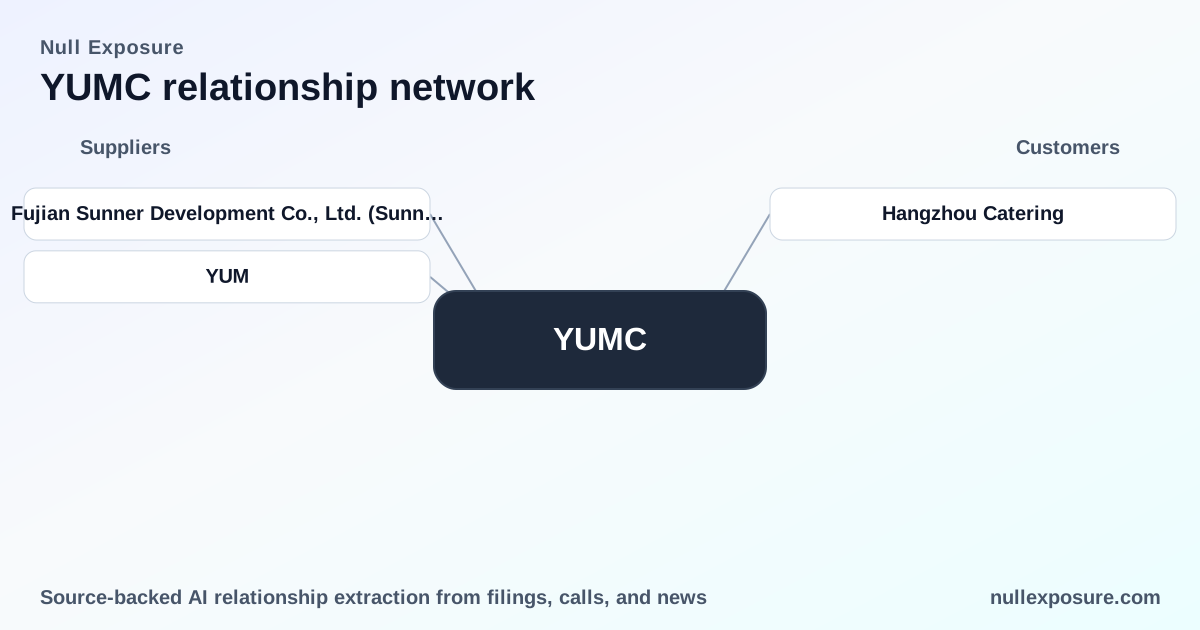
Fujian Sunner Development Co., Ltd. (Sunner)
Sunner is China’s largest white‑feathered chicken producer and Yum China’s largest poultry supplier, making it a cornerstone input for KFC and other chicken menu items; the relationship is explicitly identified in Yum China’s 2024 Form 10‑K (FY2024). According to the company’s 10‑K, this supplier status indicates concentrated exposure in the poultry category.
Yum Brands (YUM)
Yum China operates KFC, Pizza Hut and other brands in mainland China under an exclusive license from Yum Brands, so Yum Brands controls brand standards and licensing terms that shape Yum China’s strategic options; this licensing relationship was described in a March 2026 ad‑hoc news report covering the company’s operating model.
KFC
Yum China is the master franchisee and principal operator of KFC in mainland China, running KFC at scale and collecting supply and service economics through its central procurement and distribution model; this position is documented in Simply Wall St coverage in March 2026.
Pizza Hut
Yum China similarly holds the master franchisee position for Pizza Hut in China and operates Pizza Hut alongside KFC, creating shared procurement and distribution efficiencies that are also detailed in Simply Wall St articles from March 2026.
What these relationships imply for risk and value creation
- Supplier concentration vs. scale: having over 800 suppliers creates diversity, but single large suppliers such as Sunner introduce concentrated operational risk for poultry‑dependent menu items; any supply disruption or price shock at Sunner would transmit directly to food costs and store-level margins.
- Long-term licensing is a strategic asset: the 50‑year KFC and Pizza Hut license terms provide durable brand exclusivity and predictable revenue streams, while creating a dependency on maintaining “good standing” under license renewal conditions.
- Central procurement amplifies both buying power and single-point risk: central purchasing enables lower unit costs and tighter quality controls, but it also means supplier failures or logistics breakdowns have system-wide effects.
- Payments and delivery are mission-critical service relationships: with digital payments representing nearly all sales, third‑party payment processors and delivery aggregators are operationally critical — downtime or regulatory disruption in these rails affects revenue immediate and profoundly.
Practical investor checklist
- Stress test margin scenarios for poultry price shocks attributable to supplier disruption at Sunner given Yum China’s central procurement model.
- Model the economic value of the 50‑year KFC/Pizza Hut licenses as a cash flow stabilizer, balanced against operational obligations to maintain brand standards.
- Monitor third‑party payment processor and aggregator credit health and regulatory exposure given the 99% digital payments penetration reported for 2024.
- Assess supplier diversification efforts beyond the largest vendors and track logistics resilience given long-term property leases and fixed store footprints.
For actionable counterparty risk reports and supplier-level exposure analytics, visit NullExposure.
Bottom line for investors
Yum China’s supplier landscape is a mix of scale-driven procurement advantages and concentrated single-supplier risks. The company’s long-term brand licenses and extensive store footprint create stable demand for core inputs, but the combination of centralized buying, a dominant poultry supplier, and near-total digital payment dependence makes operational risk management central to sustaining margins. Investors should treat supplier relationships — especially large commodity suppliers and payments/delivery partners — as first-order variables in valuation and scenario analysis.
Dive deeper into supplier-level risk and contractual exposure at NullExposure — supplier counterparties are where operational stress translates into valuation movements.