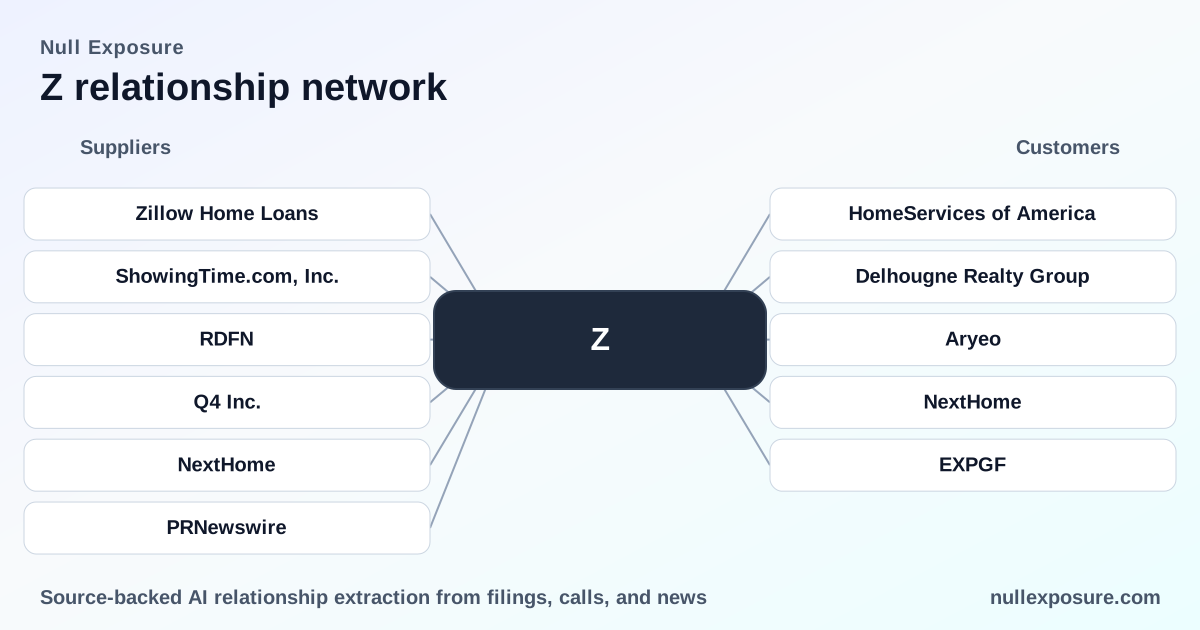
Zillow Group (Z) — Supplier relationships, contractual posture, and investor implications
Zillow Group operates a digital real estate platform that monetizes through agent lead products, advertising, software subscriptions, rentals and mortgage origination, and increasingly through professional services such as Zillow Pro and affiliated lending via Zillow Home Loans. The company blends transaction-driven revenue (agent leads and mortgage fees) with recurring platform revenue (subscriptions and data services); supplier relationships underpin both customer-facing features and the capital flows that enable mortgage origination. For a focused supplier-risk view, follow the supplier map below and consider how short‑term financing and large committed spend shape execution risk.
Learn more about supplier intelligence at the source: https://nullexposure.com/
How suppliers practically plug into Zillow’s business model
Zillow’s supplier posture reflects a mixed contracting strategy: short-term market financing sits alongside multi-year purchasing and hosting commitments. The constraints reported for the company point to the following company-level signals:
- Contracting posture: Zillow uses short-term master repurchase agreements to finance Zillow Home Loans’ origination pipeline while also maintaining a $500M revolving credit facility maturing in 2031, indicating a blend of liquidity layering (short-term warehouse-style funding plus longer-term backstop).
- Spend concentration and scale: Public disclosures list hundreds of millions in active borrowings under repurchase arrangements and $260M of non-cancelable purchase commitments spanning 2026–2029 — a firm-level signal that supplier spend and financing exposure are material to cash flow.
- Criticality and maturity: Zillow depends on third-party service providers to host core systems and manage data, which makes infrastructure suppliers operationally critical; purchase commitments across content and cloud services suggest moderate-term vendor relationships rather than one-off engagements.
Where a constraint explicitly names a relationship, it is attributed accordingly: Zillow Home Loans is documented as using master repurchase agreements to supply short-term capital to mortgage origination.
The relationships that matter — one by one
Below are the supplier and partner references surfaced in company materials and press coverage, each with a concise plain-English summary and source.
Zillow Home Loans
Zillow Home Loans serves as Zillow’s affiliate mortgage lender and provides real-time mortgage rates used to power customer-facing affordability tools, while its operations are funded in part by master repurchase agreements that provide short-term capital for originating loans. According to Zillow investor materials (FY2021–FY2024), Zillow Home Loans is both a product channel and a financing recipent via repurchase agreements; company filings describe the use of these agreements to bridge loan issuance and sale to investors. (Zillow investor releases and filings, FY2021–FY2024 — see Zillow investor news and SEC filings.)
ShowingTime.com, Inc.
ShowingTime, acquired by Zillow Group in 2021, integrates tour scheduling into Zillow’s agent ecosystem and is used by many Premier Agents to streamline showings. Zillow announced the acquisition in a 2021 investor news release describing ShowingTime as the industry leader in home-touring technology. (Zillow press release, FY2021 — investors.zillowgroup.com)
Redfin Corporation
Regulatory reporting and news outlets captured a high‑impact dispute: the FTC filed a lawsuit alleging Zillow paid Redfin to exit the large apartment rental advertising market, with alleged payments of at least $100 million to suppress competition. This litigation raises antitrust and reputational risk for Zillow’s marketplace conduct. (GlobeNewswire report summarizing the matter and shareholder litigation, FY2025 — globenewswire.com)
Q4 Inc.
Zillow’s investor-facing web pages and press materials are powered by Q4’s investor relations technology; multiple investor releases (FY2022–FY2025) carry “Powered By Q4 Inc.” footers, indicating Q4 provides IR platform services and is a recurring vendor for investor communications. (Zillow investor news pages, FY2022–FY2025 — investors.zillowgroup.com)
NextHome
NextHome executed an agreement to align with Zillow’s listing access standards, a signal that Zillow continues to formalize relationships with franchisors and broker networks to secure listing breadth and distribution. (Market coverage on partnership alignment, FY2025 — quantisnow.com)
PR Newswire
PR Newswire distributed Zillow’s October 15, 2025 release announcing Zillow Pro, Zillow’s new suite for agents; PR Newswire acted as the distribution channel for major product announcements. (PR Newswire release distribution, Oct 15, 2025 — prnewswire.com)
Risk and opportunity read-throughs for investors
Zillow’s supplier posture generates clear operational and financial vectors investors should watch:
- Funding risk concentrated in mortgage operations: The use of master repurchase agreements positions Zillow Home Loans to be sensitive to short-term funding conditions and interest-rate mechanics; the company also reported $364M of borrowings under these arrangements at a recent balance date, indicating sizable exposure. (Company disclosure snippets on repurchase borrowings, FY2025.)
- Committed spend is meaningful and multi-year: $260M in non-cancelable purchase commitments across 2026–2029 signals fixed-cost obligations for content, cloud and partnerships that constrain free cash flow flexibility. Treat these as recurring operational leverage rather than discretionary spend.
- Operational concentration on third‑party infrastructure: Dependence on external hosting and service providers makes outages or contract disputes material to product availability; this is a structural operational risk for any consumer platform with high traffic.
- Regulatory and competitive headlines carry outsized impact: The FTC/Redfin matter is a governance and antitrust risk with potential financial and behavioural remedies; investors should treat litigation timelines as drivers of near‑term volatility.
Key takeaways:
- Funding and supplier commitments are large enough to affect liquidity and margin under adverse market conditions.
- Operational stability depends on a small set of critical vendors for hosting and investor communications.
- Regulatory exposures (e.g., the FTC case involving Redfin) are the primary event risk for valuation multiples.
Explore supplier analytics and stay ahead of these risks at https://nullexposure.com/
What to monitor next quarter-by-quarter
Investors and operators should track the following signals on a recurring basis:
- Mortgage origination volumes, warehouse borrowing levels, and the spread between origination and sale timing (impacting repurchase borrowing needs).
- Changes to non-cancelable purchase commitments and disclosures about cloud/content supplier terms.
- Adoption metrics for ShowingTime and Zillow Pro among agents, which feed lead-generation revenue trends.
- Progress and developments in the FTC/Redfin litigation and related shareholder suits.
- Platform uptime and vendor replacement activity tied to major hosting suppliers.
Bottom line and action
Zillow combines consumer marketplace scale with material supplier financing and purchase commitments, and its risk profile is a function of short-term funding for mortgages, multi-year vendor commitments, and regulatory event risk. For investors evaluating supplier concentration and liquidity implications, the interplay between Zillow Home Loans’ financing tools and the company’s multi-year purchase commitments is the primary place to focus. For a deeper supplier-risk playbook, visit https://nullexposure.com/ — the single best place to operationalize supplier signals into investment decisions.
Bold, direct monitoring of funding lines, vendor commitments, and antitrust developments will separate informed investors from the market consensus.