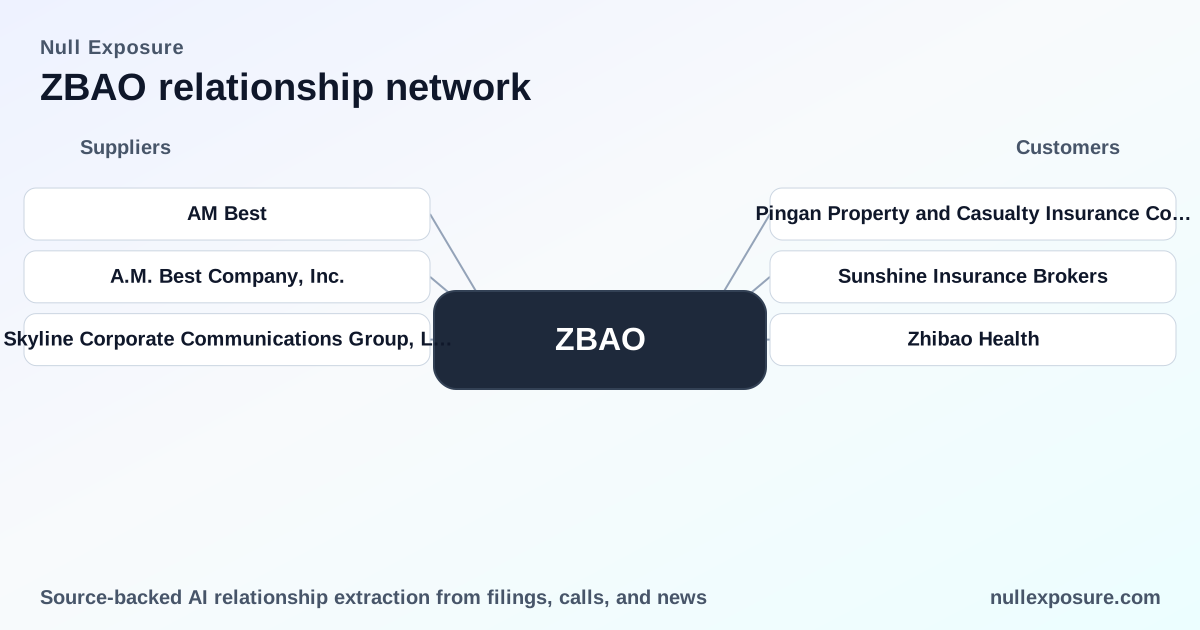
Zhibao Technology (ZBAO): Supplier relationships that matter for underwriting and distribution
Zhibao Technology operates a China-focused digital insurance brokerage platform and monetizes primarily through commissioned brokerage and value-added digital services to insurers and consumers; the company also controls insurance-capital vehicles (notably Zhibao Labuan) that support underwriting economics. Investors should evaluate Zhibao as a hybrid distribution and insurance-capital operator: revenue scales with policy volumes and digital penetration, while earnings swing with underwriting activity and integration of reinsurance/insurance vehicles. Learn more and track supplier/partner signals at https://nullexposure.com/.
How Zhibao makes money and what the financials reveal
Zhibao is a digital intermediary: it collects premiums and places risk with carriers, earns commissions and fees on policy placements, and is expanding productized digital offerings (including AI-driven agents) to increase wallet share per customer. Revenue TTM is $276.9 million with gross profit of $113.6 million, indicating durable top-line scale for a small-cap NASDAQ-listed broker. Profitability is negative: operating margin TTM is -43.9% and diluted EPS is -$0.28, reflecting investment in distribution, product development and the capital cost of affiliated reinsurance. Market capitalization is modest ($26.95 million) while insiders control nearly half the stock (46.7% insiders), which concentrates governance and strategic control.
Key financial signals:
- Scale in distribution with material gross profit, but operating losses that reflect growth and capitalized underwriting activity.
- High insider ownership creates centralized decision-making; institutional ownership is negligible (0.02%), which increases execution risk if management turnover occurs.
- Price multiples are not meaningful due to negative earnings, though forward EV/Revenue and EV/EBITDA ratios imply low market expectations relative to revenue.
Supplier and third-party relationships: what the record shows
Below I cover every named relationship in the available results and summarize the practical implications for investors.
AM Best / A.M. Best Company, Inc.
A.M. Best has assigned a Financial Strength Rating of B+ (Good) and a Long-Term Issuer Credit Rating of “bbb-” (Good) to Zhibao Labuan Reinsurance Company Limited, giving Zhibao controlled insurance capital a recognized industry rating that improves counterparty credibility and capacity for assumed business; the rating action was reported as effective November 6, 2025 and disclosed in Zhibao investor materials in early 2026 (Newsfile and FinancialContent, Jan–Nov 2025/2026). This rating reduces friction for cedants and reassures distribution partners that Zhibao’s Labuan vehicle has an independent assessment of balance-sheet strength (A.M. Best / Newsfile press releases, Nov 6, 2025–Jan 2026).
Source: A.M. Best rating announcement aggregated in company press releases and industry coverage (Newsfile/FinancialContent, November 2025 – January 2026).
Skyline Corporate Communications Group, LLC
Skyline Corporate Communications is the retained investor-relations and PR agency that issued multiple company announcements including the FY2025 results, Nasdaq deficiency disclosure and subsequent regaining-of-compliance notice, and product launches (AI agents), indicating Skyline is Zhibao’s public-communications supplier and filing disclosure conduit (Newsfile releases and trading notices, late 2025–early 2026). Skyline’s releases are the source for the company’s formal investor updates and strategic narrative.
Source: Company press releases distributed via Newsfile and market aggregators referencing Skyline Corporate Communications Group, LLC (Newsfile/TradingView/The Globe and Mail, Nov 2025 – Mar 2026).
What these relationships imply for operations and risk profile
There are no extracted contractual constraints in the relationship feed, which itself is a company-level signal: the public relationship record emphasizes ratings and communications, not onerous supplier limitations. From the available relationship signals, investors should infer the following operating model characteristics:
- Contracting posture: centralized and disclosure-driven. Zhibao uses a retained PR firm for consistent external messaging and relies on its internally controlled Labuan reinsurer for capital, suggesting direct control over key suppliers and fewer dispersed third-party dependencies.
- Concentration: material concentration of governance and strategic execution. Insider ownership near 47% and low institutional ownership concentrate decision rights and increase the influence of a tight leadership group over supplier selection and capital allocation.
- Criticality: high criticality of the Labuan reinsurance vehicle. The AM Best rating demonstrates that the reinsurance arm is operationally and commercially material—its solvency and rating status directly affect underwriting capacity and partner acceptance.
- Maturity: early-growth but operationally scaled. Revenue and gross profit show established market access; negative operating margins indicate a company still investing to mature its product and underwriting footprint.
Investment implications: opportunities and risks
Zhibao sits at the intersection of digital distribution and insurance capital, which creates asymmetric opportunities and concentrated risks.
Opportunities
- Rating validation of the Labuan reinsurer supports growth in assumed business and larger policy placements, which can lift commission economics and margin over time (A.M. Best rating, Nov 2025).
- Productization and AI agent rollout expand monetizable services beyond plain brokerage and improve customer acquisition efficiency (company press release, 2026).
Risks
- Operating losses and leverage to underwriting outcomes mean quarterly performance will be volatile; regulatory or rating setbacks at the Labuan vehicle would constrain capacity quickly.
- Information and governance concentration (high insider ownership, low institutional float) reduces independent oversight—this affects minority shareholder protections and the ease of external capital raises.
- Reliance on a small set of public-communication suppliers for disclosures increases reputational risk if messaging misaligns with market expectations; the company disclosed a Nasdaq deficiency and then regained compliance via Skyline announcements (Newsfile/TradingView, Nov 2025–Jan 2026).
Mid-read action: for a focused supplier-risk report or to monitor Zhibao’s third-party exposures and rating developments, see https://nullexposure.com/.
Practical next steps for investors and operators
- Monitor A.M. Best’s outlook and any changes to Zhibao Labuan’s Financial Strength Rating, as downgrades would constrict capital flow and partner appetite (A.M. Best / industry press, Nov 2025).
- Hold management accountable for a path to operating profitability; track quarterly trends in operating margin and underwriting loss as the clearest gauge of sustainable monetization.
- Assess governance: request clarity on insider-aligned transactions, related-party reinsurance terms, and minority holder protections given the concentrated ownership profile.
- Confirm that disclosures continue to be issued through formal channels and that Nasdaq compliance remains stable; PR cadence is currently managed by Skyline (Newsfile/TradingView, 2025–2026).
Final note and recommended next step: the two public supplier relationships disclosed—A.M. Best for rating validation and Skyline for investor communications—are consequential and actionable; investors should prioritize rating vigilance and governance review. For ongoing supplier and third-party monitoring on Zhibao and comparable China-focused insurtech suppliers, visit https://nullexposure.com/.