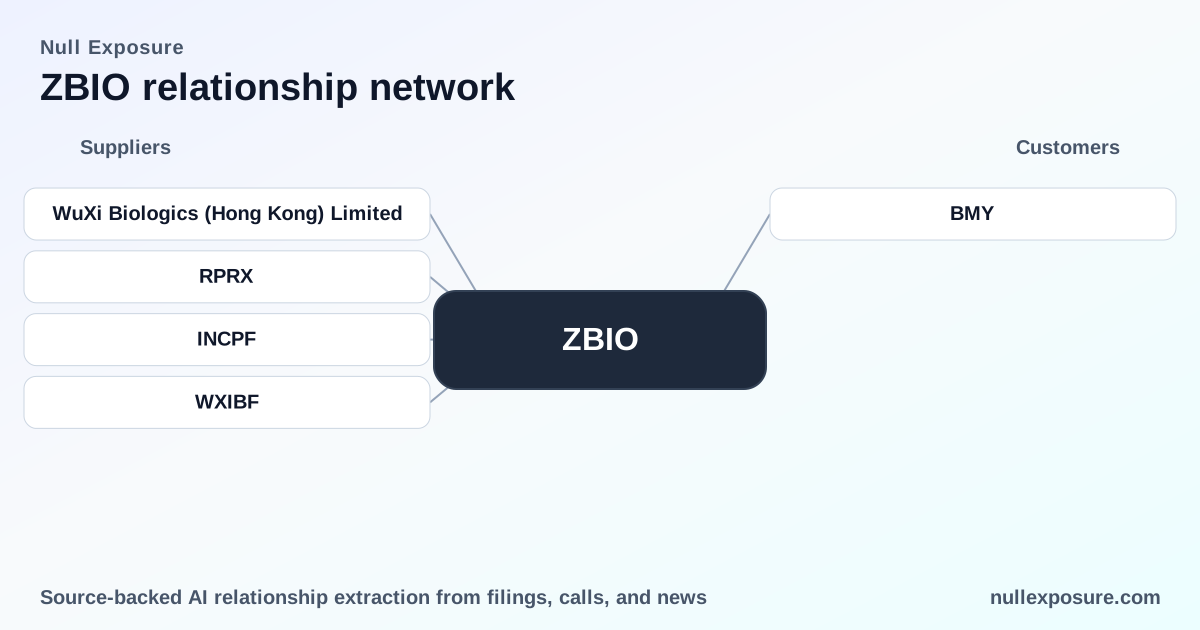
Zenas BioPharma (ZBIO) — supplier relationships that define commercial risk and runway
Zenas BioPharma is a clinical-stage immunology-focused biopharmaceutical company that monetizes through product development, partner licenses, and milestone-linked financing while depending on external manufacturers and collaborators to convert clinical assets into commercial medicines. The company’s value realization hinges on successful Phase 3 outcomes (notably INDIGO), the transition to commercial manufacturing for obexelimab and orelabrutinib, and milestone-driven cash infusions from commercial partners. For a concise supplier risk snapshot and to monitor counterparties across Zenas’ lifecycle, visit https://nullexposure.com/.
How Zenas runs its supplier base — concentrated, contractual, and capital-sensitive
Zenas operates a lean, outsourced manufacturing and services model: it does not maintain in-house labs or production capacity and relies on third-party CMOs and service vendors for R&D and manufacturing. Public filings and press releases show a single-source manufacturing posture today, a master services/framework ordering approach, and long-term commercial supply commitments aimed at securing product supply for potential launches. The operational profile is therefore defined by high supplier concentration, contractual lock-in, and material dependency on off‑site manufacturing capacity.
- Contracting posture: Zenas orders obexelimab drug substance and product under a master services agreement and reports long-term commercial supply agreements for WuXi Biologics, signaling formal, renewable commitments rather than ad-hoc spot buys.
- Concentration and geography: Manufacturing is currently centered in China with a sole CMO relationship that is critical to timelines; the company has also signaled selection of additional CMOs in the U.S., indicating active diversification.
- Financial exposure: Zenas disclosed $15.3 million of clinical manufacturing contract payment obligations (payable within 12 months) and modest fixed-lease obligations, which create near-term cash outflows tied directly to supplier contracts.
These characteristics create a defined set of operational levers and risks investors and operators must monitor: single‑source availability, validation and transfer timelines, and milestone financing cadence.
Supplier relationships you must track
WuXi Biologics (Hong Kong) Limited — the manufacturing backbone
Zenas identifies WuXi Biologics as its current sole contract manufacturing organization for obexelimab drug substance and drug product, and the company has a long-term commercial supply agreement and master services ordering relationship with WuXi. According to the company’s FY2024 Form 10‑K and subsequent press releases in January–February 2026, Zenas explicitly cites WuXi as the primary CMO supporting clinical and anticipated commercial supply. (Sources: Zenas BioPharma 2024 Form 10‑K; GlobeNewswire press releases Jan–Feb 2026)
Royalty Pharma — milestone-linked funding that raises single-data risk
Zenas structured a funding arrangement with Royalty Pharma that ties milestone payments to predefined success criteria in the Phase 3 INDIGO trial and later regulatory events, concentrating material financial upside and near-term liquidity on a single registrational readout. Market commentary in FY2025 outlines this funding deal and the contingent nature of sponsor payments. (Source: analysis and market report, TS2.Tech, FY2025)
InnoCare Pharma / InnoCare — partner and license-holder for orelabrutinib
Zenas executed a license agreement with InnoCare that granted exclusive development, manufacturing and commercialization rights for orelabrutinib in multiple indications and geographies, and InnoCare is named as a partner located in China in Zenas’ corporate disclosures. The December 2025 press release and subsequent January 2026 announcements document the license structure and the partnership framing. (Sources: GlobeNewswire press release Dec 15, 2025; GlobeNewswire Jan 5, 2026)
What the constraints tell investors about the operating model
The company-level constraint signals extracted from filings and releases paint a coherent operational picture:
- Framework and long-term contracting: Zenas orders under a master services agreement and maintains long-term commercial supply agreements—this creates contractual predictability but also lock-in costs and transfer friction if a supplier becomes unavailable.
- Critical single-source exposure: Filings explicitly state that the loss of the CMO would introduce delay and cost to re‑ qualify replacements, establishing manufacturing as a critical dependency for commercial timelines.
- Geographic concentration and diversification signals: Much of the existing manufacturing base is in APAC (China), though Zenas has selected new CMOs in North America as part of a strategic de‑risking and supply redundancy effort.
- Balanced spend profile: Near-term contract obligations for clinical manufacturing are material to operating cash flow (roughly $15.3 million within 12 months), while other obligations such as lease commitments are modest by comparison.
Together these constraints define a supplier risk posture that is contractually mature but operationally brittle: strong, explicit agreements exist, but supplier concentration and validation requirements create outsized operational and timeline risk.
Investment implications and operational priorities
For investors and operators evaluating Zenas, these are the actionable implications:
- Manufacturing continuity is the single largest operational risk; track WuXi’s delivery metrics, quality signals, and any progress on U.S.-based CMO qualification and tech transfer timelines. A delay in CMO availability directly impacts commercialization and milestone realization.
- Milestone financing magnifies binary outcome risk; Royalty Pharma’s payments tied to INDIGO concentrate financing around a single data readout, making near-term market moves sensitive to trial timing and endpoints.
- Partner economics and territorial rights matter; the InnoCare license for orelabrutinib shapes addressable markets and potential royalty streams—monitor commercialization milestones and any sub‑licensing activity.
- Liquidity planning should incorporate contract payment timing; the $15.3 million clinical manufacturing obligations due within 12 months are a concrete cash outflow to model into the company’s runway.
For continuous monitoring and counterparty intelligence, review supplier contract milestones and public filings on an ongoing basis — and if you want an organized supplier risk feed, check https://nullexposure.com/ for structured monitoring.
Practical checklist for operational due diligence
Operators and acquirors should prioritize:
- Confirming redundant qualified CMOs and documented tech transfer timelines.
- Verifying contract termination and change-of-supplier clauses in master services agreements.
- Stress-testing cash flow under delayed milestones given Royalty Pharma funding dependencies.
- Validating regulatory-compliance documentation and inspection histories for WuXi and selected U.S. CMOs.
These steps convert supplier awareness into mitigations that protect timelines and value capture.
Bottom line and next steps
Zenas BioPharma’s supplier profile is central to its commercial thesis: highly contractual and mature on paper, but operationally concentrated and therefore materially risky until dual-source manufacturing and successful tech transfers are completed. Investors should treat manufacturing continuity and milestone-linked financing as primary drivers of valuation re‑rating.
For a centralized view of Zenas’ counterparties and ongoing supplier risk signals, visit https://nullexposure.com/. If you want tailored monitoring or deeper counterparty reports, explore the platform at https://nullexposure.com/ and set alerts for contract and manufacturing filings.