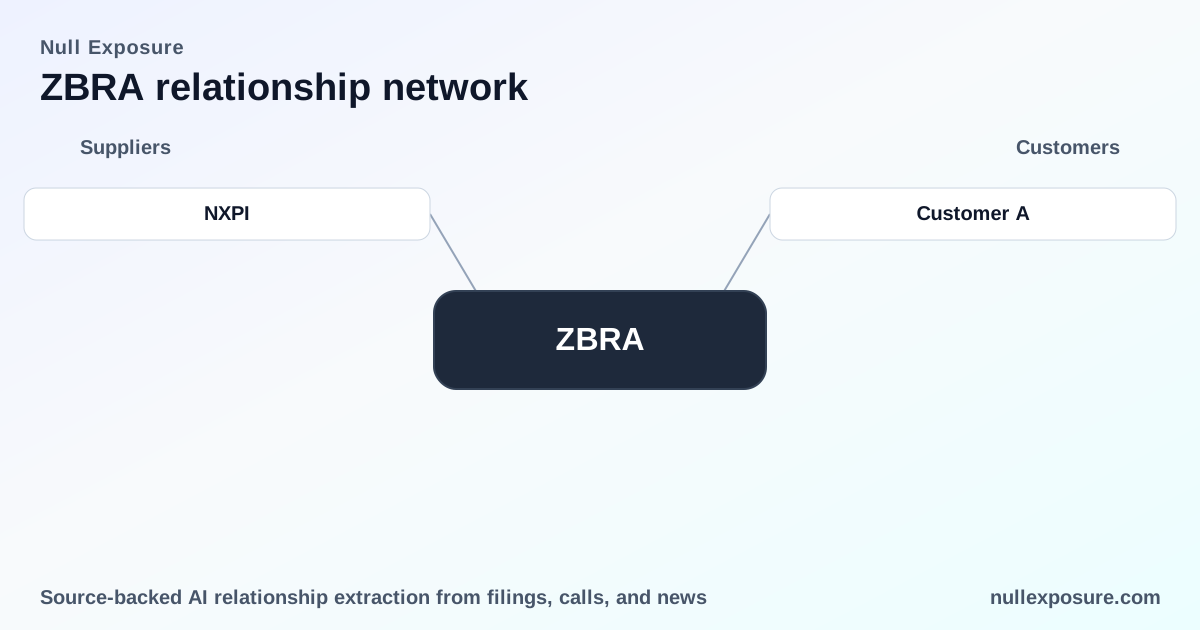
Zebra Technologies (ZBRA): supplier relationships, operating constraints, and what investors need to know
Zebra Technologies manufactures and sells barcode, RFID and specialty printing hardware and associated identification solutions that service manufacturing, logistics, retail, healthcare and government customers. The company monetizes through device and consumable sales, integrated identification solutions, and recurring enterprise service contracts, with a $5.396B revenue base and a market capitalization near $10.3B providing the commercial scale to negotiate multi-year supplier commitments and maintain global channel coverage.
Explore supplier intelligence and supplier risk profiles at https://nullexposure.com/ to map these relationships back into portfolio decisions.
High-level takeaway for investors
Zebra runs a hardware-centric supply chain whose economics are shaped by outsourced assembly in Asia and Mexico, multi-year supplier commitments, and significant concentration around electronics manufacturing services (EMS) and joint design manufacturers (JDMs). These characteristics produce steady operating leverage when demand is stable, but they also concentrate operational and geopolitical risk in a limited set of geographies and manufacturing partners. On valuation, Zebra’s forward P/E of about 11x (forward) and operating margin near 15% imply that the market is pricing in continued margin capture tied to efficient sourcing and stable supply continuity.
Visit https://nullexposure.com/ for a deeper dive into supplier exposures and contractual commitments.
How the supplier footprint constrains operations and strategy
- Geographic concentration: Final assembly is performed primarily in the Asia‑Pacific region (China, Malaysia, Vietnam, Taiwan) and Mexico. That concentration creates exposure to regional supply shocks, logistics disruption, and changing tariff regimes while also enabling cost-competitive manufacturing.
- Contracting posture and maturity: Zebra uses EMSs and JDMs to produce to its specifications, reflecting a mature outsourcing posture where the company controls design while third parties handle scale production. This reduces capital intensity but increases reliance on third‑party execution and quality control.
- Spend scale and commitments: Zebra discloses multi-year contractual commitments totaling about $101 million across forecasted periods, which places certain supplier relationships in a high spend band and signals committed capacity purchases rather than purely spot buying.
- Operational criticality and concentration risk: Outsourced manufacturing is critical to product availability; any extended disruption at EMS/JDM partners or in the APAC/Mexico production footprint would directly impact hardware shipments and revenue recognition cadence.
These constraints are company-level signals derived from Zebra’s disclosure about manufacturing locations, supplier types, and contractual commitments; they do not assign a constraint to any single named supplier unless explicitly stated in source excerpts.
Relationship-level review: every supplier mention in the record
Zebra’s relationship results in the supplied records reference NXP Semiconductors across two press items. Both must be included and are summarized below.
NXP Semiconductors — eeJournal coverage (Mar 10, 2026)
Zebra cites NXP’s new UCODE X as delivering the read/write sensitivity required for Zebra’s next‑generation RFID solutions, aligning product roadmaps to the GS1 G2V2 standard to expand RAIN RFID ecosystem interoperability. This indicates a technical supplier relationship where NXP’s tag ICs underpin Zebra’s RFID product performance (eeJournal, March 10, 2026; article on NXP UCODE X).
NXP Semiconductors — CXO Today press release (Mar 10, 2026)
In a similar disclosure, Zebra references NXP’s UCODE X for industry‑leading read/write sensitivity and low power consumption, signaling product-level dependence on NXP’s silicon to meet Zebra’s operational and performance targets for high‑volume RFID deployments (CXO Today, March 10, 2026; NXP press release).
Both items point to NXP as a component-level supplier whose IC performance is embedded in Zebra’s RFID offerings, and Zebra publicly positions this collaboration as enabling higher throughput and expanded ecosystem compatibility.
What these supplier signals mean for investors and operators
- Supplier criticality: Components from suppliers like NXP are embedded into finished RFID hardware; those relationships are functionally critical even if manufacturing is outsourced to EMS/JDM partners. Component shortages or design discontinuities would propagate through to finished goods availability.
- Concentration across the value chain: Manufacturing execution is concentrated in APAC and Mexico while key components can concentrate around a few semiconductor vendors; the result is layered concentration risk—geographic at the assembly level and vendor at the component level.
- Contracting risk and flexibility: Multi‑year commitments totaling ~$101M indicate Zebra secures committed capacity and predictable supply for at least a subset of needs, which improves forecastability but reduces spot flexibility when demand dynamics change.
- Operational maturity: The use of JDMs/EMSs to produce to Zebra’s designs reflects a mature outsourcing model that keeps capital requirements lower while requiring strong supplier governance and quality assurance disciplines.
Risk factors that should move valuation or operating decisions
- Geopolitical and logistics risk tied to the APAC and Mexico manufacturing footprint.
- Component concentration risk in semiconductor suppliers that supply critical RFID ICs.
- Contract rigidity from multi‑year commitments that lock in spend regardless of demand cycles.
These risks justify a focused supplier risk premium for investors and a prioritized supplier‑continuity program for operators.
Bottom line and recommended next steps
Zebra’s business model converts design and software/firmware value into scale by outsourcing assembly and embedding third‑party components such as NXP’s RFID ICs. Investors should treat Zebra as a hardware platform operator with structured supplier commitments and layered concentration risk that is offset by scale, margin resilience, and product differentiation. Operational diligence should prioritize supplier governance, component diversification, and contingency planning in APAC/Mexico manufacturing hubs.
For portfolio teams and procurement leaders who want a rollup of supplier commitments, concentration maps, and contract maturity profiles, start your investigation at https://nullexposure.com/.
If you want a bespoke supplier risk brief or portfolio-level exposure map for hardware OEMs, visit https://nullexposure.com/ to engage with supplier intelligence tools and tailored analysis.