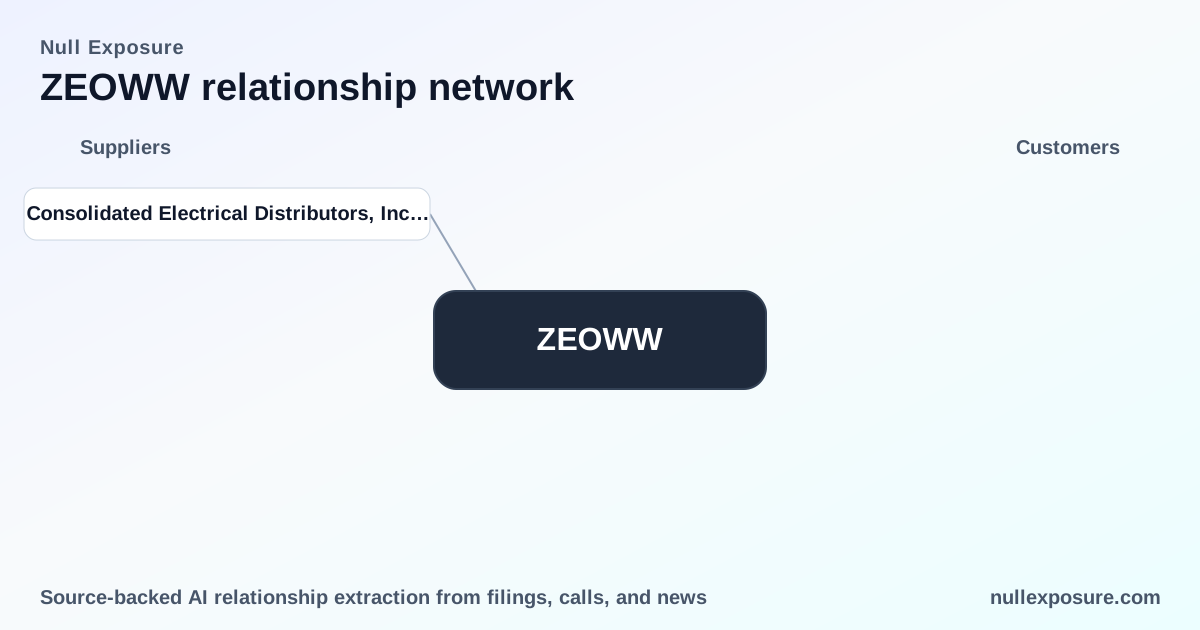
ZEOWW: Supply concentration, vendor credit, and operational leverage you need to model now
Zeo Energy Corp operates as a residential and small-commercial energy services provider that sells and installs solar energy systems and related energy-efficiency products and monetizes through equipment sales, installation services, and project revenue. The company runs an asset-light logistics posture—most equipment is drop-shipped by regional distributors—and relies materially on third‑party suppliers and subcontractors while using vendor credit to finance inventory purchases. For investors and operators evaluating supplier risk, the supplier relationship with Greentech (Consolidated Electrical Distributors, Inc.) is the dominant commercial spine of the operating model. Explore supplier disclosures and operational levers further at https://nullexposure.com/.
How Zeo makes money and why supplier behavior drives margins
Zeo’s top-line profile is straightforward: equipment sales and installation services drive revenue, supported by energy-efficiency add-ons such as insulation, roofing services, and hybrid water heaters. The company reported Revenue (TTM) of $69.43 million and gross profit of $40.09 million, but profitability is stressed—EBITDA was negative $6.97 million and profit margin ran -17.9%. According to Zeo’s FY2024 disclosure, the company supplements its in-house installation crews with subcontractors for some residential solar installs and for all insulation and certain other services, which keeps fixed labor costs variable but increases operational reliance on third parties.
Those line items make supplier relationships and logistics critical to both cash flow and gross margin realization: vendor selection, delivery timing, and credit terms flow directly into working capital and the path to profitability.
Why the Greentech relationship is the single most important supplier risk
Consolidated Electrical Distributors, Inc. (doing business as Greentech Renewables) is Zeo’s primary supplier and inventory partner. According to Zeo’s FY2024 Form 10‑K, the company purchased approximately 70% of the equipment that it installed in 2024 from Greentech, and Greentech holds inventory and drop-ships directly to installation sites. The 10‑K further discloses that purchases from Greentech are covered by a credit agreement under which Greentech extends credit, with Zeo obligated to pay by the 15th day of the month following each purchase. This creates concentrated supplier exposure coupled with short-term vendor financing that materially affects working capital. (Source: Zeo Energy FY2024 10‑K, filed Dec 31, 2024.)
Key takeaway: Greentech is both a supplier and an operational partner—responsible for ~70% of installed equipment and for inventory management and logistics—so supply disruption, pricing changes, or adverse credit re-pricing at Greentech would have immediate and material consequences for Zeo.
Operational and financial implications investors must model
Zeo’s disclosures and financials combine into a clear set of operating constraints you must incorporate into a valuation or risk assessment:
- Concentration risk is high. Purchasing ~70% of installed equipment from a single distributor creates a single-point supplier dependency; model scenarios where Greentech raises prices or restricts supply and assess cadence impacts on backlog and margin.
- Vendor credit is short-term and operationally binding. Greentech’s credit terms require payment by the 15th of the month following purchase; that structure reduces up-front cash outlay but transfers rollover and liquidity risk to Zeo’s P&L and working capital. Treat vendor credit as a financing line with variable capacity in stressed scenarios.
- Logistics and drop-shipping drive inventory risk but reduce balance-sheet inventory. Drop-shipping reduces carried inventory but increases reliance on distributors to meet installation schedules; account for potential project delays and their cost (customer churn, subcontractor idle time, warranty exposures).
- Subcontractor reliance is a company-level operational signal. Zeo uses subcontractors to install some solar systems and to deliver all insulation and certain other services, converting fixed labor into variable costs but increasing coordination complexity and quality control exposure.
Financially, negative EBITDA and negative margins alongside double-digit quarterly revenue growth (quarterly revenue growth YoY +21.6%) indicate growth is accelerating but profitability and capital efficiency lag. Investors should stress-test scenarios where supplier pricing normalizes higher or vendor credit tightens, and quantify how much margin expansion depends on supply stability versus cost reductions.
Mid-analysis action: review supplier contract provisions and ask for supplier concentration disclosures and historical vendor payment performance—useful diligence resources are available at https://nullexposure.com/.
Full supplier relationship coverage (no omissions)
Consolidated Electrical Distributors, Inc. (d/b/a Greentech Renewables): Zeo purchased at least approximately 70% of the equipment it installed in 2024 from Greentech, and Greentech provides inventory management by holding equipment until it is delivered directly to the customer site; purchases are made through a credit agreement that requires Zeo to pay by the 15th day of the month following each purchase. (Source: Zeo Energy FY2024 10‑K, Dec 31, 2024.)
That is the only supplier relationship called out in the supplier disclosures; the 10‑K also details the company’s use of subcontractors for installation and insulation services as a separate operational practice (company-level signal).
Practical checklist for investors and operators
- Request the Greentech credit agreement and run scenario analyses for early termination, pricing changes, and shortened payment windows.
- Obtain delivery performance history (lead times, fill rates) from Zeo and, if possible, from Greentech to stress-test schedule risk.
- Evaluate contingency supplier channels and lead-times to replace up to 70% of installed equipment—quantify cost delta and implementation time.
- Audit subcontractor coverage, contracts, and insurance to understand installation quality and warranty liabilities.
Actionable investor next step: if you’re performing diligence, request supplier-level P&L sensitivity and the vendor financing schedule to reconcile working capital assumptions; more resources are available at https://nullexposure.com/.
Bottom line: a concentrated supply chain that dictates valuation sensitivity
Zeo Energy’s revenue growth is real, but profitability and working capital are highly sensitive to its relationship with Greentech. The vendor-financed, short‑term credit structure combined with a 70% purchasing concentration turns supplier negotiations and logistics into first-order drivers of cash generation and margin improvement. For investors, the correct risk premium must reflect both concentration and vendor-credit exposure; for operators, priority one is supplier diversification and tighter contractual protections.
Finalize your supplier diligence checklist and scenario models now—visit https://nullexposure.com/ for structured templates and supplier-risk benchmarking to convert these disclosure signals into quantified risk adjustments.