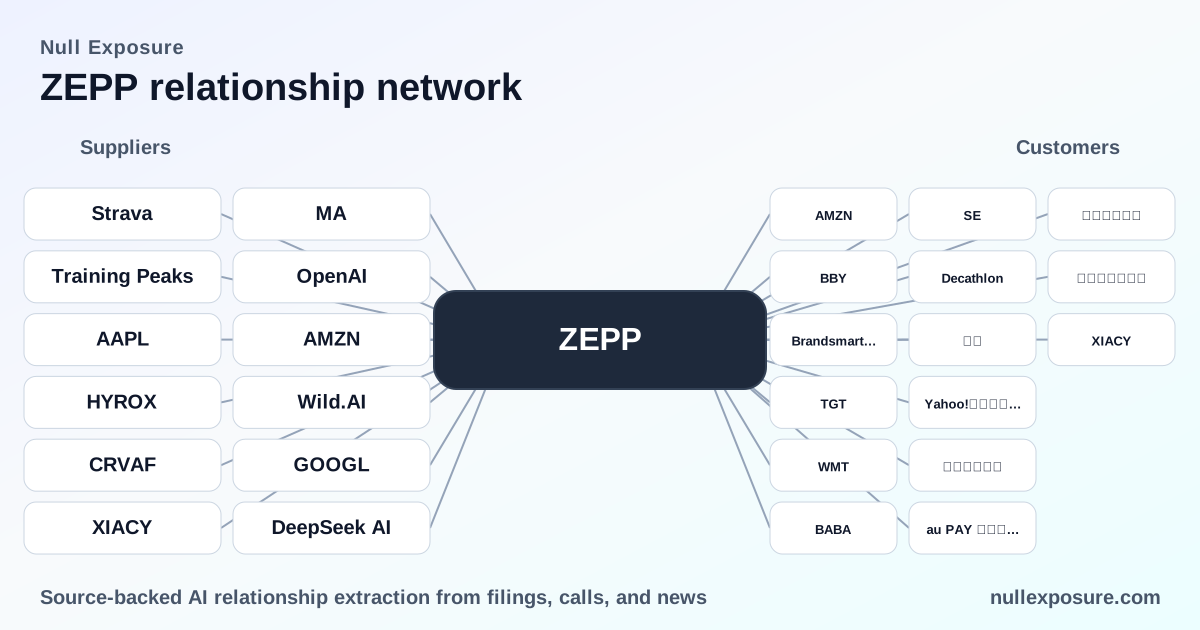
Zepp Health (ZEPP): supplier map and what it means for investors
Zepp Health builds and monetizes a vertically integrated wearables ecosystem: it sells smartwatches and bands, captures biometric and activity data through the Zepp app, and then converts that recurring user engagement into services and platform features (payments, AI assistants, third‑party integrations). Revenue is a blend of hardware sales and platform-enabled services — payments, AI-powered features, and app integrations — that increase lifetime value and reduce hardware-only margin pressure. For a focused supplier-risk read on these relationships, see more at https://nullexposure.com/.
How Zepp runs the supplier playbook
Zepp operates as a product-led platform company that outsources specialized capabilities while keeping hardware R&D and device manufacturing core to control unit economics. The company’s contracting posture is pragmatic: it partners with dominant cloud and AI providers for scale, with niche app partners for user experiences, and license/payment partners to unlock services revenue. That mix reduces go-to-market friction but creates dependency on several third parties for features that differentiate Amazfit devices.
Key operating signals investors should track
- Concentration and criticality: Cloud and AI suppliers are high-impact — a change in cost or terms (cloud compute, LLM usage) directly affects Zepp’s operating margin and product pricing.
- Maturity of relationships: Partnerships with incumbents (Mastercard, AWS, Google) imply commercial scale and enterprise-grade SLAs; integrations with newer entrants (DeepSeek AI, Wild.AI) indicate product experimentation and modular sourcing.
- Contracting posture: Public disclosures and press reports indicate commercial rather than equity alliances, signaling flexibility but also potential vulnerability to price or policy changes from suppliers.
- Data governance and geography: Use of AWS regions in the U.S. and Germany and integration with major cloud AI vendors supports compliance positioning in key markets, but also centralizes risk with those providers.
Explore supplier risk scoring and consolidated partner views at https://nullexposure.com/.
Vendor relationships: detailed review
Below are every supplier relationship surfaced in recent reporting, with a concise plain-English summary and source note.
-
Mastercard — Zepp’s Amazfit Balance supports tap-and-go payments through Mastercard, enabling contactless transactions across multiple countries and creating a direct path to payments revenue. According to a BetaNews product report (FY2026), the device supports tap‑and‑go payments in 31 countries via partnerships with Mastercard and Curve.
Source: BetaNews (March 2026). -
Curve — Curve is named alongside Mastercard as a payments partner powering tap-and-go wallet functionality on the Amazfit Balance, extending card aggregation and payment routing capabilities to Zepp users. BetaNews covered this capability in its March 2026 review.
Source: BetaNews (FY2026). -
OpenAI — Zepp integrates OpenAI models into the Zepp app and Zepp OS features (including a Food Log and in-watch assistant), using OpenAI to deliver conversational and image-recognition functionality that enhances user engagement and reduces manual effort. Multiple reports from FY2025–FY2026 document OpenAI integrations, including NotebookCheck and Zepp’s public commentary about Zepp OS and Food Log features.
Sources: NotebookCheck (FY2025); company commentary cited in FY2025 reporting. -
Google Gemini — Zepp uses Google Gemini alongside OpenAI in a hybrid AI architecture for Zepp OS 5.0, a configuration the company credits with improving functionality while lowering cost-per-interaction. This hybrid approach was discussed in an earnings call transcript (FY2025).
Source: InsiderMonkey transcript (FY2025). -
Google (platforms and health sync) — Beyond Gemini, Zepp syncs activity and health metrics with Android/Google ecosystems (Google Health), enabling cross-platform data portability and tie-ins with Android devices. Japanese coverage of earlier device generations documents Google Health sync for activity and sleep data (FY2022).
Source: Mynavi (FY2022). -
Amazon Web Services (AWS) — Zepp stores app data in AWS regions (U.S. and Germany) to meet GDPR and security requirements, signaling reliance on AWS for scalable, compliant backend services. FoneArena reported on Zepp app infrastructure and data residency practices (FY2024).
Source: FoneArena (FY2024). -
Amazon (Alexa voice assistant) — Some Amazfit models include Alexa voice-assistant support and interoperate with Amazon accounts, adding voice-enabled convenience features and ecosystem reach. Japanese product reporting from FY2022 documents Alexa integration.
Source: Mynavi (FY2022). -
Wild.AI — Zepp partners with Wild.AI to deliver women’s wellness features on Amazfit watches, expanding specialized health functionality and addressing a niche user cohort that increases device stickiness. AthletechNews reported this integration as a FY2024 initiative.
Source: AthletechNews (FY2024). -
DeepSeek AI — Zepp has discussed evaluating DeepSeek AI as a potential cost-reduction partner for running AI features, which signals active vendor optimization to control operating costs for compute-heavy services. NotebookCheck noted Zepp’s consideration of DeepSeek in product reporting (FY2025).
Source: NotebookCheck (FY2025). -
Strava — Zepp’s platform integrates activity and training data with Strava, enabling social and performance features that drive engagement among endurance and enthusiast users. An earnings-call transcript referenced this integration as part of ecosystem expansion (FY2025).
Source: InsiderMonkey (FY2025). -
TrainingPeaks — Zepp integrates with TrainingPeaks for structured training plans and coaching workflows, supporting advanced athlete use cases and differentiating Amazfit in the sports segment. This integration was also mentioned in the FY2025 earnings call transcript.
Source: InsiderMonkey (FY2025). -
HYROX — Zepp includes HYROX Race Mode in several Amazfit watches, targeting indoor competitive fitness users and strengthening product-market fit for high-intensity training segments. NotebookCheck documented HYROX mode on Amazfit devices (FY2025).
Source: NotebookCheck (FY2025). -
Xiaomi — Reporting on Zepp’s shipment performance referenced market dynamics with Xiaomi’s wearables; a FY2024 industry report noted that declines in Xiaomi and self-branded products affected shipment mixes and competitive pressures. This indicates competitive overlap and channel-level demand sensitivity.
Source: SGBOnline (FY2024).
What investors should watch next
- Cost of AI and cloud: Zepp’s hybrid AI strategy materially reduces per-use cost today — this is a major margin lever. Track AI vendor terms and cloud-region pricing changes.
- Payments monetization: Mastercard/Curve partnerships open recurring revenue streams; monitor take-rates, geographic rollouts, and regulatory requirements.
- Ecosystem stickiness: Third‑party integrations (Strava, TrainingPeaks, Wild.AI, HYROX) increase retention; quantify active user conversion to paid features.
- Supplier concentration risk: Heavy reliance on AWS and two major AI providers concentrates operational risk; scenario stress-tests should model supplier pricing and availability shocks.
For a consolidated supplier risk profile and model scenarios, visit https://nullexposure.com/.
Bottom line
Zepp’s supplier map reflects a deliberate strategy: outsource scale-critical infrastructure and AI to market leaders, partner with niche fitness and wellness apps for differentiated features, and leverage payments partners to create recurring revenue. This mix reduces time‑to‑market and increases feature velocity, but it also concentrates exposure to cloud and AI vendors and to payments network terms. Investors should value Zepp not only as a hardware seller but as a platform operator whose margin trajectory depends on supplier economics and the company’s ability to convert integrations into monetized services. For deeper supplier analytics and scenario modeling, go to https://nullexposure.com/.