Zeta Global (ZETA) — Supplier Relationships and Strategic Implications for Investors
Zeta Global is an AI-driven marketing cloud that monetizes through a mix of recurring subscription software, data licensing, and usage- or performance-based media fees charged to enterprise customers. The company builds proprietary consumer intelligence and layers machine learning-driven campaign orchestration on top of that asset, then sells access to the stack via multi-year licenses, month-to-month subscriptions and performance-linked media arrangements with publishers and partners. For investors, the supplier map is central: data suppliers, cloud/AI partners, and media vendors collectively determine product differentiation, cost structure and margin volatility. Learn more about supplier mapping and risk scoring at https://nullexposure.com/.
The short take: why suppliers are a financial lever for Zeta
Zeta’s gross margins and growth profile are driven by two supplier dynamics: first, the rights and duration of data licensing that feed its consumer intelligence; second, the pricing and billing model of media and technology partners where fees are frequently revenue-share or usage-based. The company’s operating model blends sticky, contractual revenue (subscriptions and long-term licenses) with variable costs tied to campaign performance (cost-per-click, CPM, rev-share)—a structure that magnifies leverage when revenue scales and penalizes margins when media costs spike. Institutional ownership is high, and that puts supplier announcements under close scrutiny because any change to third-party terms has immediate earnings implications.
Explore Zeta supplier signals and risk indices: https://nullexposure.com/
Public relationship signals — what is on the record
-
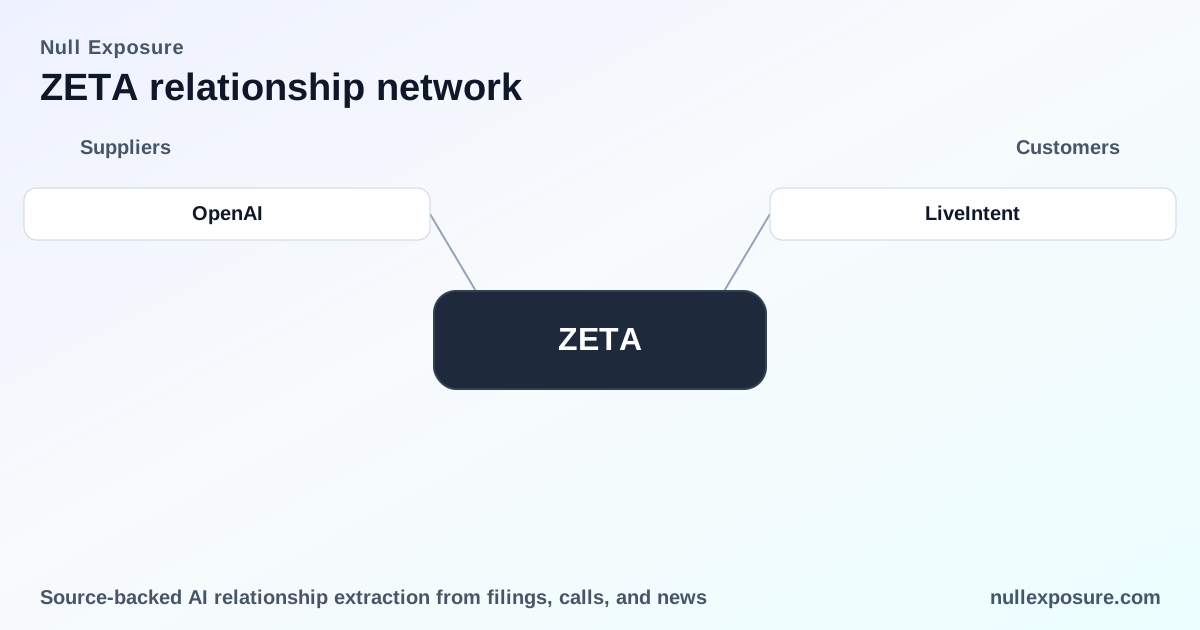
OpenAI — TS2 Tech reported in March 2026 that Zeta announced a strategic partnership with OpenAI to power an enterprise marketing agent branded “Athena by Zeta,” and that the announcement contributed to a near-52-week high in Zeta’s share price. The tie to OpenAI is presented as a product enhancement designed to accelerate AI capabilities in marketing (TS2 Tech, March 10, 2026).
-
OpenAI — A separate TS2 Tech item in March 2026 reiterated the partnership framing, noting that Zeta has been marketing itself as an “AI marketing cloud” and that the OpenAI relationship was a focal point of recent headlines. The coverage emphasized market reaction to the announcement (TS2 Tech, March 10, 2026).
-
OpenAI — A third TS2 Tech article in March 2026 described the partnership as centered on “Athena,” an AI agent for marketing teams, and tied the disclosure to day-to-day stock price movements and regulatory filings newsflow. The report underscored the commercial narrative Zeta is using to position the product (TS2 Tech, March 10, 2026).
Each of the three items stems from the same wave of public reporting in early March 2026 and converges on the same commercial claim: Zeta has formalized an AI partnership that feeds its product roadmap and investor narrative (TS2 Tech coverage, March 10, 2026).
What that OpenAI linkage means for product and revenue
The OpenAI partnership is a strategic accelerator for Zeta’s go-to-market: it upgrades the company’s AI proposition, shortens time-to-market for advanced agent capabilities, and strengthens enterprise sales pitches. For revenue, the collaboration enables cross-sell opportunities inside existing accounts and provides a platform for premium pricing tiers tied to advanced AI features. From the cost side, integration with third-party AI models introduces a new class of variable costs—model usage and inference fees—that convert software margin into a hybrid of fixed subscription and per-use expense. The market reaction to the announcement confirms investor sensitivity to supplier-enabled product differentiation.
Company-level constraints and what they signal about contracting posture
The public disclosures and company filings reveal consistent characteristics across Zeta’s supplier base. These are company-level signals, not specific to any single partner:
-
Licensing is a core modality. Zeta routinely purchases and licenses third-party data and retains a mix of perpetual and term-limited rights depending on vendor agreements, which creates variability in long-term data portability and cost predictability.
-
Long-term contracts co-exist with subscription deals. The company uses perennial license terms in some cases and fixed-term subscriptions in others, producing a revenue base that is partially sticky but also subject to renewal cycles.
-
Subscription and usage-based billing are both material. Zeta’s infrastructure supports traditional MRR plus usage-based monetization such as cost-per-lead or cost-per-impression arrangements—this duality magnifies upside but introduces volatility when campaign volumes change.
-
Role diversity: licensor and service integrator. Zeta acts both as a buyer/licensor of data and as a service provider that engages external specialists for security, testing and integration functions—this increases operational complexity and puts a premium on vendor governance.
These constraints imply that investors should evaluate not just the existence of partnerships, but the contractual mix (perpetual vs. term), renewal cadence, pricing units (flat vs. usage) and vendor substitution cost.
Concentration, criticality and maturity considerations
-
Concentration risk: Zeta’s business depends on aggregating many data and media relationships, so a small number of critical suppliers—particularly those providing unique data or AI models—would create outsized operational leverage. The OpenAI announcement elevates one such relationship into a potentially high-criticality supplier role.
-
Criticality and vendor lock: Perpetual licensing clauses in some agreements increase product defensibility; however, term-limited licenses tied to exclusive features create the opposite effect when vendors can withhold or change access.
-
Maturity of supplier engagements: The mix of long-term licenses and subscription contracts signals a maturing commercial model but also a heterogenous vendor landscape where contractual inconsistency can complicate forecasting.
Investors should therefore treat supplier disclosures as forward-looking indicators of margin sustainability and product durability.
Risk checklist for investors and operators
- Validate whether AI-model fees are treated as pass-through or absorbed by Zeta’s margins.
- Confirm renewal terms and perpetual versus term-limited rights on core data feeds.
- Track revenue correlation between Athena rollout and upsell/retention in enterprise cohorts.
- Monitor media cost exposure where payments are CPC/CPM or rev-share.
If you want a structured supplier risk brief tailored to Zeta and comparable peers, visit https://nullexposure.com/ to request a bespoke analysis.
Final assessment and recommended next steps
Zeta’s supplier profile combines strategic AI partnerships that enhance product value with a mixed-contract economics that produces both recurring revenue and variable cost exposure. The OpenAI relationship is an important product and narrative lever, but the underlying company-level contract types—licensing, long-term, subscription and usage-based arrangements—are the real drivers of margin and operational risk. Investors should prioritize contract-level disclosures, cost pass-through mechanics, and renewal timelines when underwriting growth.
For deeper maps of supplier criticality, contract types and exposure scenarios, get a tailored report at https://nullexposure.com/.