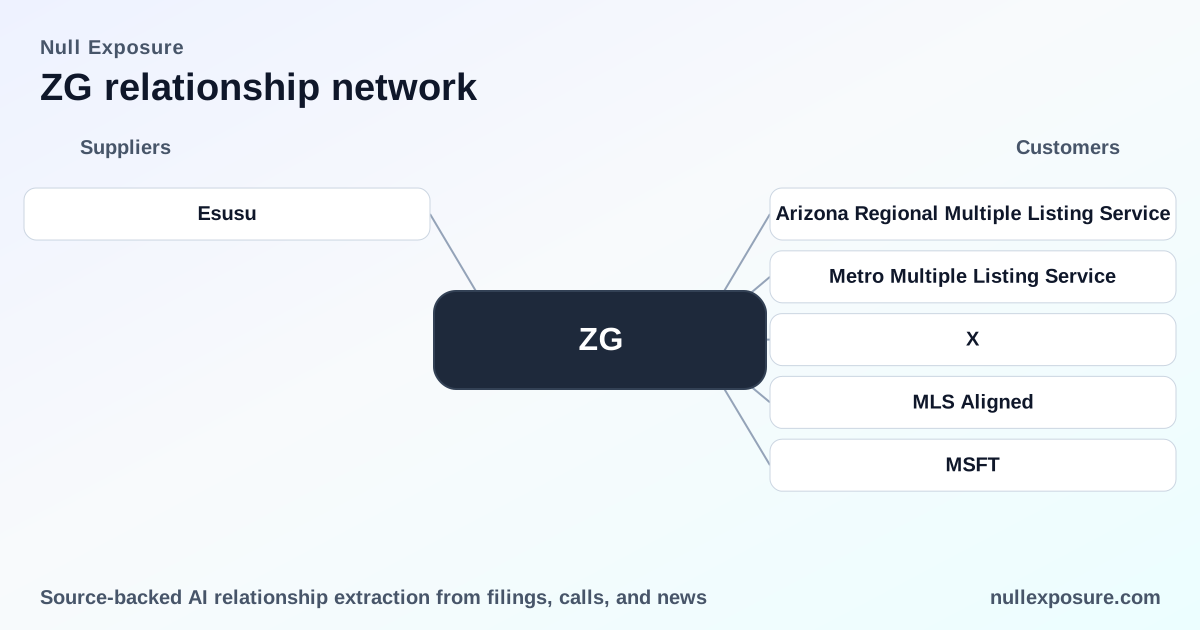
Zillow Group (ZG) — supplier relationships, contracts and what investors should price in
Zillow Group operates a digital real estate platform that connects consumers, agents, lenders and renters through mobile apps and websites and monetizes primarily through advertising and lead-generation services plus fees tied to marketplace transactions and enabled services. Investors should view Zillow as a platform business with revenue driven by traffic quality and the conversion of that traffic into paid seller/buyer and rental services. Its supplier posture—long-term credit facilities, sizable purchase commitments, license-dependent data inputs and cloud-hosted infrastructure—directly influences margins, operational resilience and go-to-market flexibility.
Explore deeper supplier risk and relationship intelligence at https://nullexposure.com/ for a structured view of counterparty exposure and contractual footprints.
How Zillow’s supplier profile shapes the business model
Zillow’s operating model relies on third-party content, licensing agreements and cloud infrastructure to keep its consumer-facing products current and performant. That mix produces a predictable cost base for critical inputs but concentrates operational risk where a limited number of vendors provide essential services.
Company filings show two structural signals that matter for investors:
- Long-dated financial and procurement commitments. Zillow entered a $500 million revolving credit facility effective January 30, 2026 with an availability profile extending to January 30, 2031, and reports roughly $260 million in non-cancelable purchase commitments scheduled through 2029. These items establish a baseline liquidity posture and fixed cash outflows tied to suppliers and service partners (company filing disclosures, fiscal 2025/2026).
- Mixed licensing posture. Zillow both purchases and licenses data content; some agreements carry perpetual rights, others are fixed-term licenses. This creates a hybrid supplier maturity profile—some inputs are permanent, others require renegotiation or replacement on cadence (company disclosures, FY2025).
From an investor viewpoint, these constraints indicate contractual stability for core content and infrastructure but persistent vendor-concentration risk where a handful of providers host essential services. Expect operating leverage to be sensitive to changes in licensing fees, cloud costs and partner economics.
Dealer-level implications: concentration, criticality and negotiating posture
Zillow’s supplier characteristics translate into practical business dynamics:
- Contracting posture: A mix of long-term purchase commitments and revolving credit suggests the company negotiates multi-year deals for cost predictability while preserving liquidity optionality through the credit facility.
- Concentration and criticality: Disclosures acknowledge a limited number of third-party services support essential functions; that creates single‑point-of-failure exposures for hosting and data feeds.
- Maturity and flexibility: Perpetual rights on some purchased content reduce renewal risk for parts of the product stack, while term-based licenses create recurring negotiation points that can compress margins if pricing shifts.
Key investor takeaway: Zillow balances stability and exposure—stable fixed commitments reduce short-term volatility, but vendor concentration and recurring license renewals remain active operational risks.
Supplier relationships investors should track now
Below are the supplier and partnership relationships surfaced in the review, with concise plain-English summaries and source references.
Esusu
Zillow expanded rent-reporting capabilities through a partnership with Esusu to enable millions of renters to build credit histories using on-platform rent reporting, strengthening Zillow’s rental product and supporting tenant financial readiness (MarketScreener, March 10, 2026). Source: https://www.marketscreener.com/news/zillow-and-esusu-partner-to-expand-credit-building-for-renters-nationwide-ce7d5ad9df80f62d
(That is the full set of supplier relationships surfaced in the reviewed window.)
Why the Esusu tie matters for revenue and regulatory attention
The Esusu partnership is strategically consistent with Zillow’s effort to deepen engagement in the rental market. Enabling rent-based credit reporting enhances Zillow’s rental product stickiness, improves lead quality for property managers and opens cross-sell paths into mortgage and moving-related services. For investors, the key outcomes to monitor are incremental user engagement metrics, conversion rates from renter to buyer funnels, and any data-sharing or regulatory implications associated with credit-reporting functionality.
Financial and valuation context investors should not ignore
Zillow’s market capitalization stands near $10.2 billion with trailing revenue of approximately $2.58 billion and modest reported EBITDA (company overview, latest quarters). Margins are tight; small swings in partner pricing or cloud costs will have outsized effects on operating profit. The company’s forward P/E of ~20.9 and elevated beta (~2.14) price in considerable growth optionality and volatility.
Key numbers to watch:
- Revenue TTM: $2.583B
- Market cap: $10.21B
- EBITDA: $69M
- Forward PE: 20.92
- Profit margin: 0.89% (TTM)
These metrics underline why supplier arrangements that impact content costs, cloud hosting fees or credit-reporting integrations are direct drivers of near-term profitability.
If you need vendor-level contract exposure mapped to cash flow sensitivity, review a structured supplier scorecard at https://nullexposure.com/ to quantify counterparty concentration and contractual timelines.
Practical risk checklist for operators and investors
- Confirm which content and data feeds are under perpetual rights versus fixed-term licenses; renewals that shift from perpetual to term-license pricing are earnings risks.
- Monitor cloud provider concentration and outage SLA language; outages to hosted services are high-impact for platform uptime.
- Map purchase commitment timing to free cash flow windows; multi-year purchase commitments and the revolving credit facility affect liquidity flexibility.
Active monitoring of these items converts qualitative supplier exposure into measurable earnings risk.
Final view and investor actions
Zillow’s platform economics depend on high-quality, continually updated content and resilient hosting—both supplied externally. The combination of long-term purchase commitments and licensing arrangements gives the company cost visibility but concentrates critical operational risk in a few providers. Partnerships like the Esusu integration are growth-positive for the rental vertical and should improve engagement metrics if executed cleanly.
For investors and operators who require deeper counterparty transparency, get a structured exposure assessment and contract horizon analysis at https://nullexposure.com/. For tailored briefings on how supplier contracts feed into earnings sensitivity, request a focused report via https://nullexposure.com/—we provide executable intelligence that links vendor terms to cash flow outcomes.