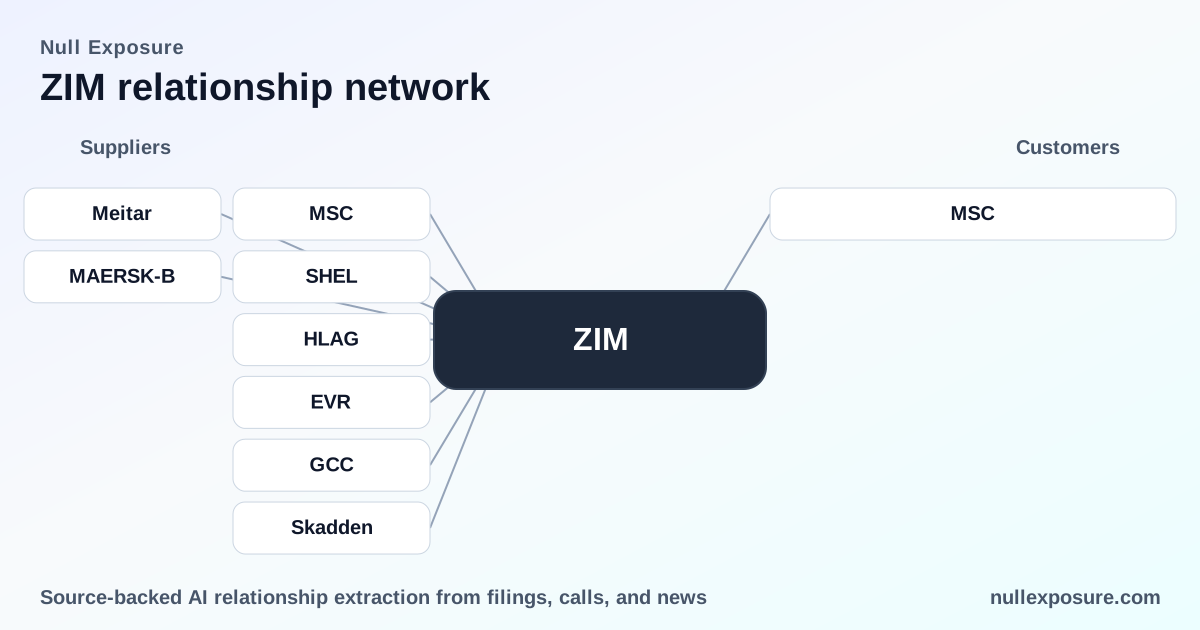
ZIM Integrated Shipping Services — supplier relationships and strategic implications for investors
ZIM is a global container shipping operator that monetizes through freight revenue, slot sales and charters, and supplementary shipping services (including car carriers and LNG-backed fuel agreements). The company operates its own vessel fleet while routinely entering commercial slot arrangements and time-charter deals that optimize capacity utilization and reduce capital intensity; these partnerships, combined with recent financial advisory activity, position ZIM as a commercially nimble carrier whose near-term value will be shaped as much by partner arrangements as by macro freight rates. For a consolidated view of ZIM’s supplier and partner exposures, visit https://nullexposure.com/.
Executive snapshot: what investors should focus on
ZIM reports USD 6.90bn revenue TTM and EBITDA of USD 948.7m, with a market capitalization around USD 3.22bn (latest quarter FY2025/FY2026 references). Profitability and cash generation are substantial relative to equity — trailing PE around 3.2 and EV/EBITDA ≈ 2.3 — but quarterly growth metrics show volatility: quarterly earnings and revenue are down year-on-year. These metrics reflect a business that is capital-intensive in fleet ownership but actively uses commercial partnerships and time charters to optimize asset deployment.
From an operating-model perspective, investors should treat the following company-level constraints as structural signals:
- Contracting posture: ZIM balances owned tonnage with slot-sharing and time-charter agreements, indicating a hybrid asset-light/asset-heavy approach that reduces absolute capital exposure while retaining control of key services.
- Concentration and criticality: The company relies on a small set of large partners for network reach and tonnage reciprocity; those relationships are commercially material and have direct impact on route capacity and revenue stability.
- Maturity and strategic positioning: ZIM is a mature liner operator with active strategic review activity (investment-banking engagement), suggesting management readiness to reorganize capital structure or pursue M&A if it enhances scale or unlocks shareholder value.
Get ongoing supplier-risk intelligence at https://nullexposure.com/.
The relationships that matter — partner-by-partner read
MSC
ZIM operates certain services where ZIM provides vessels and MSC takes roughly 30% of the slot capacity, while on other services MSC supplies tonnage and ZIM takes slots — a reciprocal slot/tonnage arrangement that smooths capacity across trades. This setup was discussed in The Loadstar (March 2026) in the context of consolidation and network rationalization.
Shell
ZIM has secured LNG supply agreements with Shell and expanded into car carrier services, indicating a strategic push to secure lower-emission fuel sources and diversify cargo mix beyond standard containerized freight. MarineLink reported these commercial developments in March 2026.
Hapag-Lloyd
A consolidation report noted that a newly structured entity will operate under the ZIM trademark but receive commercial support from Hapag-Lloyd and access to the Gemini network, signaling material commercial cooperation that broadens ZIM’s network reach (MarineLink, March 2026).
Evercore
ZIM’s board engaged Evercore as financial adviser to run a structured sale process, a clear corporate-action signal that directly affects shareholder outcomes and strategic alternatives. This engagement was disclosed in company coverage and financial reporting in early 2026 (TS2.tech and Calcalist reporting, March 2026).
Gram Car Carriers
Gram Car Carriers signed a five-year time charter with ZIM for the mid-size vessel VIKING SEA (4,200 CEU) through Q4 2027, adding USD 558m of contract backlog to Gram’s book and reflecting ZIM’s use of third-party tonnage for specialized auto-carrier capacity (Shippax press release, 2026).
Skadden
ZIM retained Skadden as legal counsel in connection with the board’s strategic process, indicating high-stakes transactional work consistent with the Evercore-led sale process (TS2.tech, March 2026).
Meitar
ZIM also retained Meitar as legal counsel, a complementary Israeli legal adviser role for the sale/strategic review activity; local counsel engagement underscores cross-jurisdictional complexity in the process (TS2.tech and Calcalist, March 2026).
A.P. Moller – Maersk
ZIM and A.P. Moller – Maersk expanded a joint Far East–East Coast South America service (ASAS/ASE), adding calls and deploying 14 vessels averaging 10,000 TEU to enhance connectivity on that trade lane, representing tactical scale benefits from cooperation with one of the industry’s largest carriers (Simply Wall St coverage, March 2026).
What these relationships collectively mean for ZIM’s operating posture
The relationship set demonstrates a deliberate hybrid strategy: ZIM keeps strategic control through its own fleet while outsourcing or selling slots to global carriers and leasing specialist tonnage where beneficial. Two structural implications stand out:
- Network amplification through partnerships: Commercial support from Hapag-Lloyd and joint services with Maersk materially extend ZIM’s network footprint without equivalent fleet reinvestment, increasing route density and customer access while keeping capex contained.
- Transactional risk and potential upside from strategic review: The Evercore-led sale process, supported by Skadden and Meitar, elevates the probability of a change in ownership or commercial consolidation; investors should treat ongoing M&A process developments as drivers of near-term valuation volatility.
Key risks are clear and concentrated: slot and tonnage arrangements with large carriers (MSC, Maersk, Hapag-Lloyd) are commercially critical and expose ZIM to counterparty rebalancing; dependence on third-party charters for niche capacity (e.g., Gram Car Carriers) creates contract renewal risk, and the sale process introduces execution risk and potential strategic shift. Investors should prioritize updates to contract terms, charter durations, and any regulatory filings tied to the sale process.
Continue to track ZIM’s supplier exposures and partner actions at https://nullexposure.com/.
What investors should watch next
- Official filings or press releases from ZIM on the structured sale process and any binding offers; Evercore’s role indicates speed and seriousness.
- Amendments to slot or tonnage agreements with MSC, Maersk, and Hapag-Lloyd that affect capacity allocations on key trade lanes.
- Renewal terms or early termination risk on the Gram Car Carriers time charter for auto capacity, and the operational impact of Shell LNG supply agreements on bunker costs.
- Any regulatory or antitrust scrutiny arising from deeper commercial integration with major carriers.
Bottom line: ZIM’s current value proposition is a combination of owned fleet economics and leverage through commercial partnerships; the sale process and partner agreements will dictate whether investors should value ZIM as a standalone operator or as a consolidation target. For a consolidated monitoring feed and supplier-risk signals, visit https://nullexposure.com/.