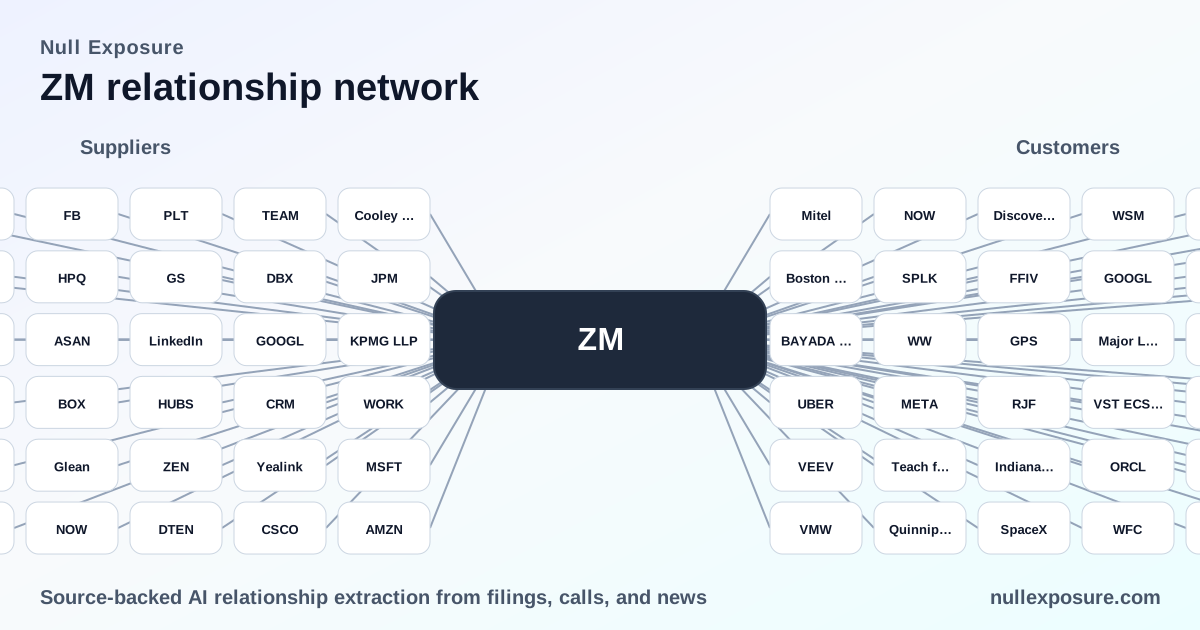
Zoom (ZM) — supplier relationships investors should track
Zoom monetizes a global collaboration platform through subscription licenses and enterprise offerings (Meetings, Zoom Phone, Zoom Workplace and a marketplace of integrated apps and hardware). The company contracts a mix of cloud infrastructure, hardware partners, professional services, and financial/legal advisors to deliver uptime, integrations, and go‑to‑market capabilities; these relationships translate directly into operating leverage, product breadth, and potential concentration risk for buyers and suppliers alike. For a concise, investor‑grade map of those relationships, visit https://nullexposure.com/.
What the supplier list implies about Zoom’s operating model
Zoom operates as a software platform that outsources critical pieces of its stack and partner ecosystem rather than vertically integrating every component. That operating posture drives three practical investor takeaways: technology dependence, partner‑enabled distribution, and measured contractual commitment.
Contracting posture and spend profile
Zoom reports a significant level of both short‑term and long‑term, non‑cancelable purchase obligations — $236.5 million due within 12 months and $233.7 million due beyond 12 months as of January 31, 2025 — implying active recurring procurement of third‑party services and hardware rather than one‑off projects. According to the company filing for that period, this mix signals both operational flexibility and sizeable vendor exposure (SEC registration/annual materials, FY2025).
Provider mix and criticality
Zoom uses large public cloud providers, co‑located data centers and equipment partners for endpoint hardware and room systems. It also engages professional services firms for audits, legal counsel, and capital markets work; these are matured, high‑criticality relationships that support uptime, compliance, and strategic transactions (SEC registration, Zoomtopia and press releases, FY2019–FY2024).
Visit https://nullexposure.com/ to explore how these relationships affect supplier risk and exposure.
Supplier roster and plain‑English takeaways
Below are every named relationship surfaced in the referenced materials, with a concise investor‑oriented summary and the source context.
-
Cooley LLP — Cooley acts as Zoom’s legal counsel on securities matters and strategic transactions, including representation in registration statements and M&A advisory contexts. Source: SEC registration statement (FY2019) and GlobeNewswire release on the Five9 transaction (FY2021).
-
J.P. Morgan — Served as a principal underwriter/book‑running manager in Zoom’s capital markets activity tied to its public offering. Source: ITPro coverage of the IPO (FY2021).
-
KPMG LLP — The independent registered public accounting firm relied upon for audited consolidated financial statements in Zoom’s registration materials. Source: SEC registration statement (FY2019).
-
Slack — Listed as one of many cloud software integrations in Zoom’s platform and marketplace, enabling workflow connectivity between communication tools. Source: SEC registration statement (FY2019).
-
Microsoft — Both an integration partner (Office, Teams, Outlook) and cloud provider through Azure; Zoom leverages Microsoft services for hosting and interoperability. Source: SEC registration statement and Zoom market materials (FY2019 / FY2024).
-
Amazon Web Services (AWS) — AWS is used to host web applications and certain non‑real‑time messaging services, forming a core public cloud infrastructure component. Source: SEC registration statement (FY2019).
-
Atlassian — An integration partner (Jira & Confluence) in Zoom’s App Marketplace and AI/third‑party app connectivity for enterprise workflows. Source: Zoomtopia launch materials (FY2024).
-
Dropbox — Part of the list of enterprise cloud integrations that tie Zoom into customers’ content repositories. Source: SEC registration statement (FY2019).
-
Google — Integration partner across Calendar, Gmail and Docs and referenced as a platform integration and endpoint compatibility partner. Source: SEC registration statement and Zoomtopia (FY2019 / FY2024).
-
salesforce.com (Salesforce) — Identified as an integrated cloud application in Zoom’s platform, facilitating CRM and meeting workflow connections. Source: SEC registration statement (FY2019).
-
Yealink — Hardware partner supplying desk‑phone/tablet appliances that run Zoom Phone and Zoom Rooms; used for hybrid work endpoints. Source: HiddenWires coverage of Zoom Phone Appliances (FY2021).
-
Cisco — Cited for interoperability: Zoom’s Conference Room Connector supports Cisco H.323/SIP room systems, enabling customers to preserve existing investments. Source: SEC registration statement (FY2019).
-
Poly — Hardware partner for Zoom Phone Appliances and USB/speakerphone endpoints; part of Zoom’s strategy to offer turnkey room systems. Source: HiddenWires and GlobeNewswire (FY2020–FY2021).
-
Goldman Sachs & Co. LLC — Named financial advisor in strategic transactions such as the announced Five9 acquisition effort. Source: GlobeNewswire release on Five9 (FY2021).
-
Microsoft Azure — Explicitly referenced as a public cloud used for hosting certain critical aspects of Zoom’s business. Source: SEC registration statement (FY2019).
-
LinkedIn — Included in the list of cloud software integrations that Zoom supports to enable richer enterprise collaboration. Source: SEC registration statement (FY2019).
-
HubSpot — Appears in Zoom’s App Marketplace references as an integrated marketing/CRM app enabling ecosystem workflows. Source: SEC registration statement (FY2019).
-
Zendesk — Listed among third‑party apps that Zoom’s AI offerings connect to for orchestration and insights. Source: Zoomtopia materials (FY2024).
-
Amazon — Cited for device support (Echo Show) and ecosystem compatibility for Zoom for Home endpoints. Source: Zoom press releases for Zoomtopia (FY2020).
-
DTEN — Hardware partner for Zoom for Home appliances and room systems. Source: Zoom press release (FY2020).
-
Facebook (Meta) — Platform collaboration via the Zoom on Portal app and device-level support for video endpoints. Source: Zoom press release (FY2020).
-
HP — Identified as a vendor for upcoming hardware offerings in Zoom’s room and endpoints roadmap. Source: Zoom press release (FY2020).
-
Neat — Mentioned as a hardware partner for additional appliances coming to market alongside Zoom Rooms. Source: Zoom press release (FY2020).
-
Lenovo — Cited as a forthcoming hardware partner contributing to Zoom’s appliance portfolio. Source: Zoom press release (FY2020).
-
Equinix — Referenced in Zoom’s ESG/operations context for data center renewable energy coverage and global colocation usage. Source: Zoom ESG/impact report (FY2025).
-
Polycom — Referenced similarly to Cisco as an H.323/SIP systems provider compatible with Zoom’s Conference Room Connector. Source: SEC registration statement (FY2019).
-
YouTube — Included in app marketplace listings, enabling content workflows and video hosting integrations. Source: SEC registration statement (FY2019).
-
Cloudflare — Named in press coverage about an outage that affected Zoom’s service availability, underscoring third‑party network dependency. Source: News coverage of the outage (reported FY2023).
-
Kahoot! — Education/engagement partner with an app that allows hosting Kahoot! games directly in Zoom Meetings. Source: Aithority coverage of partnership (FY2020).
-
Box — Listed in Zoomtopia materials as a connected third‑party app for file access and orchestration. Source: Zoomtopia materials (FY2024).
-
Glean — Included among third‑party apps integrated into Zoom’s AI Companion to surface workplace information. Source: Zoomtopia materials (FY2024).
-
Workday — Named as a potential connected app for Zoom’s AI synthesis and enterprise productivity integration. Source: Zoomtopia materials (FY2024).
-
ServiceNow — Included as an enterprise integration point for Zoom’s AI and orchestration features. Source: Zoomtopia materials (FY2024).
-
Workvivo — Partnered on AI‑first employee engagement solutions built on Zoom’s platform. Source: Zoomtopia materials (FY2024).
-
Asana — Listed among third‑party apps that Zoom’s AI Companion can orchestrate with for task and project workflows. Source: Zoomtopia materials (FY2024).
How to use this mapping as an investor
- Risk monitoring: The combination of large cloud partners (AWS, Azure, Equinix) and hardware vendors (Poly, Yealink, DTEN) creates concentration points for uptime and procurement; outages or contract disputes could have outsized operational impact (SEC filing; outage press coverage, FY2019–FY2023).
- Strategic optionality: Integrations with CRM, HR and collaboration suites (Salesforce, Workday, Atlassian, ServiceNow) increase stickiness and provide cross‑sell channels for higher‑ARPU enterprise packages (Zoomtopia, FY2024).
- Contract maturity and spend: The roughly equal split of near‑term and longer‑term purchase obligations totaling approximately $470 million indicates meaningful recurring vendor commitments rather than purely ad‑hoc sourcing (SEC filing, as‑of Jan 31, 2025).
For a deeper breakdown of supplier exposure, onboarding risk and concentration scoring, explore the investor toolkit at https://nullexposure.com/.
Bottom line
Zoom runs a partner‑centric model: cloud and colocation for backbone capacity, hardware partners for endpoint reach, and a broad integrations ecosystem to lock in enterprise workflows. That structure supports rapid product expansion but concentrates operational risk with a handful of large suppliers and service providers — a dynamic investors must monitor against uptime incidents, vendor contract renewal cycles, and strategic M&A that could reconfigure advisor relationships.
If you want a tailored supplier risk briefing or to benchmark Zoom’s vendor concentration against peers, start here: https://nullexposure.com/.