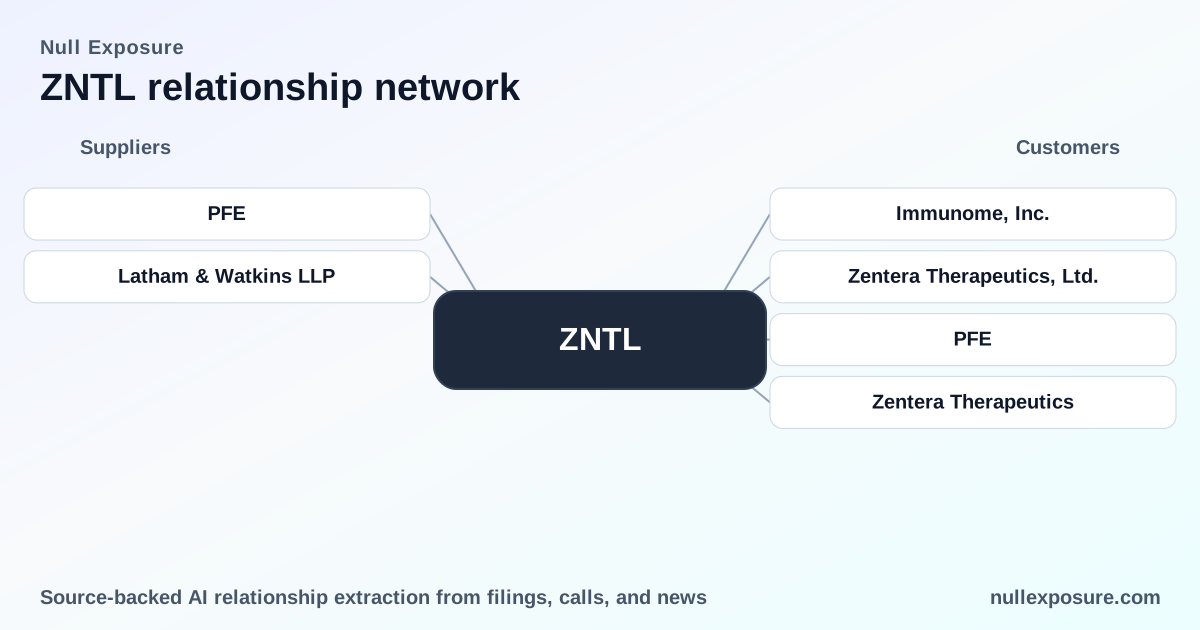
ZNTL supplier profile: what investors need to know about partners, supply posture, and deal economics
Zentalis Pharmaceuticals operates as a clinical-stage biopharma developer that monetizes through licensing deals, equity investments from strategic partners, milestone payments, and downstream commercialization economics; the company outsources manufacturing and clinical service work to third parties and leverages partner capital and capabilities to advance its pipeline. For investors evaluating supplier and partner risk, Zentalis’s model is driven by partner-funded development and purchase-order manufacturing, which concentrates operational exposure in a small set of contractual relationships and geographic footprints. If you want a concise, data-driven view of counterparty relationships and supplier posture, visit https://nullexposure.com/ for the full platform offering and sourcing intelligence.
How Zentalis runs its supplier network — concise operating thesis
Zentalis does not own manufacturing capacity and relies on contract manufacturing organizations (CMOs) and contract research organizations (CROs) for production, packaging, and clinical trial services. The company purchases clinical supplies on a spot or purchase-order basis rather than under long-term supply agreements, and it funds development through licensing and partner investments that deliver non-dilutive capital and development support. The combination of spot purchasing, outsourced manufacturing, and partner-funded development makes operational execution highly dependent on stable CMO performance and timely partner cooperation, while limiting fixed capital intensity on Zentalis’s balance sheet.
Key constraints and what they signal about business model and risk
- Contracting posture — spot buy: Zentalis explicitly states it does not have long‑term supply agreements and purchases required supply on a purchase‑order basis. This creates flexibility but also elevates execution risk during capacity shortages or geopolitical disruption.
- Licensing as a monetization channel: Zentalis has an exclusive license agreement (through a subsidiary) with Recurium IP, creating future milestone and royalty economics. The firm also carries development and regulatory milestone obligations up to tens of millions of dollars under licensing structures.
- Geographic exposure — APAC and global trials: Clinical quantities of azenosertib are produced by third parties outside the U.S., including in China, and the company conducts international clinical trials. Geographic concentration in APAC increases single-region production risk.
- Materiality of manufacturing: Disruption at ex‑U.S. manufacturers, including in China, is flagged as capable of impairing day‑to‑day operations and development timelines — this is a company‑level material risk signal.
- Roles outsourced: Zentalis treats CMOs as manufacturers and distributors for clinical supplies and relies on CROs and independent investigators as service providers for trial execution.
- Relationship stage and spend: Supplier relationships are active and the company reports potential development and regulatory milestone exposure in the $10M–$100M range, indicating meaningful contingent spend tied to partner or license outcomes.
These constraints collectively indicate an operating model that prioritizes capital-light development and partner alignment, while trading off elevated supplier concentration and execution sensitivity.
Relationships that shape operational and valuation outcomes
Pfizer — strategic investor and clinical collaborator.
Pfizer made a $25 million equity investment in Zentalis and agreed to jointly advance a synthetic-lethality oncology candidate through clinical development, providing development capacity and expertise in exchange for economic and pipeline upside (GlobeNewswire, Apr 27, 2022; FierceBiotech coverage). A FierceBiotech article described Pfizer’s financial commitment and joint clinical support, and a GlobeNewswire press release detailed the investment and operational collaboration (https://www.fiercebiotech.com/biotech/spying-synthetic-lethal-promise-pfizer-bets-wee-25m-zentalis-signs-support-cancer-trials; https://www.globenewswire.com/news-release/2022/04/27/2430034/0/en/Zentalis-Pharmaceuticals-Announces-25-Million-Equity-Investment-from-Pfizer.html).
Latham & Watkins LLP — legal counsel on the Pfizer transaction.
Latham & Watkins represented Zentalis in connection with the Pfizer equity investment and related transactional documentation, supplying corporate and securities advisory services for the deal execution (Latham & Watkins news release, 2022). The law firm’s advisory role is documented by its client announcement outlining the transactional team (https://www.lw.com/en/news/2022/04/latham-watkins-advises-zentalis-pharmaceuticals-equity-investment-pfizer).
Why these relationships matter for investors
Pfizer’s $25M investment is a de‑risking commercial signal: strategic capital from a major pharmaceutical company demonstrates validation of the underlying program and provides Zentalis with development resources beyond internal capacity. That investment also creates tighter co‑development obligations and potential milestone upside that influence valuation and upside capture.
Legal advisors indicate standard deal sophistication: having a large international law firm counsel the transaction signals that Zentalis executes partnership and capital transactions to market standards, which reduces legal execution risk on partnership formations.
However, the company’s procurement posture tempers the upside. Spot purchasing and CMO reliance mean that successful trial execution and timely supply are operationally critical; any CMO interruption, particularly in APAC facilities, will translate directly into delayed trials and deferred milestones. For many investors, the takeaway is that partnership quality and supply chain resilience are the primary operational levers behind valuation realization.
If you are re-evaluating counterparty exposure or benchmarking partner concentration, check our platform for deeper supplier-level risk scoring at https://nullexposure.com/.
Practical implications for portfolio and operational risk management
- For valuation models, treat Pfizer’s investment as both capital and expertise that reduces near-term dilution and improves development probability; bake in milestone upside consistent with the disclosed $10M–$100M spend band for licensing payouts.
- Stress-test timelines for scenarios where APAC manufacturing faces disruption: given explicit reliance on non‑U.S. CMOs, a single‑region supply stop could push clinical milestones and trigger contingent spend non‑linearities.
- Prioritize monitoring of contract types and counterparty tenure: the current purchase‑order posture implies limited contractual protection against capacity allocation conflicts during competing demand periods.
Bottom line and investor actions
Zentalis runs a partner‑centric, capital‑light development model where strategic investments (like Pfizer’s $25M) and licensing create the primary value uplift, while CMOs and CROs deliver operational execution. The firm’s spot procurement and APAC manufacturing exposure are the principal operational risks that will determine whether partnership upside converts into realized returns.
For a deeper dive into supplier relationships, counterparty exposure, and to track changes in Zentalis’s partner network, visit https://nullexposure.com/. To integrate this supplier intelligence into your investment due diligence, sign up or contact our team at https://nullexposure.com/ for tailored reporting and alerts.