Zscaler (ZS) — Supplier Relationships and Operational Constraints that Matter to Investors
Zscaler operates a cloud-native security platform and monetizes by selling subscription-based secure access services to enterprises, augmenting capability through strategic acquisitions and platform integrations that expand addressable use cases. Management grows recurring revenue by embedding adjacent capabilities (device security, managed detection) into the core platform and monetizes through tiered SaaS contracts and add-on services.
For investors evaluating Zscaler’s supplier posture, the key lens is how these integrations and third-party relationships influence platform stickiness, concentration risk, and capital allocation. Learn more about how we map supplier exposure at the firm level at https://nullexposure.com/ — a practical hub for supplier-risk intelligence and decision support.
Why supplier relationships are a strategic margin lever for Zscaler
Zscaler’s business model depends on continuous delivery of security functionality at scale, which requires both internal R&D and selective external partnerships or acquisitions to plug capability gaps quickly. Acquisitions are being used as a growth and defense mechanism: they broaden the product suite and reduce time-to-market for critical features that customers demand. This accelerates cross-sell into existing enterprise contracts and strengthens subscription renewal economics.
At the same time, Zscaler’s operating posture on supplier contracting and its reliance on limited-sourced SaaS vendors introduce two structural constraints investors should price into risk and valuation models:
- Contracting posture — spot purchasing for hardware/components: Company disclosures state that Zscaler generally purchases equipment or components on a purchase-order basis and does not maintain long-term supply contracts, indicating flexibility but also exposure to episodic supply shocks.
- Supplier concentration — critical services from sole or limited-sourced SaaS vendors: The company explicitly identifies dependence on a small set of SaaS providers for critical capabilities, a concentration that creates single-point operational risk.
Both signals translate into operational risk that can affect uptime, onboarding velocity, and ultimately renewal rates if unresolved. Explore how supplier concentration affects valuation multiples and scenario analyses at https://nullexposure.com/.
Supplier roll-call: the relationships behind recent platform moves
Zscaler’s most recent public supplier/partner activity reflects acquisitive expansion. The public reporting for FY2026 highlights two specific additions:
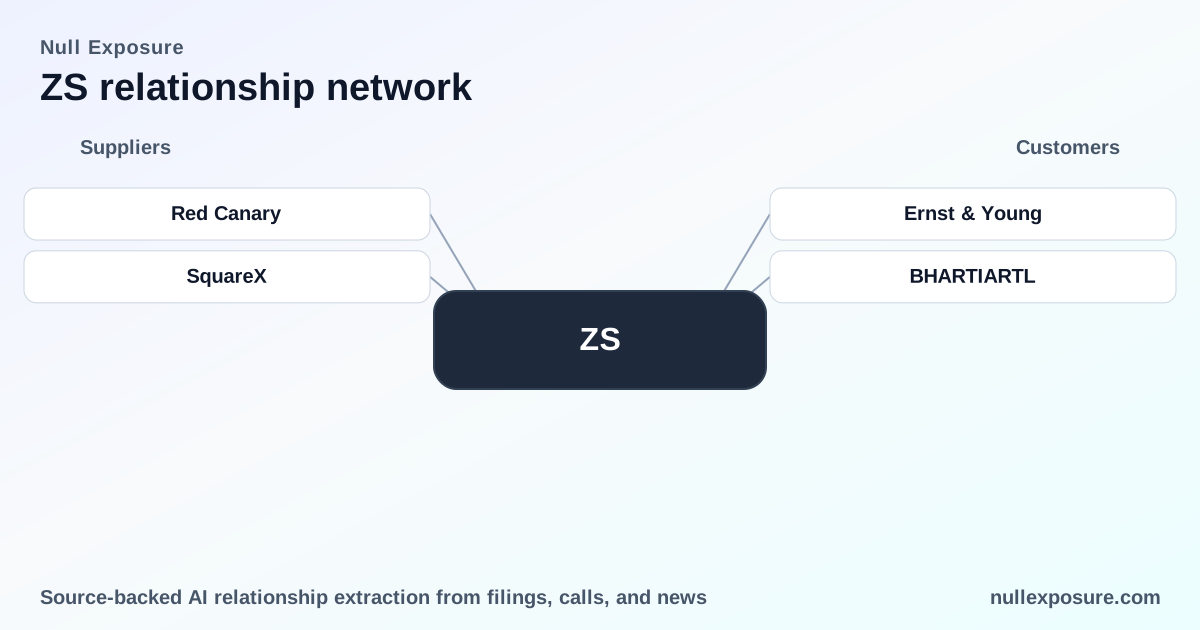
- Red Canary — Zscaler integrated Red Canary to support agentic security operations, indicating a strategic push into managed detection and incident response capabilities that complement its cloud controls. According to a Finviz report on Zscaler’s FY2026 results (March 10, 2026), Red Canary was integrated to bolster platform-level security operations.
- SquareX — Zscaler acquired SquareX to secure unmanaged devices via browser extensions, extending coverage to unmanaged endpoints and browser-based threats and improving control over shadow IT vectors. The same Finviz FY2026 write-up (March 10, 2026) notes SquareX was purchased to address unmanaged-device exposure through browser-extension controls.
These two relationships were reported as strategic acquisitions in FY2026 and reflect a clear product roadmap: extend inspection and response up and down the endpoint stack to preserve the core network-agnostic security value proposition.
What these supplier and acquisition moves mean for revenue and margin
Acquisitions such as Red Canary and SquareX are designed to drive incremental ARR and reduce churn by embedding differentiated services into renewal conversations. For investors, the key implications are:
- Revenue: Embedded managed detection (Red Canary) and unmanaged-device controls (SquareX) create upsell opportunities into existing enterprise customers, supporting higher average contract values.
- Costs and margins: Integrations initially increase opex (acquisition costs, integration engineering, and potential platform harmonization). Over time, successful integration will convert to higher gross margins if the capabilities can be delivered natively rather than via expensive third-party contracts.
Investors should track near-term integration spend and any reported customer migration metrics (e.g., attach rates for new modules) as these will determine whether the acquisitions accelerate scalable revenue or remain cost centers.
Operational constraints and what they signal about resilience
Two company-level constraints from public disclosures deserve emphasis as they materially shape supplier risk and business continuity:
- Contracting posture: Zscaler’s reliance on purchase orders rather than long-term supply contracts for equipment/components gives the company procurement flexibility but exposes it to supply-chain volatility for critical hardware. This is a firm-level signal: if macro supply pressures re-emerge, short-term provisioning for hardware-heavy rollouts could be delayed.
- Criticality of limited-sourced SaaS vendors: The company acknowledges reliance on sole or limited-sourced SaaS vendors for services core to operations. This concentration is a structural operational risk that could affect service availability or bargaining power if a vendor negotiating posture changes.
Both constraints are company-level signals about how Zscaler structures its external relationships and should be treated as persistent aspects of its operating model unless management changes procurement strategy.
How investors should weigh the reward versus the supplier risk
Balancing acquisition-driven product expansion against supplier constraints leads to a clear investor checklist:
- Monitor integration KPIs: attach rates for Red Canary and SquareX functionality, incremental ARR contribution, and customer retention trends.
- Watch procurement disclosures: any shift from spot purchase posture to multi-year supply agreements would reduce supply-chain risk and should be treated as a positive governance signal.
- Assess vendor concentration remediation: evidence of diversifying critical SaaS vendors or moving capabilities in-house materially reduces single-point failure risk.
Key takeaway: Zscaler is actively expanding its platform through strategic acquisitions that meaningfully enhance product scope, but the firm’s procurement posture and reliance on limited-sourced vendors create quantifiable operational risk that should be priced into downside scenarios.
If you want a deeper supplier-risk profile and impact modeling for Zscaler, visit https://nullexposure.com/ for detailed scenario tools and supplier mapping.
Closing—what to watch next quarter
Investors should watch management commentary on FY2027 adoption metrics for Red Canary and SquareX, any disclosure of supply contracts versus spot purchases, and specific remediation plans for vendor concentration. These items will determine whether the acquisitions accelerate durable ARR growth without a material increase in platform fragility.
For practical investor tools and ongoing supplier monitoring for Zscaler and peer security vendors, visit https://nullexposure.com/ — we curate the signals that matter for investment and operational decisions.
Bold takeaway: Zscaler’s acquisitive strategy strengthens product breadth and upsell potential, but procurement and vendor-concentration constraints are material operational risks that require active monitoring.