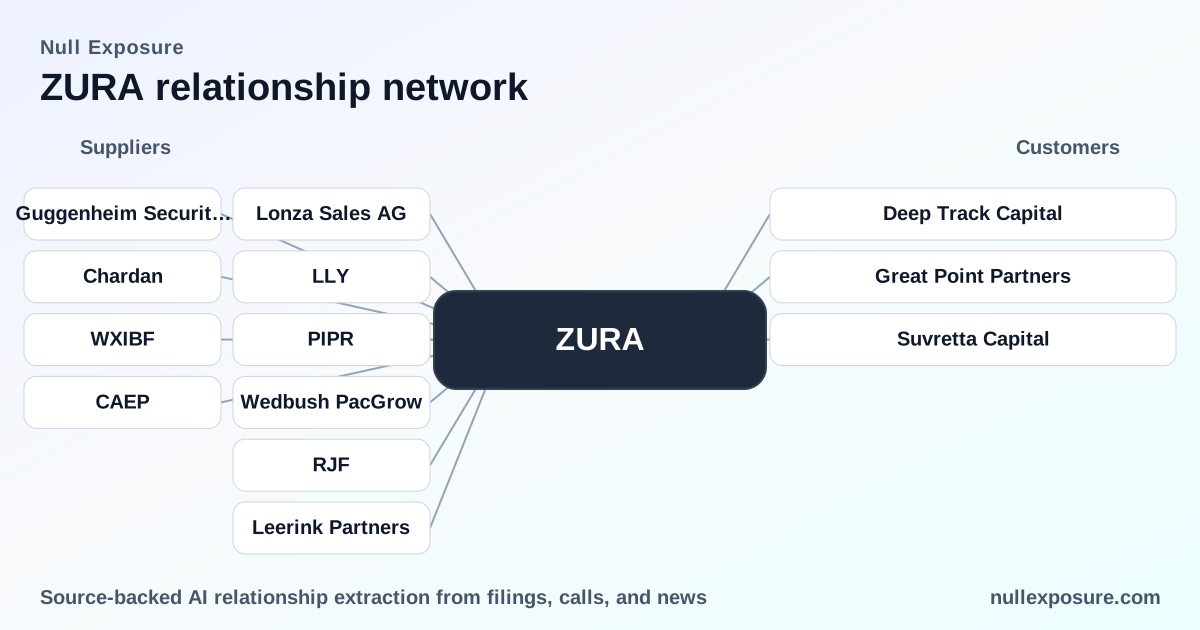
ZURA supplier relationships: what investors need to know before underwriting operational risk
Zura Bio operates as a licensing-centric biotech developer: the company acquires and holds in‑licenses to clinical-stage biologics, outsources manufacturing and clinical execution to third parties, and monetizes through equity raises, milestone-triggered payments, and eventual commercial royalties or sublicensing. Revenue is prospective and contingent; the balance sheet depends on successful clinical readouts and continued access to third‑party manufacturing and IP. For a quick way to monitor relationship-level exposures and supplier concentration, visit https://nullexposure.com/.
How Zura structures partnerships and why that matters to investors
Zura’s operating model emphasizes licensing and third‑party manufacturing/services rather than internal production. The company’s public disclosures lay out a mixed contracting posture: framework agreements (MSAs) for ongoing manufacturing relationships and discrete license agreements that convey critical development and commercialization rights. These choices create predictable legal control of technology but concentrate operational risk externally.
- Contracting posture: Zura uses both framework master services agreements and multiple licensing arrangements to secure rights and capacity, which supports scalability but increases counterparty dependence.
- Concentration and criticality: WuXi Biologics has historically been the sole supplier for at least one product (torudokimab), highlighting supply concentration in APAC; Lilly and Pfizer licenses are material to pipeline development and carry termination risk that is business‑critical.
- Maturity and stage: Most supplier and license relationships are active and multi‑year, with licenses executed in 2022–2023 and ongoing manufacturing arrangements through 2024–2025, positioning the company to run mid‑stage clinical programs while remaining dependent on outside partners.
- Spend profile: Upfront license consideration for Lilly in 2023 was in the $1m–$10m band (specifically a $5.8m cash element plus equity), indicating that Zura’s current cash commitments to secure IP are nontrivial but not large scale by biotech standards.
For a centralized snapshot of these relationships and their operational impact, see https://nullexposure.com/.
Partner-by-partner notes investors should track
Lonza Sales AG
Zura entered a worldwide non‑exclusive license with Lonza for Lonza’s gene expression system, positioning Lonza as an IP supplier for expression technologies that support Zura’s development programs. According to Zura’s FY2024 10‑K filing, this license grants global rights under specified commercial terms. (Source: Zura FY2024 10‑K, Dec 31, 2024.)
Eli Lilly and Company (LLY)
Zura licensed tibulizumab (ZB‑106) from Eli Lilly on April 26, 2023, acquiring development and commercialization rights for a potentially first‑in‑class bispecific antibody; the Lilly license is material to Zura’s pipeline and includes milestone and royalty obligations. (Source: BizWire press release reporting Zura financing and licensing, June 6, 2023; referenced in FY2023 disclosures.)
WuXi Biologics (WXIBF)
Zura entered a cell line license agreement and a biologics master services agreement with WuXi Biologics for cell line know‑how, biological materials, and manufacturing services; WuXi has historically been the sole supplier of torudokimab drug substance and conducted stability work in China. (Source: Zura FY2024 10‑K and contractual excerpts, July 2023 MSA and Cell Line License language.)
Piper Sandler (PIPR)
Piper Sandler acted as a joint bookrunning manager on Zura’s public offering, signaling institutional placement capability and market access for follow‑on financing. Intellectia reporting on pricing of the offering notes Piper Sandler’s role in the underwriter syndicate (FY2026 coverage). (Source: Intellectia, March 2026.)
Wedbush PacGrow
Wedbush PacGrow served as the lead manager on Zura’s public offering, a structural signal that the firm took an active syndicate role to place equity and validate market appetite. (Source: Intellectia coverage of the offering, March 2026.)
Raymond James (RJF)
Raymond James served as a co‑lead placement agent on a prior financing, supporting Zura’s June 2023 capital raise and demonstrating relationships with investor networks that underwrite early financing rounds. (Source: BizWire press release via FinancialContent, June 6, 2023.)
Leerink Partners
Leerink Partners is a repeated underwriter in Zura’s syndicate activity, listed as a joint bookrunning manager for the public offering, reinforcing sell‑side coverage and institutional distribution for equity capital raises. (Source: Intellectia reporting on the offering, March 2026.)
Guggenheim Securities
Guggenheim Securities served as the lead placement agent for the approximately $80m financing in June 2023, indicating involvement in pre‑public capital formation and investor introductions. (Source: BizWire press release via FinancialContent, June 6, 2023.)
Chardan
Chardan acted as a co‑lead placement agent on the June 2023 financing, participating in early institutional syndication and capital formation for Zura’s clinical programs. (Source: BizWire press release via FinancialContent, June 6, 2023.)
Cantor (CAEP)
Cantor was part of the underwriting group for Zura’s public offering, listed among the joint bookrunning managers; its participation contributes to syndicate depth for equity execution. (Source: Intellectia reporting on the offering, March 2026.)
What this network signals about operational risk and upside
Zura’s model is IP‑driven and externally executed: success scales if licenses convert to-approved products and if third‑party manufacturing shifts from single‑source arrangements to diversified, qualified suppliers across EMEA and APAC. The key risks for investors are supply concentration (WuXi historically sole supplier for a candidate), termination exposure in license agreements with major pharma (Pfizer and Lilly rights are business‑critical), and execution risk in outsourced clinical and manufacturing activities.
At the same time, the presence of several established investment banks (Leerink, Piper Sandler, Wedbush, Cantor, Guggenheim, Raymond James, Chardan) across recent financings improves liquidity optionality and signals that the market has accepted Zura’s capital story at multiple points. Underwriting support reduces near‑term refinancing risk but does not eliminate development or supply chain exposures.
If you want a concise, relationship‑level risk table and ongoing monitoring feeds, explore the centralized supplier profiles at https://nullexposure.com/.
Actionable takeaways for investors and operators
- Prioritize counterparty diversification: mitigate single‑source manufacturing exposure by tracking qualification of alternative CMOs in EMEA/US to replace or complement WuXi.
- Stress-test milestone obligations: model contingent payments to Lilly and Pfizer as downside scenarios to understand dilution and cash runway impacts.
- Monitor syndicate activity: continued engagement by major underwriters is a liquidity positive—watch bookrunning roles and follow‑on pricing as leading indicators of market confidence.
- For a tailored supplier risk assessment and alerting on contract changes, visit https://nullexposure.com/.
Zura’s value inflection points are clear: successful clinical results and secured, diversified manufacturing will unlock commercial optionality; until then, investors must underwrite significant counterparty and IP‑termination risk. For ongoing coverage and relationship tracking, return to https://nullexposure.com/.