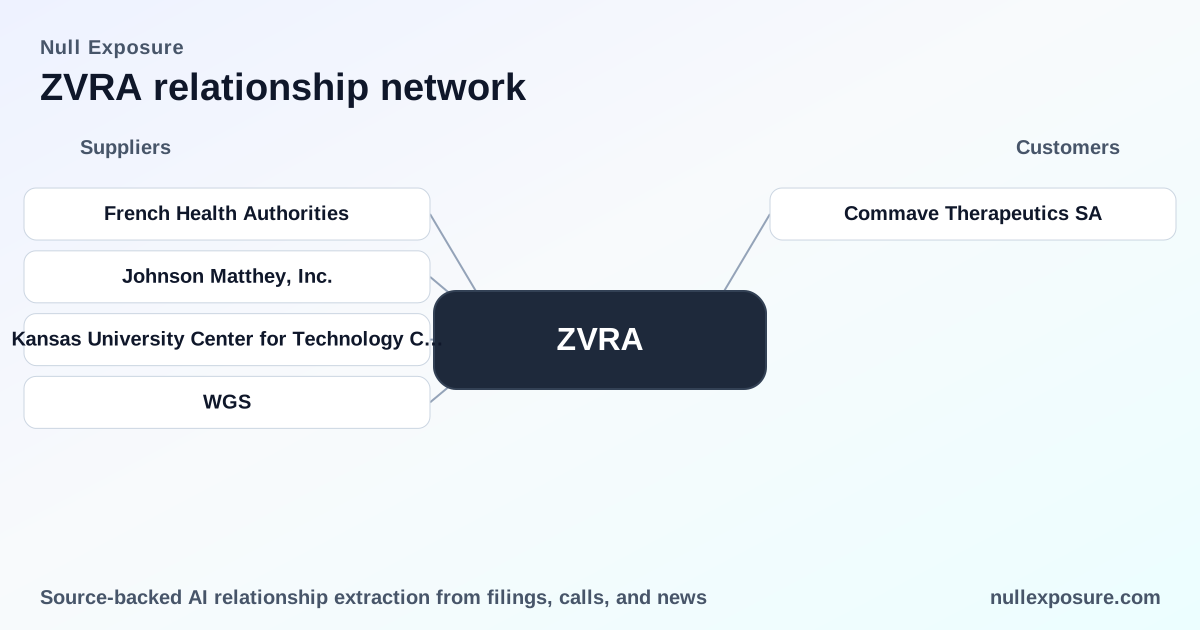
ZVRA supplier relationships: a concise briefing for investors and operators
Zevra Therapeutics (Nasdaq: ZVRA) operates as a commercial-stage rare-disease biopharmaceutical company that monetizes through specialty-product sales and targeted commercial partnerships, supported by third‑party manufacturing, distribution and licensing arrangements. Revenue recognition and margin dynamics depend on national pricing agreements and specialty pharmacy distribution, while operating leverage is influenced by royalties and outsourced manufacturing costs. For a granular, sourced supplier view, see the full profiles at https://nullexposure.com/.
The high-level take: outsourced manufacturing, concentrated distribution, and targeted partnerships
Zevra’s operating model is built around a lean, outsourced infrastructure. Key characteristics that shape supplier risk and economics:
- Contracting posture — heavily outsourced. Zevra contracts third parties for manufacturing, clinical services and distribution rather than investing in internal large‑scale manufacturing capacity. This reduces fixed capital but increases vendor dependency. (Company disclosures in FY2024 detail multiple contract-manufacturing and service arrangements.)
- Concentration — single specialty distributor. The company uses a single specialty pharmacy provider as its distributor for approved products, creating meaningful counterparty concentration that affects sales execution and inventory flow.
- Criticality — supplier inputs are mission‑critical. The company explicitly identifies dependency on specific materials (SDX, sodium phenylbutyrate, arimoclomol) as critical to commercialization and development, elevating supply chain risk.
- Contract maturity and flexibility — short- to mid-term commitments. Lease and vendor arrangements include short-term leases and service contracts; this supports operational agility but increases renewal and renegotiation exposure.
- Spend profile — supplier spend skewed toward modest operating commitments. Lease liabilities and supplier spend disclosed fall within a small-to-midsize band, suggesting most agreements are service-oriented rather than large capital contracts.
These characteristics define both the upside — low capital intensity and flexible go‑to‑market — and the downside — outsized vendor dependency and pricing exposure. Explore supplier-level alerts and historical filings at https://nullexposure.com/ to track changes in real time.
Relationship-by-relationship breakdown
French Health Authorities
According to Zevra’s FY2024 10‑K filing, the French Health Authorities and the manufacturer have agreed to a price for sales under the French AC. This indicates Zevra’s commercial products are subject to negotiated national pricing regimes in France, which directly influence revenue per unit sold and reimbursement access. (Source: FY2024 10‑K)
Johnson Matthey, Inc.
The FY2024 10‑K references a Material Supply Agreement dated November 2, 2009 with Johnson Matthey, Inc., identifying Johnson Matthey as a historical supplier of materials to Zevra. This long-standing contractual linkage positions Johnson Matthey as a supplier with an established procurement relationship. (Source: FY2024 10‑K)
Kansas University Center for Technology Commercialization, Inc.
Zevra pays a low-single-digit percentage royalty to Kansas University Center for Technology Commercialization, Inc. on net sales of MIPLYFFA, per the FY2024 10‑K. This royalty obligation reduces gross margins on MIPLYFFA sales and is a fixed contractual cash outflow correlated to unit volumes. (Source: FY2024 10‑K)
GeneDx
A March 2026 BioSpace press release reported that GeneDx launched a genetic testing program with Zevra Therapeutics, with Zevra providing financial support to improve diagnosis of Niemann‑Pick disease type C (NPC). This is a commercial and patient‑access initiative intended to expand the diagnosed patient pool and support downstream product uptake. (Source: BioSpace press release, March 2026)
What these relationships tell you about execution risk and growth levers
Zevra’s supplier map outlines a clearly asset‑light commercialization engine: clinical and manufacturing functions are outsourced, distribution relies on a single specialty pharmacy, licensing and royalty obligations exist, and the company engages payers and national authorities for pricing.
Key implications:
- Revenue sensitivity to pricing and reimbursement. The French pricing agreement is an example of national-level pricing influence; similar arrangements in other markets will drive realized prices and reimbursement timelines.
- Supply chain concentration is a material commercial risk. Reliance on contract manufacturers and specific raw materials is explicitly flagged as critical to commercialization; any disruption will materially affect supply and launch cadence.
- Royalties and licensing are embedded in the cost structure. Royalty payments to Kansas University are a recurring margin drag tied to MIPLYFFA sales.
- Strategic commercial investments are used to expand diagnosis and demand. The partnership with GeneDx signals a proactive approach to market development through funded diagnostic programs rather than direct salesforce expansion.
Midway checkpoint: to monitor evolving supplier exposure and new contractual events, consult the supplier intelligence hub at https://nullexposure.com/.
Practical risk checklist for investors and operators
Monitor these items over the next 12–24 months:
- Confirm continuity and capacity of contract manufacturers for SDX, sodium phenylbutyrate and arimoclomol; interruptions here are high‑impact.
- Track distributor performance metrics and any moves away from the single specialty pharmacy model to reduce concentration risk.
- Watch reimbursement outcomes in major markets where Zevra negotiates pricing; national agreements materially affect revenue per unit.
- Review royalty trends tied to MIPLYFFA and any licensing changes that could alter margin profiles.
- Evaluate the effectiveness of diagnostic partnerships (e.g., GeneDx) in increasing diagnosed patient counts and conversion to therapy.
Bold action items: validate supply agreements, stress-test distributor dependence, and model royalty outflows into long‑term margin forecasts.
Final take and next steps
Zevra runs a capital-efficient, partner-heavy commercial model that accelerates time-to-market while transferring significant operational risk to suppliers and payers. For investors this translates into a binary risk/reward profile: scalable revenue upside if supply and reimbursement lines hold, and pronounced downside if vendor or pricing disruptions occur. For operators, priority actions are supplier diversification and strengthened contract protections for critical inputs.
For a deeper supplier-by-supplier dossier and ongoing supplier signals, visit https://nullexposure.com/. If you want supplier alerts and tailored exposure reports for your portfolio, start here: https://nullexposure.com/.