ZYBT: What the IPO advisory slate reveals about supplier posture and capital strategy
Zhengye Biotechnology Holding Limited (ZYBT) commercializes its operations through a combination of product and technology development and access to public capital markets; the company monetizes by advancing its biotechnology assets to market while sourcing growth capital through securities offerings. ZYBT’s most visible supplier relationships are tied to its Nasdaq initial public offering (IPO), where legal counsel and a sole book-running manager executed critical capital-market functions that underwrote the company’s $6 million raise. For investors and operators, those relationships are direct indicators of contracting posture, capital access, and the company’s external dependency profile. Learn more or run a deeper supplier analysis at https://nullexposure.com/.
Why the IPO partners matter more than their logos
The identities and roles of IPO advisers do more than populate a prospectus footnote: they reveal how ZYBT contracts for governance, compliance, and capital distribution. A U.S. securities counsel shapes disclosure and regulatory defensibility; a book-runner controls investor outreach and price discovery. The FY2025 offering was executed with a narrow advisory slate, a configuration that signals concentration of critical external capabilities into two counterparties—useful for gauging operational resilience and sourcing risk.
A Quiver Quant news release dated March 10, 2026, reports that ZYBT closed an initial public offering raising $6 million on Nasdaq, and it names the advisers involved. That transaction provides the only supplier-level disclosures in the available relationship records, so investors should treat these counterparties as strategic touchpoints for capital and compliance execution. For detailed supplier risk monitoring and mapping, visit https://nullexposure.com/.
The supplier relationships returned in the record
Hunter Taubman Fischer & Li LLC — U.S. securities counsel
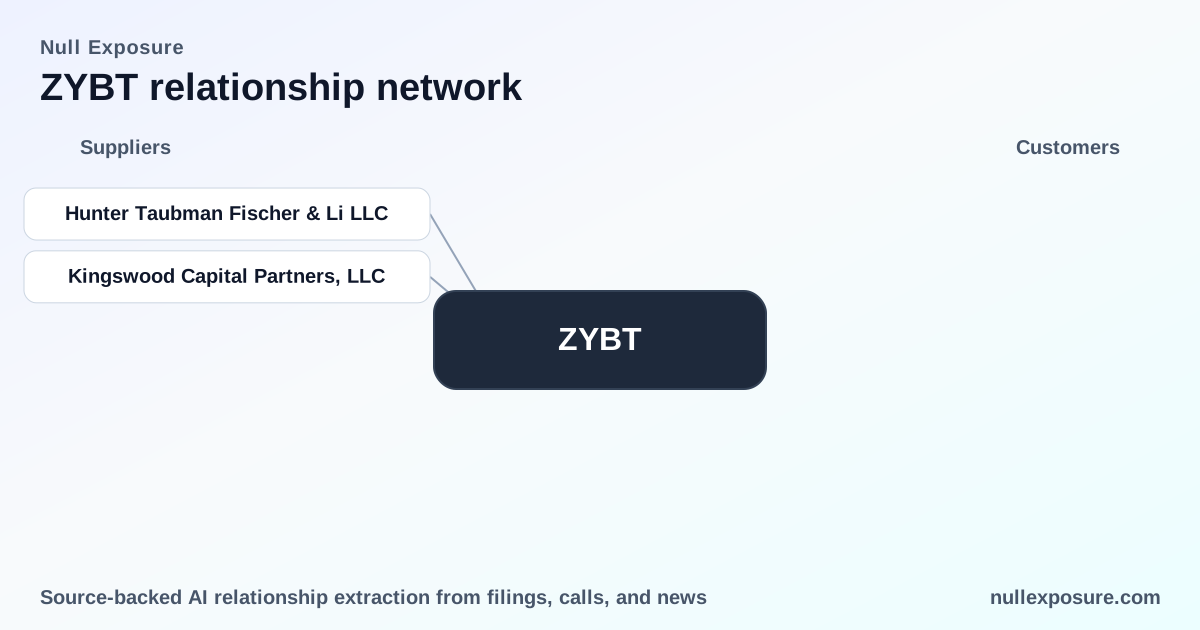
Hunter Taubman Fischer & Li LLC served as U.S. securities counsel to ZYBT in connection with the offering, handling legal work required to satisfy U.S. securities law and Nasdaq listing requirements. According to a Quiver Quant news release (March 10, 2026), their role centered on transactional counsel for the company’s IPO. Source: Quiver Quant news report, March 10, 2026.
Kingswood Capital Partners, LLC — Sole book-running manager
Kingswood Capital Partners, LLC acted as the sole book-running manager for the offering, directing investor solicitation, pricing mechanics, and allocation during the $6 million Nasdaq IPO. The same Quiver Quant coverage (March 10, 2026) identifies Kingswood as the primary capital markets intermediary on the deal. Source: Quiver Quant news report, March 10, 2026.
What the absence of other supplier constraints signals
The available relationship records returned no explicit contractual constraints or supplier-level restrictions. At the company level, the lack of named constraints in the supplier record is itself a signal: it implies that public disclosures prioritized IPO counterparty identity over granular contractual metrics such as exclusivity, termination rights, service-level maturity, or concentration thresholds. This absence should be read as a transparency gap rather than proof of low risk.
- Contracting posture: ZYBT relied on external advisers for core capital-market functions, indicating an outsourcing posture for regulatory and distribution tasks rather than in-house capability.
- Concentration: The visible supplier footprint for the IPO is concentrated—two advisers controlled critical paths for legal compliance and investor distribution.
- Criticality and maturity: Legal and book-running services were critical for the transaction. The advisory slate’s composition signals a standard IPO governance approach but provides limited insight into long-term supplier maturity or ongoing vendor diversification.
Investment implications — what investors should watch next
ZYBT’s capital-market relationships are a snapshot of where operational risk is concentrated. For investors and counterparties, the acute takeaways are:
- Execution risk is concentrated in a narrow advisory set. A single book-runner and singular U.S. securities counsel handled the IPO, meaning any future financings or compliance stress tests will likely rotate through a small number of external providers.
- Disclosure focus is transactional, not contractual. Public materials emphasize the transaction outcome ($6M raise) and adviser names, but do not disclose contractual terms that define service continuity or fallout scenarios.
- Governance and market access are externally provisioned. ZYBT monetizes through capital markets access; therefore, the durability of that access hinges on the ongoing reputational and operational alignment with firms like Kingswood and their distribution networks.
Operational investors should request counterparty agreements, conflict-of-interest disclosures, and any retainer arrangements governing continued post-IPO services. Research teams should track follow-on financing activity and whether ZYBT expands its advisory panel beyond the FY2025 slate.
For a vendor-concentration heatmap and deeper supplier intelligence, consult https://nullexposure.com/.
Tactical checklist for operators and buyers
- Verify whether Hunter Taubman Fischer & Li LLC remains retained for ongoing disclosure obligations or was transaction-limited.
- Confirm whether Kingswood will handle follow-on offerings or secondary placements, and obtain placement history to judge distribution depth.
- Seek contractual clauses on termination, exclusivity, and indemnities for both advisers to assess service continuity risk.
- Monitor filings and press releases for new adviser additions or changes to the capital-raising strategy.
Bottom line: capital advisory is the visible supply chain
The FY2025 Nasdaq offering crystallized ZYBT’s immediate supplier profile: legal counsel and a single book-runner performed the two highest-leverage external functions needed to access U.S. public investors. That arrangement delivered a successful $6 million raise, but it also concentrates execution risk and reduces transparency on contractual protections. Investors should treat these disclosures as a starting point for questions about ongoing capital access, vendor diversification, and contract-level resiliency.
For continuous supplier monitoring and to connect these relationship signals with broader counterparty risk analytics, visit https://nullexposure.com/.